
The best electronics projects for high school STEM move beyond one-step novelty builds and ask students to design, test, measure, and improve a real system. Strong choices include sensor projects, timed-output circuits, logic builds, and Arduino-based systems that generate evidence students can analyze.
Last updated: July 3, 2026.
What makes a project feel high school level?
A high school electronics project does not have to be expensive or complicated. The difference is usually in the thinking, not the parts count. Students should have to make a decision, test a variable, troubleshoot the build, or explain why the output changed.
That is why a good high school project usually goes one step beyond a simple LED demo. The TeachEngineering engineering design process hub keeps coming back to the same pattern: design, build, test, and improve. That is a much stronger fit for high school STEM than asking students to copy a diagram once and stop there.
Start with the concept you want students to own
The easiest way to choose the right project is to start with the concept, not the gadget. If the real goal is timing, pick a timer project. If the goal is sensing and data, use a sensor build. If the goal is control logic, use a digital electronics project.
The Science Buddies high school electricity and electronics library is useful here because it shows how broad the category already is. As of July 3, 2026, that library lists 64 results for high school electricity and electronics science projects, which is a reminder that "electronics" is not one kind of lesson. Teachers need a sorting system.
Project types that work well in high school STEM
| Project type | What students learn | Best fit |
|---|---|---|
| Timing and output circuits | Cause and effect, oscillation, delay, and output behavior | STEM, CTE, intro electronics |
| Sensor and data projects | Inputs, measurement, graphing, and calibration | Physics, engineering, robotics |
| Logic and control builds | Decision-making, truth tables, and digital behavior | Digital electronics, CS integration |
| Real-world systems builds | How components work together in devices students recognize | Project-based STEM, capstone-style units |
Good timing and output projects
Timing projects are strong because students can hear or see the output change immediately. A build such as How to Build an Electronic Metronome Circuit or How to Build a Variable Timer Circuit gives students something observable to adjust and explain.
These projects also create good lab questions. What happens when you change the resistor or capacitor value? How does a shorter delay compare with a longer one? Why does one output pulse while another stays steady? That is the kind of reasoning that separates a high school STEM project from a one-and-done craft.
Good sensor and data projects
High school students should also spend time on projects that generate data. The recent TeachEngineering sound detection and soundproofing activity is a strong model because students use a sound sensor or sound level meter, collect readings over time, and analyze the results with graphs and descriptive statistics.
That same pattern works for circuit-based light, moisture, or resistance investigations. A project such as How to Build a Moisture Detector Circuit becomes much stronger when students compare dry and damp conditions, record thresholds, and explain why the output switches.
Good logic and control projects
Some students are ready for projects that move closer to digital systems. A post such as AND, OR, and NOT gates explained with real circuits helps students connect electronics to computer science instead of treating them as separate subjects.
These projects work especially well in high school because they reward precise thinking. Students must predict an output, test the circuit, compare the result to a truth-table style expectation, and then find wiring or logic errors when something does not match.
Good real-world systems projects
The most memorable high school projects often connect to a recognizable system. The TeachEngineering smart prosthetic hand activity is a strong example because students build with an Arduino, a force-sensitive resistor, and a servo motor while collecting data about how joint angle affects applied force.
That kind of project is not powerful because it looks advanced. It is powerful because students can explain what each subsystem is doing. The same reasoning applies to classroom robotics work such as How a Light Sensor Works in a Robot and Motors, Sensors, and Power.
How to choose the right project for your students
- Choose one main concept first: timing, sensing, logic, output control, or system integration.
- Match the build to the student skill level, not just the course title.
- Prefer projects with a measurable change, adjustable input, or clear troubleshooting path.
- Use low-voltage power and breadboards first so revision stays easy.
- Ask whether students will need to explain, graph, or improve the design.
A simple project selection checklist
A project is usually strong enough for high school STEM if students can answer yes to most of these questions:
- Can students identify the input, process, and output?
- Can they change one variable and observe a meaningful result?
- Can they explain why the result changed?
- Can they troubleshoot a failure without replacing the whole build?
- Can the class compare different designs or data sets afterward?
Common mistakes when planning high school electronics projects
- Picking projects that are flashy but have no measurement or explanation component.
- Assigning the same exact build to every student without room for testing or revision.
- Jumping into microcontrollers before students understand simpler circuit behavior.
- Using a project that is really middle school level and only looks advanced because it has many wires.
- Forcing product links or robotics language into lessons that are really about basic circuit reasoning.
What to use in class
If you need a structured path for logic, timing, and output work, the Mr Circuit Lab 5 Digital Electronics STEM Kit is the most natural product-level extension from these project types. For broader implementation planning, the For Schools and Educators page is the better starting point.
FAQ
What are the best electronics projects for high school STEM?
The best ones ask students to build, test, measure, and improve a system. Sensor projects, timing circuits, logic builds, and real-world control systems usually work better than simple copy-only builds.
Do high school students need Arduino for a strong electronics project?
No. Arduino can help, but a strong project can also come from timer circuits, logic gates, measurement-based breadboard work, and sensor comparisons without programming.
How advanced should a high school circuit project be?
It should be advanced enough that students make decisions and explain results, but not so advanced that debugging becomes random trial and error.
Are breadboard projects still appropriate for high school?
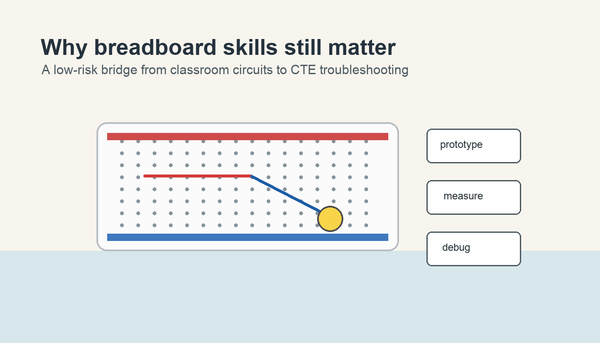
Yes. Breadboards are often the best choice because students can revise, test, and troubleshoot without turning the lesson into a fabrication exercise.
What makes a project too weak for high school STEM?
If students only copy a diagram, see it work once, and never measure or explain anything, the project is usually too weak.
Sources
- Science Buddies: High School, Electricity & Electronics Science Projects
- TeachEngineering: Get a Grip: Engineering a Smart Prosthetic Hand
- TeachEngineering: Statistical Analysis of Noise Detection and Soundproofing
- TeachEngineering: Build Your Own Night-Light with Arduino
- TeachEngineering: Engineering Design Process