
You can run a 30-student electronics lab on a small budget by using shared low-voltage stations, clear group roles, reusable component kits, reset trays, and a strict end-of-class inventory routine. The goal is not to buy every student every part. The goal is to make hands-on circuit work predictable, safe, and repeatable.
Large electronics classes usually fail for practical reasons: missing parts, tangled wires, weak batteries, unclear roles, and too much teacher troubleshooting at once. A budget lab works when the room is designed around flow. Students know where parts come from, where finished builds go, who checks the circuit, and how the station resets before the next class.
Start With the Station Model
For 30 students, the most budget-friendly setup is usually 10 pairs or 6 groups of five. Pairs give every student more hands-on time, but groups of five reduce the number of full kits required. Choose the model based on the activity and your inventory.
| Class model | Best for | Tradeoff |
|---|---|---|
| 10 pairs | Intro builds, meter practice, LED circuits. | Needs more breadboards and batteries. |
| 6 groups of five | Design challenges, sensor demos, shared troubleshooting. | Needs clear roles so everyone participates. |
| Teacher demo plus stations | First day with new tools or multimeters. | Less independent build time. |
For early lessons, assign roles: builder, parts manager, meter operator, recorder, and checker. Rotate roles each lab. This keeps one confident student from taking over the breadboard while others watch.
Use Reusable Low-Voltage Materials
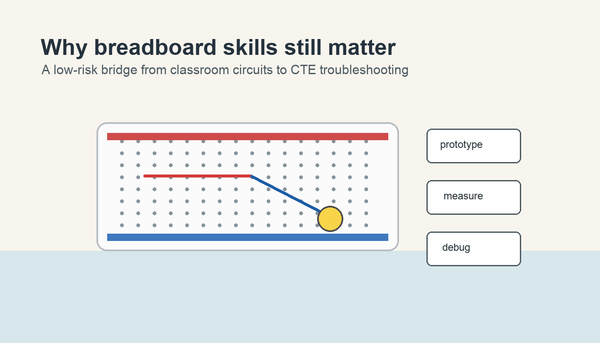
Begin with parts that support many lessons. Science Buddies introduces breadboards as a common beginner electronics base, and TeachEngineering circuit activities often use breadboards, LEDs, sensors, wires, and resistors as reusable classroom materials. These parts are useful because they can be rebuilt many times without soldering.
| Starter item | Why it earns its place | Budget note |
|---|---|---|
| Solderless breadboards | Support many beginner circuits without soldering. | Buy enough for pairs or stations first. |
| Jumper wires | Enable fast rebuilds and troubleshooting. | Sort by length or color to reduce mess. |
| LEDs and resistors | Teach polarity, current limiting, and output behavior. | Buy extras because they are easy to lose. |
| Switches or pushbuttons | Turn physical action into circuit input. | Use in robotics and digital logic lessons. |
| Battery holders | Keep work low-voltage and classroom friendly. | Label class sets and check batteries regularly. |
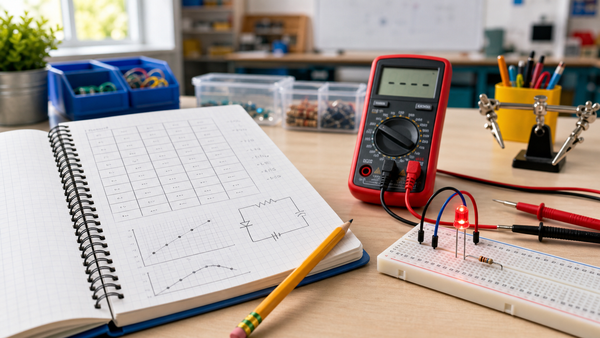
| Digital multimeters | Let students verify voltage, resistance, and continuity. | Share one meter per group if needed. |
Build Reset Trays Instead of Loose Bins
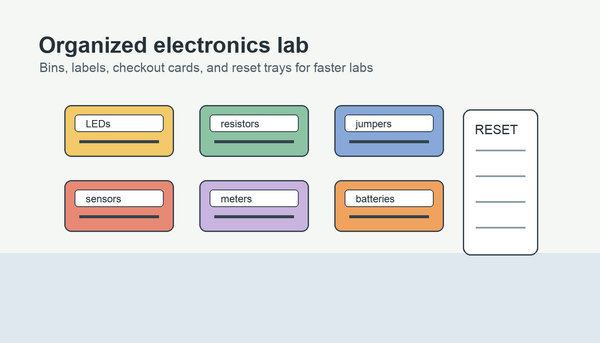
Loose bins are cheap at first but expensive in teacher time. A reset tray is a small container with exactly the parts needed for one station. At the end of class, the parts manager checks the tray against a simple inventory card before the group leaves.
This connects with the broader routine in how to organize components for a classroom electronics lab. The key is not fancy storage. The key is that every part has a visible home and every group knows what "reset" means.
Use a Five-Minute Safety and Setup Routine
Even low-voltage electronics labs need clear safety habits. The CDC/NIOSH school lab safety guide emphasizes creating a safe learning environment through appropriate precautions and procedures. OSHA's eye and face protection guidance also reinforces matching protection to the hazards present. For a beginner electronics classroom, that means teacher-approved low-voltage power, no mains electricity, careful battery handling, and eye protection when the activity creates a realistic eye hazard.
- Power stays disconnected until the checker approves the layout.
- Students use only the battery packs or supplies assigned for the activity.
- No one changes meter jacks or settings without checking the instructions.
- Loose wires and parts stay in trays, not on the floor.
- Damaged batteries, hot components, or unknown parts go to the teacher.
- Every station resets before dismissal.
For a deeper safety checklist, use electronics lab safety for middle and high school.
Choose Labs That Reuse the Same Core Kit
A small budget stretches further when several lessons use the same parts. One breadboard, one battery pack, LEDs, resistors, switches, and a meter can support lessons on closed circuits, polarity, resistance, current, troubleshooting, inputs, outputs, and simple sensors. Students gain skill because they see familiar parts in new combinations.
Start with solderless breadboard basics, then move into LED circuits, switch inputs, meter checks, and troubleshooting. Once the routine works, add sensors or timers.
Common Budget Lab Mistakes
- Buying too many project types at once: Start with one reusable core kit before adding variety.
- Skipping labels: Unlabeled drawers create missing-part problems.
- Letting every group troubleshoot at once: Use a checker role and a help queue.
- Not budgeting for consumables: Batteries, LEDs, and jumper wires need replacements.
- Ignoring reset time: A lab that does not reset today starts broken tomorrow.
Where Mr Circuit Fits
Mr Circuit kits can reduce teacher setup time because they package beginner electronics parts around classroom-ready builds. That matters most in a 30-student room: the easier it is to distribute, build, troubleshoot, and reset, the more time students spend learning circuits instead of searching for parts.
FAQ
How many electronics kits do I need for 30 students?
For full participation, 10 pair stations is a strong target. If the budget is tight, six shared stations can work with clear roles and rotation.
What should a beginner electronics lab buy first?
Start with breadboards, battery holders, LEDs, resistors, jumper wires, switches, and a few shared multimeters.
How do I stop parts from disappearing?
Use reset trays, inventory cards, labeled bins, and a parts manager role in every group.
Can a small-budget lab still teach real electronics?
Yes. Reusable low-voltage parts can teach circuit paths, polarity, resistance, inputs, outputs, measurement, and troubleshooting.
Should every student have a multimeter?
Not at first. One meter per group can work if students rotate the meter operator role and record readings in notebooks.