
A strong electronics lab safety checklist covers low-voltage power sources, battery handling, damaged wires, student spacing, eye protection when needed, and one core rule: disconnect power before changing the circuit. Good classroom safety is mostly about routines, supervision, and organized materials, not just warning students once.
Last updated: June 17, 2026.
Why electronics labs need their own safety routine
Teachers sometimes treat beginner electronics as automatically safe because the circuits are low voltage. That is the wrong mindset. OSHA's electrical hazard guidance is clear that low voltage does not automatically mean low hazard. In a school setting, the point is not to make the lesson sound dangerous. The point is to build habits that prevent avoidable mistakes, damaged parts, tripping hazards, overheated batteries, and confused troubleshooting.
Electronics labs are manageable when the routines are simple and repeated. That is especially true in middle school, early high school, CTE intro courses, and homeschool co-ops where not every student has steady hands or prior lab experience.
What the safety sources point to
NSTA's classroom safety guidance emphasizes supervision, electrical safety checks, safe extension-cord use, GFCI protection near water, and protective eyewear where impact hazards exist. OSHA's laboratory safety guidance adds the broader principle that electrical hazards must be assessed and that unexpected energization should be prevented during maintenance or adjustment. CPSC battery guidance reinforces the need for suitable battery systems, charge and discharge protection, and short-circuit protection.
Together, those sources lead to one practical classroom conclusion: the safest beginner electronics room is organized, inspected, and powered only when students are ready.
Pre-lab checklist
| Before students begin | Why it matters |
|---|---|
| Inspect wires, leads, battery holders, and breadboards for damage | Prevents avoidable shorts, exposed conductors, and false troubleshooting |
| Set out only the parts needed for that lesson | Reduces clutter and misuse |
| Confirm battery type and voltage match the planned activity | Helps prevent overload or incorrect substitution |
| Keep liquids and wet materials away from the electronics area | Supports safer electrical workspaces |
| Clear walking paths and manage cords | Reduces trips, accidental pulls, and knocked-over equipment |
If extension cords are needed, NSTA advises using them only for temporary needs and managing them so they do not create trip hazards. That matters even more in a lab where students move between stations carrying battery packs, kits, and notebooks.
The one rule students should hear every time
If you teach only one electronics safety sentence, teach this one: disconnect power before changing the circuit. That rule prevents many common beginner problems all at once. It lowers the chance of accidental shorts, protects LEDs and sensors from sudden miswiring, and gives students a clear pause point before experimenting.
It also supports better thinking. Students troubleshoot more accurately when they trace the path with power off instead of poking around a live build.
During-lab monitoring checklist
- Watch for students moving wires while the battery is still connected.
- Stop any direct battery-to-battery-terminal shortcuts immediately.
- Check that polarized parts such as LEDs are being oriented intentionally.
- Make sure work areas stay organized enough for students to trace the circuit path clearly.
- Listen for overheating concerns, repeated buzzing, or rapid battery drain that may signal a fault.
- Keep students from crowding into one station where hands, wires, and tools overlap too much.
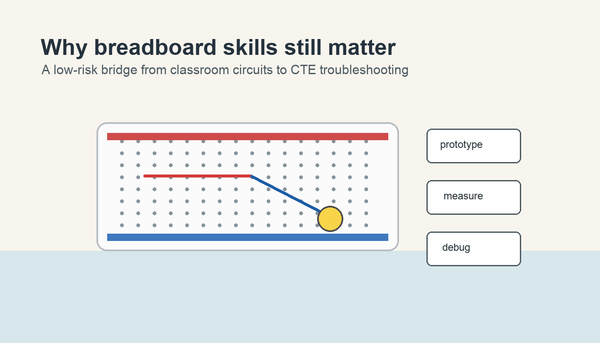
This is where Mr Circuit's troubleshooting checklist is useful. A safety routine and a troubleshooting routine should reinforce each other. Students should learn to power down, inspect, trace, fix, then retest.
Battery safety in a classroom electronics lab
Batteries are often the safest practical power source for beginner electronics, but they still need clear handling rules. The CPSC points to battery systems that include appropriate protection and are suitable for the intended load. In classroom practice, that means using the right battery holders, the right kit parts, and avoiding improvised setups that students cannot interpret reliably.
It also means preventing shorts during storage and handling. Loose batteries should not roll around with metal objects. Battery packs that look swollen, damaged, or unusually hot should be removed from use. Students should not be asked to "see what happens" if they bypass the intended load.
When eye protection and room setup matter most
NSTA notes that eye protection should be used when physical impact hazards are present. In electronics labs, that does not mean every low-voltage LED lesson automatically requires goggles. It does mean you should think about the specific activity. If students are cutting leads, snapping components into place forcefully, launching small mechanical parts, or working around any possible projectile hazard, eye protection becomes the right call.
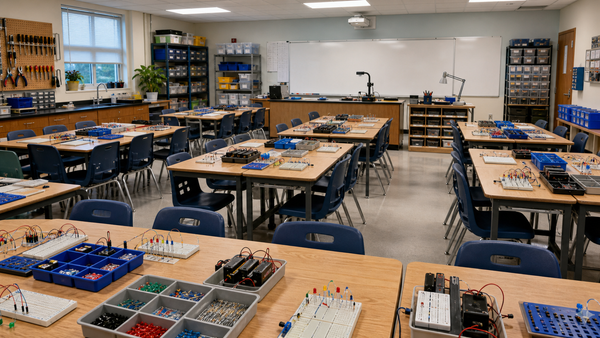
Room setup matters too. Students need enough spacing to keep kits, wires, and notebooks from spilling into each other. Crowded stations turn small mistakes into shared mistakes.
Safe meter use and teacher demonstrations
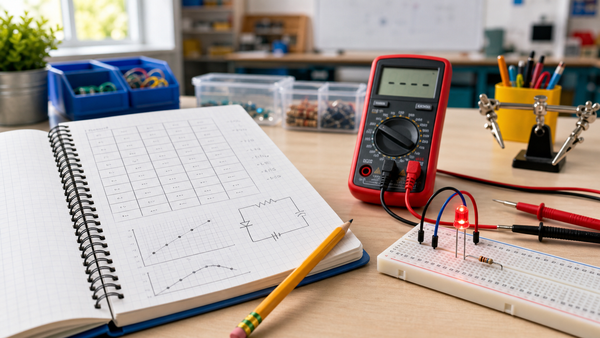
If students are using multimeters, make the meter part of the safety lesson, not just the measurement lesson. Use one clear routine for where probes go, which setting to choose, and when to ask for help. Mr Circuit's digital multimeter guide fits naturally here because students should know how to measure without creating a new fault.
The same applies to demonstrations. If the teacher is showing a night-light build, buzzer circuit, or breadboard fault, the demonstration should model the same power-off, inspect, reconnect routine the students are expected to use later.
Shutdown and storage checklist
- Disconnect batteries and other power sources from student builds.
- Collect damaged wires, weak batteries, and failed components into a separate bin.
- Return usable parts to labeled storage so the next class starts organized.
- Check that extension cords and chargers are unplugged if they were used temporarily.
- Document any recurring issue, such as hot battery holders, loose alligator clips, or damaged meters.
These end-of-class steps matter because most preventable lab problems repeat across days. If the setup resets cleanly, the next group starts stronger.
How this supports teacher confidence
Teachers do not need to be electrical engineers to run a safer beginner lab. They need a repeatable system. Mr Circuit's teacher confidence guide already makes that point. This checklist turns it into classroom operations.
For schools building broader STEM and CTE support, the For Schools and Educators page and beginner kit resources such as the Mr Circuit Lab 1 Basic Electronics STEM Kit are natural next steps.
FAQ
Is a low-voltage electronics lab automatically safe?
No. Low voltage reduces some risks, but students still need routines for battery handling, damaged wires, spacing, and power-off rewiring.
What is the most important safety rule in a beginner electronics class?
Disconnect power before changing the circuit.
Do students always need goggles for electronics labs?
Not always, but eye protection should be used when the activity includes impact or projectile hazards or your local policy requires it.
How should batteries be handled in class?
Use the correct battery type, prevent short circuits, remove damaged batteries from use, and store cells so metal objects cannot bridge the terminals.
Why does organization matter so much in electronics safety?
Because cluttered workspaces make it harder to trace circuits, easier to short components, and more likely that students will trip, tug, or confuse their parts.
Should teachers use the same troubleshooting routine every class?
Yes. A consistent power-off, inspect, trace, fix, and retest routine improves both safety and learning.