
Students should predict before they measure because a measurement only becomes useful evidence when learners already have an idea to test. In circuit lessons, prediction helps students place the meter more carefully, compare results to a model, and explain what changed instead of treating the display as a random answer machine.
Last updated: June 28, 2026
Without prediction, measurement can become passive. Students touch probes to a circuit, read a number, and wait for the teacher to tell them whether it is “right.” With prediction, the same reading turns into reasoning. Students decide what they expect, justify it, measure, and then revise their explanation if the result is different.
Why prediction matters in STEM and NGSS-style instruction
The Next Generation Science Standards describe science and engineering as more than fact recall. Students are expected to use models, plan investigations, analyze evidence, and revise explanations. Appendix F and the middle school practice progressions both emphasize describing, testing, and predicting phenomena, then using evidence to refine understanding.
That fits electronics almost perfectly. A simple circuit gives students an immediate system to predict, test, and revise. They can predict whether the battery voltage will be around a certain value, whether the resistor measurement should be high or low, or where current must be measured in series. The meter reading then confirms or challenges the model.
Prediction changes how students use the meter
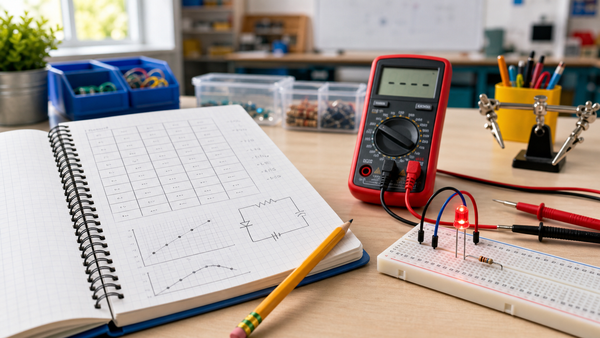
When students make no prediction, they often move straight to trial and error. They change the dial without thinking, move the probes randomly, and sometimes switch into current mode without understanding where the meter belongs. The Mr Circuit multimeter guide gives the setup routine, but prediction gives that routine a purpose.
| Without prediction | With prediction | Classroom difference |
|---|---|---|
| Students chase numbers | Students test an idea | More explanation, less guessing |
| Probe placement is random | Probe placement follows the model | Fewer meter mistakes |
| Unexpected results feel like failure | Unexpected results become evidence | Better troubleshooting conversations |
| The teacher interprets everything | Students justify their own reasoning | Stronger independent thinking |
Use short prediction prompts before every measurement
Prediction does not need to take ten minutes. In fact, a strong classroom routine can happen in one sentence. Before students measure, ask: “What do you expect the meter to show, where will you place the probes, and why?” That one prompt forces them to connect the circuit layout to the tool.
Here are three practical examples:
Battery voltage. Before checking the source, students can predict whether a fresh battery pack should read close to its labeled value. Then they compare that expectation with the method in the battery voltage article.
Resistance. Before testing a resistor, students can predict whether the value should be low, medium, or high and whether the part must be disconnected first. Then they use the resistance routine to see how the actual result compares.
LED current. Before measuring current, students should predict where the meter must go and what would happen if they placed it across the source. That is the safety connection built into the LED current guide.
Prediction improves troubleshooting
Prediction is not only for correct builds. It becomes even more valuable when a circuit fails. If students think an LED should have voltage across it but the meter shows otherwise, the mismatch points them toward an open circuit, reversed component, or misplaced lead. If they expected resistance in one section but measured nearly zero, they may have discovered a short or bypass path.
That is why prediction fits naturally with the troubleshooting checklist article. Students are not just hunting for any error. They are comparing the real circuit to an expected model and using evidence to decide what to check next.
A simple predict-measure-explain routine
- Predict what the meter should show.
- State where the probes or leads should go.
- Measure using the correct meter mode.
- Compare the result to the prediction.
- Explain what the result means for the circuit model.
Teachers can put this on the board or on a lab handout. The routine is short enough for beginners and strong enough to support middle school, high school, CTE, and homeschool lessons.
Why prediction also supports safety
Prediction slows students down in a good way. If they must say where the meter will go before they connect it, they are less likely to use the wrong jack, switch to the wrong mode, or place the meter across the source when they intended to measure current. That matters in every measurement lesson, but especially when students are new to multimeters.
| Prediction prompt | Why it helps | Example |
|---|---|---|
| What number do you expect? | Focuses students on circuit behavior | “Around 3 volts across the battery pack” |
| Where should the meter connect? | Improves probe placement | “Across the battery, not in series” |
| What would a surprising result mean? | Prepares students to troubleshoot | “A lower value might mean a weak battery or wrong contact point” |
What teachers should listen for
The goal is not perfect predictions. The goal is reasoned predictions. Students should be able to say more than “I don’t know” or “maybe it will work.” Listen for statements tied to the model: the battery should push voltage, the resistor should raise resistance, the current meter should go in series, the switch should open or close the path. Those statements show understanding that can be tested.
If students are not ready to give a number, ask for direction first. Should the value be higher or lower? Should there be continuity or not? Should the LED branch show current only when the path is complete? Those simpler predictions still create better evidence use than skipping prediction entirely.
Why this habit is worth building
Prediction before measurement turns electronics from a parts activity into a thinking activity. It builds safer meter habits, stronger troubleshooting, and better explanations after the lab. It also aligns well with evidence-based STEM teaching, which is why it belongs in any classroom that wants students to do more than follow steps.
For broader classroom planning, For Schools and Educators is the most relevant internal resource page. If a program wants a more structured measurement setup, the optional Mr Circuit Lab 2 digital multimeter STEM kit is the most natural product reference.
Frequently Asked Questions
Why predict before measuring if the meter will give the answer anyway?
Because prediction turns the reading into evidence that confirms or challenges a student idea instead of just producing a number.
Do predictions need to be exact numbers?
No. Beginners can start with directional predictions such as higher, lower, open, closed, or in series versus across.
How does prediction help with troubleshooting?
It gives students a model to compare against the real result, which helps them decide what to check next.
Does prediction slow the lesson down too much?
No. A short 10- to 20-second prediction prompt often saves time by reducing random meter mistakes.
What is the best first prediction in a circuit lesson?
Ask what the battery voltage, resistor value, or current path should look like before anyone touches the meter.