
Ground in a circuit is the reference point the rest of the circuit is measured against. In beginner electronics, teachers usually treat ground as 0 volts and use it as the shared return point for current, but that does not always mean the circuit is physically connected to the earth.
Last updated: June 22, 2026.
What Ground Means in Simple Classroom Language
The fastest student-friendly definition is this: ground is the circuit's home reference point. When students measure voltage, they are comparing one place in the circuit to another. As All About Circuits explains, ground is usually defined as the reference point that carries 0V for the rest of the circuit.
That matters because voltage is not a floating number by itself. A voltage reading only makes sense when students know what point they are measuring from. This is why ground and voltage should be taught together instead of as separate vocabulary words.
Ground Is Often the Negative Side, But That Is Not the Whole Story
In simple battery-powered classroom circuits, ground often lines up with the negative side of the battery. That makes it tempting to tell students that ground just means "negative." For many beginner builds, that shortcut works well enough to get started, especially on a breadboard.
But the better explanation is that ground is the chosen reference node of the circuit. A DigiKey breadboard guide puts it plainly: every power supply has a ground rail used as a 0V reference point, and it may not actually be connected to earth. That distinction keeps students from carrying a half-true definition into later electronics work.
Circuit Ground vs Earth Ground
| Type | What it means | Best beginner explanation |
|---|---|---|
| Circuit ground | The shared 0V reference inside the circuit | The point the rest of the circuit is measured against |
| Earth ground | A connection to the earth for safety or reference | The real physical ground used in power systems and equipment safety |
| Chassis ground | A connection to a device frame or case | The metal body connection that may or may not match circuit ground |
This distinction matters because beginners often see the word "ground" and imagine a rod in the dirt or the third prong on a wall plug. In low-voltage classroom work, that is usually not what they are dealing with. They are dealing with circuit ground, the common reference point for the battery, breadboard rails, and measurements.
How Ground Appears on a Schematic
When students start reading diagrams, ground becomes easier to recognize visually. In SparkFun's schematic tutorial, the ground node is shown as a voltage symbol that stands in for a shared connection. Like-named nodes such as GND connect to each other even if a wire is not drawn all the way across the page.
That is why a schematic can look "broken apart" at first but still be completely correct. The GND symbols are telling the reader, "all of these points belong to the same shared reference node." Students who miss that idea often think the circuit is unfinished when it is actually just using normal schematic shorthand.
How Ground Appears on a Breadboard
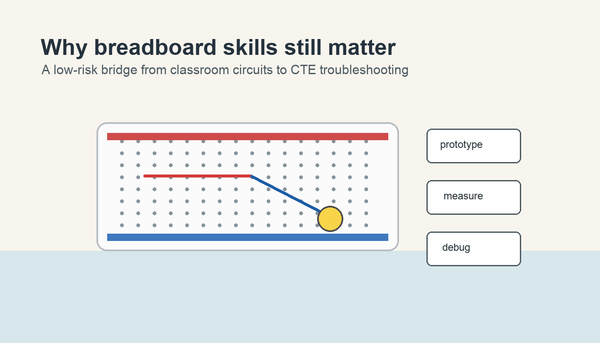
On a breadboard, ground is usually easier to teach because students can trace it physically. One rail may be marked with a minus sign or blue stripe and treated as the ground rail. In a beginner LED build, several parts may all connect back to that rail because they share the same reference and return path.
This connects naturally to how batteries work in simple student circuits. If students understand that current must leave the source and return to it, ground stops looking like a magical symbol and starts looking like an organized part of the path.
A Good Classroom Routine for Teaching Ground
- Show the battery or supply first.
- Point to the common return side and label it ground.
- Have students find every place marked GND on the schematic.
- Trace those points to the breadboard rail or common node.
- Measure a few voltages using ground as the reference lead.
That routine keeps the idea concrete. It also supports later lessons on current, resistance, and polarity.
Common Beginner Mistakes
- Thinking ground always means the circuit is connected to the earth.
- Assuming ground and negative mean exactly the same thing in every context.
- Ignoring GND symbols on a schematic because no wire is drawn between them.
- Using the word "ground" without first identifying the circuit's reference point.
DigiKey's article on negative voltage rails also warns that "ground" can change meaning depending on the supply setup or isolation boundary. That is more advanced than most beginners need at first, but it reinforces the same teaching point: ground is a reference choice inside a system, not a magical universal location.
A Simple Example Students Understand Fast
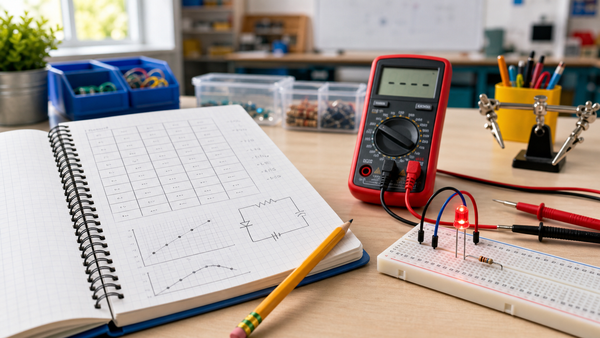
Imagine a battery, a resistor, and an LED connected in one loop. If the negative side of the battery is labeled GND, students can measure the voltage at the LED's anode relative to ground. That language helps them understand what the meter is doing, why the reading changes at different points, and why "0V" does not mean "nothing is happening."
This is also a useful pre-lab concept before students read schematic diagrams or start troubleshooting why a build does not work.
Where This Fits in the Mr Circuit Sequence
Ground is easiest to teach in a low-voltage build sequence such as the Mr Circuit Lab 1 Basic Electronics STEM Kit, where students can see the battery, rails, resistor, and LED at the same time. The point is not to make ground sound advanced. The point is to give students a precise word for the connection pattern they are already using.
For educators planning a broader introduction to electronics, the For Schools and Educators page is the better next stop for sequencing and classroom fit.
Sources and Further Reading
- All About Circuits: An Introduction to Ground
- SparkFun Learn: How to Read a Schematic
- DigiKey PDF: Large Solderable Breadboard Hookup Guide
- DigiKey: Designing Negative Voltage Rails
FAQ
What is ground in one sentence?
Ground is the shared reference point a circuit uses for voltage measurements and return paths.
Is ground always the negative side of the battery?
In many beginner battery circuits, yes, but the more accurate idea is that ground is the chosen 0V reference point.
Is circuit ground the same as earth ground?
No. Circuit ground is an internal circuit reference, while earth ground is a physical safety or reference connection to the earth.
Why do so many schematic points use the same ground symbol?
Because those points are all connected to the same reference node, even when a wire is not drawn between them.
Why should students learn ground early?
Because it makes voltage, meter readings, schematics, and troubleshooting much easier to understand.