
Voltage is the electrical push that moves charge through a circuit. In a beginner-friendly definition, voltage is the difference in electrical potential between two points, which is why a battery can push charge through a wire, resistor, and LED when the path is complete.
That answer is short, but it matters because students often mix up voltage, current, and resistance. They may think voltage is the same thing as electricity itself, or they may describe it as "how much power" a battery has. A better classroom explanation is that voltage is what pushes charge, current is the rate at which charge moves, and resistance is what pushes back against that movement.
What voltage means in simple words
Khan Academy describes voltage as electric potential difference, and The Physics Classroom explains it as the change in electric potential that gives charge energy to move through a circuit. In plain classroom language, voltage tells you how much push is available between two points.
A battery creates that push by keeping one terminal at higher electrical potential than the other. The Physics Classroom notes that a 12-volt battery supplies 12 joules of energy for every 1 coulomb of charge that passes through it. That is why voltage is often described as energy per charge, even though most beginners learn it first as the push that starts charge moving.
What voltage does in a real circuit
Voltage does not guarantee that anything will happen by itself. A battery can sit on a table with voltage across its terminals, but current will not flow unless the circuit is closed. Once you connect the battery, wires, resistor, and LED in a complete loop, the voltage difference can drive charge through the circuit.
- The battery creates a potential difference. One side is higher in electrical potential than the other.
- The circuit closes. Now charge has a full path through the wire and components.
- Energy is transferred through the components. The LED lights and the resistor limits current.
This is one reason voltage is easier to teach with a real build than with a long abstract lecture. Students can see that the battery matters, but they also see that the circuit has to be complete before anything works.
Voltage vs current
| Concept | What it tells students | Simple question it answers |
|---|---|---|
| Voltage | The push available to move charge | How hard is the circuit being pushed? |
| Current | The rate of charge flow | How much charge is moving each second? |
These ideas are related, but they are not interchangeable. A stronger battery can increase the push. A higher resistance can still limit how much current flows. That is why students eventually need the relationship explained in Ohm's Law in One Class Period.
A simple classroom example with an LED
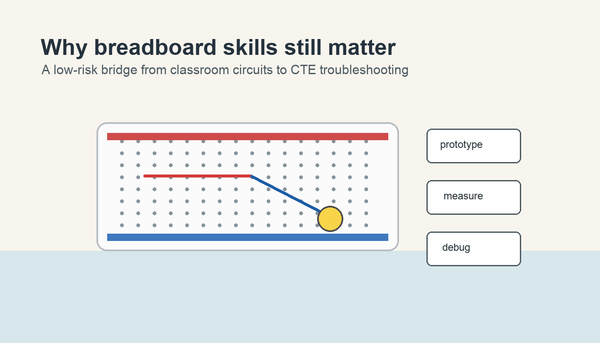
Suppose students build a circuit with a 9-volt battery, one resistor, and one LED on a breadboard. The voltage source is the battery. If the LED is facing the correct direction and the resistor is in place, the circuit can light safely.
Now ask students to compare three situations:
- The battery is connected correctly and the circuit is closed.
- The battery is connected, but one wire is loose.
- The battery is present, but the LED is reversed.
In all three situations, the battery still has voltage. What changes is whether the circuit is complete and whether the parts are arranged so current can flow properly. That distinction helps students stop saying "there is no voltage" every time a circuit fails.
How to explain voltage without overusing the water analogy
Teachers often compare voltage to water pressure. That analogy can help at the start because it gives students an image of push. But it is only a partial analogy. Water pressure is not identical to voltage, and students can get confused if the comparison becomes the whole lesson.
A better approach is to use the analogy briefly, then return to the actual circuit:
- Voltage is the push.
- Current is the flow.
- Resistance limits the flow.
- The battery provides the push in a simple student circuit.
After that, let the breadboard and the meter do the teaching.
How students can measure voltage safely
For beginner classroom work, voltage is usually the easiest electrical quantity to measure with a digital multimeter. Students place the probes across two points in the circuit, not in series inside the circuit path. This makes voltage measurement a good first troubleshooting step in low-voltage lessons.
If you want students to see that measurement connects directly to reasoning, pair a simple build with the Mr Circuit Lab 2 digital multimeter STEM kit. The point is not just to get a number. The point is to help students ask whether the battery still has useful voltage, whether the source is connected properly, and whether the expected voltage difference appears where it should.
Common mistakes when teaching voltage
1. Treating voltage as the same thing as current
Students need to hear early that voltage is not the flow itself. It is the electrical difference that can drive the flow.
2. Saying a circuit has "no voltage" whenever it does not work
A battery may still have voltage even when the circuit is open, wired incorrectly, or blocked by a bad connection.
3. Skipping the role of the battery
Students should understand that the source creates the potential difference that makes circuit behavior possible.
4. Jumping to mains electricity examples
Keep voltage lessons grounded in safe, low-voltage classroom builds such as batteries, LEDs, breadboards, and simple meters.
A quick classroom routine for teaching voltage
One simple routine is to give students an LED circuit that works, then ask them to predict and test what will happen when one condition changes.
- Measure the battery voltage first.
- Build the circuit and confirm the LED lights.
- Move one wire so the circuit opens.
- Ask students whether the battery still has voltage.
- Reconnect the circuit and test again.
This routine teaches an important habit: do not guess based only on whether the bulb or LED is on. Use measurement and circuit logic.
For teachers building a broader beginner pathway, the Mr Circuit Lab 1 Basic Electronics STEM Kit is the most natural internal example because it keeps the lesson centered on low-voltage, no-solder circuits. The For Schools and Educators page is the best internal destination for classroom program planning.
Frequently Asked Questions
What is voltage in one sentence?
Voltage is the electrical push, or potential difference, that can move charge through a closed circuit.
Is voltage the same as current?
No. Voltage is the push that can drive charge, while current is the rate at which charge flows.
Why does a battery have voltage?
A battery uses chemical energy to maintain a difference in electrical potential between its terminals.
Can you have voltage without current?
Yes. A battery can have voltage across its terminals even when the circuit is open and no current is flowing.
What is a good voltage example for students?
A battery, resistor, and LED circuit is a strong example because students can see what happens when the path is complete, reversed, or open.