
Resistance is the opposition to charge flow in a circuit. In simple classroom terms, resistance is how much a wire or component pushes back against moving charge, which is why resistors are used to limit current, protect LEDs, and make circuit behavior more predictable.
This matters because students often see a resistor as a random part that must be included because the teacher said so. A better explanation is that resistance changes how easily charge can move through a circuit. More resistance means less current for the same voltage. Less resistance means charge can move more easily.
What resistance means in simple words
The Physics Classroom defines resistance as the hindrance to the flow of charge through a wire or device. Khan Academy uses the same core idea and ties resistance to Ohm's law and the unit ohm. Those explanations work well together for beginners: resistance is what slows or limits charge flow.
The SI unit for resistance is the ohm, written as the omega symbol, Ω. NIST identifies the ohm as the SI unit of electrical resistance. Students do not need the formal metrology first, but they do need to understand that a larger ohm value usually means more opposition to current.
Why resistance matters in real circuits
Resistance is not just a vocabulary word. It directly affects whether a circuit behaves safely and predictably. In a beginner LED circuit, the resistor limits current so the LED does not receive more current than it should. Without that resistor, students may connect the LED directly to a battery and wonder why it fails.
That makes resistance one of the most practical early topics in electronics. It connects abstract ideas to visible results.
What changes resistance?
The Physics Classroom notes that wire resistance depends on length, cross-sectional area, and material. That gives teachers a helpful bridge from component behavior to physical design choices.
| Factor | What happens to resistance | Simple explanation |
|---|---|---|
| Longer wire | Resistance increases | Charge has more material to move through. |
| Wider wire | Resistance decreases | Charge has more room to move. |
| Different material | Resistance changes | Some materials oppose charge flow more than others. |
Most middle school students do not need a full resistivity lesson, but they can understand that not all conductors behave the same way and that geometry matters.
Resistance and current are connected
The Physics Classroom's Ohm's law explanation is useful here: current is directly proportional to voltage and inversely proportional to resistance. That means if the voltage stays the same and resistance goes up, the current goes down. If resistance goes down, current can increase.
| If resistance... | And voltage stays the same... | Then current... |
|---|---|---|
| Increases | Battery push is unchanged | Decreases |
| Decreases | Battery push is unchanged | Increases |
That relationship is one reason the internal article Ohm's Law in One Class Period pairs so naturally with this topic.
Why LEDs need resistors
Students remember resistance better when it solves a real problem. An LED is a strong example. If students connect an LED directly to a battery without appropriate current limiting, the current may be too high. A resistor adds controlled resistance so the LED can operate safely in the circuit design.
That is also why the existing Mr Circuit post Reading the Resistor Color Code Without Memorizing is a useful follow-up. Students can move from "why the resistor matters" to "how do I identify the resistor value?"
How students can see resistance in class
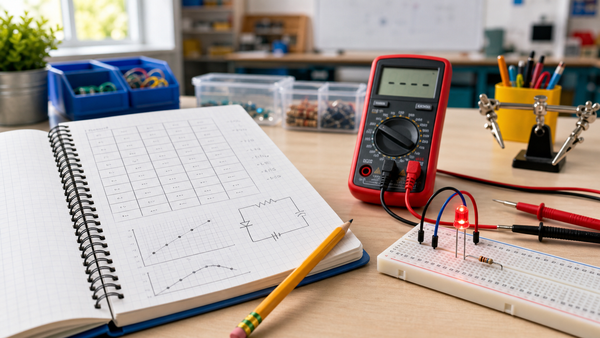
A simple breadboard investigation works well:
- Build one LED circuit with a resistor value that allows normal brightness.
- Replace that resistor with a larger value and observe the change.
- Discuss why the LED brightness changed and what that suggests about current.
This keeps the lesson practical. Students are not memorizing ohms in isolation. They are seeing resistance affect circuit behavior.
Can students measure resistance?
Yes, but they need to learn the right habit: resistance is measured with the circuit powered off and with the meter used correctly. This is where a classroom troubleshooting pathway matters. The Mr Circuit Lab 2 digital multimeter STEM kit is the most relevant internal product example because it turns voltage, current, and resistance into structured measurement practice.
For beginners who are still learning part names, the Mr Circuit Lab 1 Basic Electronics STEM Kit is the better first step because it keeps the build simple and low-voltage.
Common mistakes when teaching resistance
1. Treating the resistor as a random extra part
Students should know the resistor changes current and protects or shapes circuit behavior.
2. Teaching ohms without a real circuit example
Resistance is easier to remember when students connect it to LED brightness, troubleshooting, and measurement.
3. Mixing up resistance and voltage
Voltage provides push. Resistance pushes back. They interact, but they are different ideas.
4. Ignoring physical factors
Wire length, width, and material help students see that resistance is not just a number printed on a chart.
A practical classroom use case
One good lesson sequence is to start with a working LED build, introduce the resistor's job, then ask students to compare two resistor values. Finish by having them explain why the LED changed brightness and how that relates to current. This keeps the article's definition grounded in visible behavior.
For broader program support, the For Schools and Educators page is the best internal navigation page for teachers building a larger STEM or CTE sequence.
Frequently Asked Questions
What is resistance in simple words?
Resistance is how much a wire or component opposes the flow of electric charge.
What unit measures resistance?
Resistance is measured in ohms, written with the symbol Ω.
Why do LEDs need resistors?
Resistors limit current so the LED can operate safely and predictably in the circuit.
Does more resistance mean more current?
No. If voltage stays the same, more resistance means less current.
Can a wire have resistance too?
Yes. Wires also have resistance, and it changes with length, width, and material.