
How to Choose Between Demonstration, Pair Work, and Individual Builds
Use a teacher demonstration when the tool, circuit, or safety routine is new. Use pair work when students need discussion, shared troubleshooting, or limited materials. Use individual builds when the goal is independent skill evidence. Most strong STEM lessons use all three in sequence.
This decision matters because the same circuit can teach different things depending on the format. A demonstration can make the invisible visible. Pair work can improve troubleshooting talk. Individual builds can show whether each student can actually wire, test, and explain the circuit without hiding behind a partner.
Quick Decision Table
| Lesson condition | Best format | Reason |
|---|---|---|
| New tool, new meter setting, or new safety routine | Demonstration | Students need one clear model before touching parts |
| Limited kits or mixed experience levels | Pair work | Students can share roles and verbalize decisions |
| Checking mastery of a known build | Individual builds | Each student produces independent evidence |
| Complex design challenge | Pair or small team | More ideas, testing, and revision are useful |
| High-risk misconception or repeated wiring mistake | Demonstration, then pairs | Reset the model before students practice |
When to Use a Demonstration
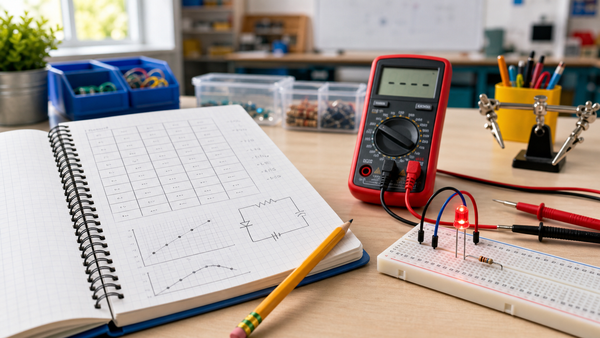
A demonstration is best when students need to see the exact routine before trying it. In electronics, that includes placing an LED with correct polarity, using a resistor, setting a multimeter, connecting a battery holder, or tracing current through a breadboard row. A short demonstration can prevent twenty minutes of scattered mistakes.
Keep demonstrations focused. Build one small circuit, ask students to predict the result, show the outcome, and then pause for one explanation. If the demonstration becomes a lecture, students may watch passively without learning the hand skill. The goal is to give them a model they will immediately use.
The National Academies Framework for K-12 Science Education describes practices such as developing models, planning investigations, analyzing data, and constructing explanations. A demonstration can support those practices when students predict, observe, and explain rather than merely watch.
When to Use Pair Work
Pair work is useful when the lesson benefits from talk. One student can build while the other checks the diagram. One can hold the notebook while the other tests the switch. One can explain the path while the other points to each connection. This is especially helpful in a mixed-skill class because stronger students learn by explaining and newer students hear peer language before teacher language.
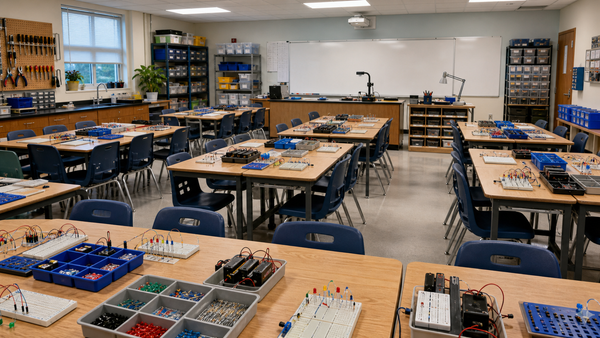
Pair work also helps when materials are limited. If you have fifteen kits for thirty students, pairs are practical. The risk is that one student does all the work. Solve that by assigning rotating roles: builder, checker, recorder, and explainer. For more class-structure ideas, see how to manage mixed skill levels in a STEM class.
When to Use Individual Builds
Individual builds are best for evidence. If the learning target is "each student can build a complete LED circuit with a resistor," then every student needs a chance to do that alone. Individual work reveals who understands polarity, breadboard rows, current-limiting resistors, and troubleshooting.
Do not use individual builds too early. If students are still confused by the breadboard, individual work can turn into quiet frustration. Use individual builds after a short demonstration and at least one guided practice round. Then collect evidence through a working circuit, a sketch, a measurement, or a short explanation.
A Hybrid Flow for a Circuit Lesson
- Demonstrate: Build one LED circuit under a document camera and ask for predictions before connecting power.
- Pair practice: Students build the same circuit in pairs, with one builder and one checker.
- Pair troubleshoot: Give one intentional fault, such as a reversed LED or a missing jumper.
- Individual check: Each student builds or sketches the circuit independently.
- Notebook evidence: Students answer: What was the input, output, and proof that the path was complete?
This flow pairs well with asking students to predict before they measure and teaching students to use a digital multimeter.
How This Connects to Engineering Design
The NGSS middle school engineering design standards ask students to define criteria and constraints, evaluate solutions, analyze test data, and improve designs. Demonstration, pair work, and individual builds each support a different part of that cycle. Demonstration clarifies the model. Pair work supports testing and discussion. Individual work creates evidence of understanding.
Project libraries such as Science Buddies electricity and electronics projects and curriculum resources such as TeachEngineering's electricity unit offer activity ideas, but the teacher still has to choose the format. A project that is too hard individually may work well in pairs. A project that is too chaotic in pairs may need one teacher demonstration first.
Common Mistakes
- Using pair work without roles, which lets one student disappear.
- Using individual builds before students have seen a clear model.
- Demonstrating for too long and leaving too little build time.
- Assessing a pair product as if it proves both students understand.
- Choosing the format based only on materials instead of the learning target.
FAQ
Is demonstration less hands-on than pair work?
It can be, but a short demonstration with prediction and explanation can make later hands-on work more productive.
How many students should share one circuit kit?
Two students per kit is usually best for beginner electronics. Groups of three or four need stronger roles to keep everyone active.
When should students build circuits individually?
Use individual builds after students have practiced the routine and when you need evidence that each learner can build, test, or explain the circuit.
What if I do not have enough materials for individual builds?
Use a rotation: some students build, some sketch or predict, and some troubleshoot a prepared example. Then rotate roles.
How do I grade pair work fairly?
Grade the team product lightly, then collect individual evidence through a sketch, explanation, measurement, or exit question. See how to grade hands-on circuit projects for rubric ideas.
For classroom pacing, combine this decision guide with ways to keep students engaged during circuit labs.