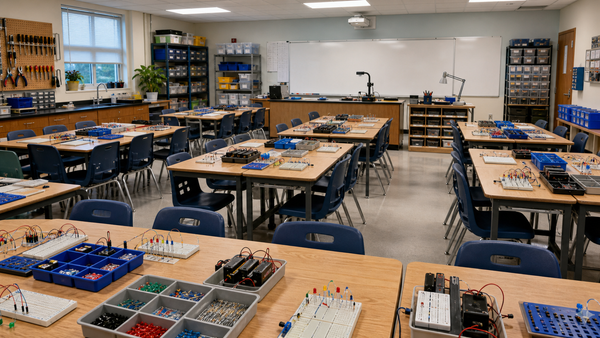

Students stay engaged during circuit labs when they have a job to do, a prediction to test, and a reason to explain what happened. Engagement does not come from making the lab louder or more complicated. It comes from giving students enough structure that they can stay active instead of waiting for the teacher to rescue every problem.
Last updated: June 15, 2026.
Why students drift during circuit labs
Circuit labs look hands-on, but that does not guarantee engagement. In many rooms, one student does all the building, one student watches, and one student waits for the teacher. The parts are active, but the thinking is uneven.
That is a problem because STEM learning depends on participation in problem solving, evidence use, and explanation. The U.S. Department of Education's YOU Belong in STEM initiative emphasizes quality learning environments where students build those skills. A circuit lab should be one of the clearest places to do that well.
What engagement looks like in a good circuit lab
Engaged students are not just touching components. They are predicting, building, observing, talking, and revising. They can answer questions like:
- What do you think will happen when the switch closes?
- What evidence tells you the path is complete?
- What changed after you moved the resistor?
- What should you test next?
Those are better indicators of engagement than noise level or how quickly a group finishes.
Use roles so every student has a reason to pay attention
| Common problem | Better teacher move | Expected student behavior |
|---|---|---|
| One student does all the building | Assign rotating roles | More students handle evidence and explanation |
| Groups wait for teacher help | Use a troubleshooting checklist first | Students test simple causes before asking |
| Students copy without thinking | Require predictions before changes | Students connect action to reasoning |
| Fast finishers disengage | Add an extension question | Students compare, measure, or redesign |
Simple roles work well in beginner labs: builder, checker, recorder, and explainer. They do not need to be rigid forever, but they help new groups avoid passive participation.
Start with a prediction, not with the instructions
Before students touch the parts, ask one question they have to answer with the build. For example:
- Will the LED light if we reverse it?
- What changes if we add another battery?
- What happens when the switch is open instead of closed?
That small shift increases attention because students now have something to look for. It also aligns with the content itself. In OpenStax's current chapter, current depends on the movement of charge through a complete path. Students are more likely to notice that idea when they are testing a claim, not just assembling a diagram.
Use quick teacher check-ins that demand evidence
Many teacher check-ins accidentally reduce engagement. If the teacher walks up and fixes the problem immediately, the group learns to wait passively. A better check-in is short and evidence-based:
- What did you expect?
- What happened instead?
- What have you already tested?
That structure keeps the student thinking in the lead. It also matches research from Stang and Roll's lab-engagement study, which found that more instructor-initiated interactions in physics labs were associated with stronger student engagement.
Let students compare virtual and physical circuits
A pre-lab or midway reset with the PhET Circuit Construction Kit: DC simulation can help students stay engaged because it makes the invisible visible. Students can test whether a path is complete, compare resistor changes, or preview a layout before rebuilding it physically.
The point is not to replace the hands-on lab. The point is to reduce confusion that has nothing to do with the learning target. When students can compare a physical build with a simulation, they often recover faster from small setup errors.
Build troubleshooting into the structure
Engagement rises when students know what to do after something fails. That is why a troubleshooting routine matters so much. Instead of calling out, "Mine doesn't work," students should have a first response:
- Check the power source.
- Check whether the path is complete.
- Check polarity.
- Check one connection at a time.
Mr Circuit's student troubleshooting checklist is useful here because it gives beginners a sequence. Structure keeps the lab from collapsing into learned helplessness.
Plan for mixed readiness without lowering the task
One reason engagement drops is that some students finish too quickly while others get stuck immediately. A better plan is to keep the core task shared and vary the follow-up:
- Everyone builds the same starter circuit.
- Some groups add measurement or explanation prompts.
- Fast groups test one variable change and justify the result.
- Struggling groups keep the core build but get a tighter checklist.
That approach pairs well with this mixed-skill-level strategy post and with confidence-building routines that reward evidence of progress, not just speed.
Common habits that kill engagement
- Giving directions that are so complete no student has to think.
- Letting one confident student dominate the build.
- Waiting until the end for reflection.
- Fixing every problem at the table instead of prompting a test.
- Using "finish early" as the main success signal.
These habits are common because they make the room feel under control. But they often reduce the actual thinking students do.
Where Mr Circuit fits naturally
Mr Circuit materials make this easier when a class needs a low-voltage, beginner-friendly starting point. The Lab 1 Basic Electronics STEM Kit works well when teachers want a repeatable circuit setup, and the For Schools and Educators page can help programs match kits to the classroom context.
Still, the strongest engagement move is not the kit by itself. It is the lesson structure around the kit: roles, predictions, evidence, and revision.
FAQ
How do I keep one student from doing all the work?
Assign rotating roles and require every group to explain its evidence, not just show a working build.
Should students use a simulation before the physical lab?
Often yes. A short PhET preview can reduce setup confusion and improve the quality of student predictions.
What is the best teacher check-in question?
Ask what students expected, what they observed, and what they already tested. That keeps the conversation anchored in evidence.
How long should a beginner circuit lab last?
It is usually better to run one focused build with reflection than to squeeze in too many tasks and lose the discussion.
What if students finish early?
Give them one extension variable to test, measure, or explain. Do not make early finish the end of the learning.
How do I engage students if I am not an electronics expert?
Use a clear routine. You do not need every answer in advance if students have a structure for predicting, testing, and revising.