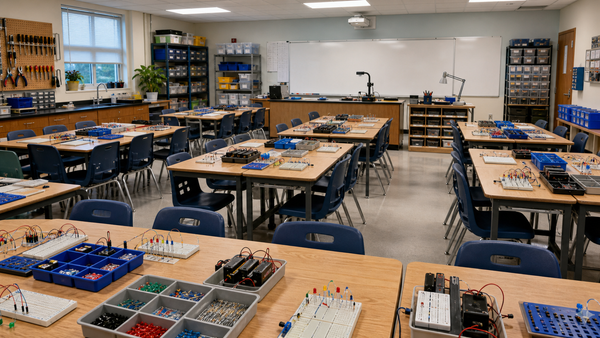

Students build confidence in technical subjects when they can see that effort changes the result. Confidence does not grow from praise alone. It grows when students feel they belong, get an achievable first success, receive useful feedback, and have repeated chances to improve a design, measurement, or explanation.
Last updated: June 12, 2026
That matters because many beginners enter electronics, robotics, engineering, coding, or physics class already convinced that technical work is for someone else. A student who believes "I am just not good at this" often avoids risk before the real learning even starts. Teachers cannot fix that with slogans. They can change it with classroom design.
Confidence in technical subjects is specific, not generic
The Institute of Education Sciences makes an important point: belonging, growth mindset, and self-efficacy are attitudes and beliefs that students keep renegotiating as classes get harder, and they are domain-specific. A student may feel confident in English and uncertain in circuits. That means technical confidence grows through technical experiences, not only through general encouragement.
In practical terms, students need repeated evidence that they can participate in challenging work, recover from mistakes, and improve their results.
Belonging comes before risk-taking
CASEL's guidance on supportive classroom environments is useful here because it connects belonging with self-efficacy and intrinsic motivation. Students take more academic risks when they believe the room is safe for mistakes, questions, and partial understanding.
In a technical classroom, that means students should hear and see these messages often:
- Confusion is normal at the beginning.
- Troubleshooting is part of the work, not proof that you are failing.
- Asking for evidence is stronger than guessing.
- Revision is expected.
If students think every mistake will expose them as "not technical," they will avoid the very behaviors that build competence.
Start with quick wins that still feel real
One of the fastest ways to grow confidence is to let beginners succeed early in an authentic task. That does not mean lowering standards to nothing. It means choosing a first challenge that is achievable, visible, and worth doing.
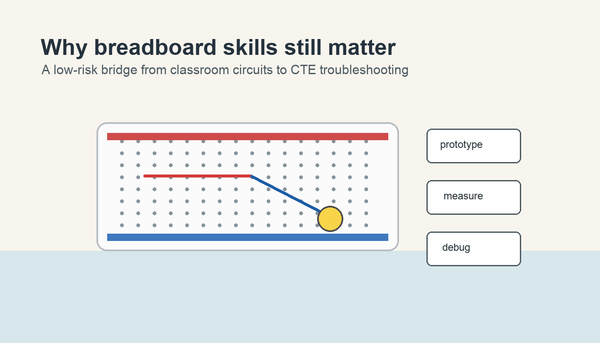
A simple circuit is a good example. A student who can build a closed path, make the LED light, and explain what changed when a wire was moved has already crossed an important line. They have proof that they can act on a technical system and get a result.
The internal article How to Teach Electronics When You Are Not an Electronics Expert supports this well because it focuses on routines, safety, and manageable beginnings rather than pretending students need advanced expertise on day one.
Confidence barrier vs teacher move
| Common barrier | Teacher move that helps |
|---|---|
| "I do not belong in technical classes." | Use inclusive language, visible support, and examples that show many kinds of learners succeeding. |
| "If I make a mistake, everyone will know I am bad at this." | Normalize troubleshooting and publicly model error correction. |
| "I never know where to start." | Use structured launch routines, checklists, and one clear first step. |
| "Other students are already ahead of me." | Give shared goals with different levels of support and extension. |
| "I worked hard but cannot tell if I improved." | Use reflection prompts that connect effort, evidence, and result. |
Feedback should point to the next action
Students gain confidence when feedback helps them do something concrete. "Good job" feels pleasant, but it does not teach. "Your circuit path is almost complete. Check whether the battery and LED are actually connected through a closed loop" gives the student a way forward.
This is one reason the TeachEngineering e4usa 2025 course description stands out. It explicitly describes engineering learning as increasing student confidence through critical self-reflection and feedback. Confidence grows when students can connect their decisions to the next improvement.
Use reflection to turn progress into identity
Many students improve without noticing that they improved. Reflection makes progress visible. After a build, ask questions like:
- What was one thing you could not do at the start that you can do now?
- What evidence helped you fix a problem?
- What will you try first next time?
These questions help students build a technical identity around action and progress, not around perfection.
Ownership matters more than hype
A recent Smithsonian STEMvisions article from February 24, 2026 emphasizes ownership and exposure when building student confidence for STEM programs and careers. The same principle applies in class. Students are more likely to grow when they make decisions, explain choices, and see how their work connects to real systems.
The National Inventors Hall of Fame guidance on STEM confidence points in the same direction by highlighting invention-oriented problem solving. Confidence grows when students are acting on real problems, not just consuming technical information.
Do not confuse confidence with ease
Some teachers accidentally remove every challenge in the name of confidence. That is a mistake. Students do not feel truly capable when nothing difficult is asked of them. They feel capable when the challenge is real but manageable, and when the classroom gives them tools to persist.
That is why How to Manage Mixed Skill Levels in a STEM Class matters here. Confidence does not require identical work for everyone. It requires a shared goal with different levels of support and extension so students can experience growth without being overwhelmed.
Routines that build confidence over time
- Begin with one visible success in the first few minutes or first day.
- Model one mistake and how to fix it.
- Give students sentence stems for technical explanation.
- Use checkpoints before frustration turns into shutdown.
- Make revision normal by building it into the schedule.
- Ask students to name one new thing they can now do.
The published article Circuits Students Should Understand Before Robotics also fits naturally because sequencing matters. Confidence rises when students are not thrown into a complex system before they understand the basic ideas underneath it.
What teachers should avoid
- Praising students so vaguely that they cannot tell what worked.
- Letting advanced students dominate tools and decisions.
- Using public comparisons that make beginners feel permanently behind.
- Calling mistakes "careless" before students have learned a troubleshooting routine.
- Starting with a challenge that is so open-ended that students do not know how to enter the task.
These patterns often create technical anxiety rather than reducing it.
Where Mr Circuit fits naturally
The best general implementation page for schools is For Schools and Educators. For classroom activity design, 10 Hands-On STEM Activities That Teach Real Problem Solving is the strongest companion link because it shows how students can succeed through structured challenge rather than passive completion.
Frequently Asked Questions
What builds confidence faster: praise or success?
Useful success builds confidence faster, especially when students can explain what they did to reach it. Praise helps most when it points to a real action or improvement.
How do I help students who already think they are bad at STEM?
Give them a manageable first task, visible support, and a way to see progress. Do not wait for confidence to appear before giving them a chance to succeed.
Does confidence mean students should never feel frustrated?
No. Productive frustration is normal in technical learning. The goal is to give students routines and support so frustration turns into problem solving instead of avoidance.
Can confidence grow in mixed-skill classrooms?
Yes. It often grows well there when students share the same goal but receive different levels of support and challenge.
Why do reflection questions matter so much?
They help students notice that their actions changed the result, which is one of the strongest sources of self-efficacy in technical work.
Sources
- IES: Belonging, Growth Mindset, and Self-Efficacy
- CASEL: A Supportive Classroom Environment
- TeachEngineering: e4usa Legacy Course Description 2025
- Smithsonian STEMvisions: Building Students' Confidence for Success in STEM Programs and Careers
- National Inventors Hall of Fame: How Can Educators Support STEM Confidence?