
Before robotics, students should understand how a battery powers a closed circuit, how polarity affects components, how switches and sensors act as inputs, how motors act as outputs, and how to troubleshoot with basic measurements. Those ideas make robots understandable instead of mysterious black boxes.
Last updated: June 7, 2026.
Robotics classes go better when students do not meet motors, sensors, and wiring for the first time on robot day. TeachEngineering and FIRST both frame robotics as a mix of building, control, safety, and systems thinking. That only works well when students already know what a simple circuit is doing.
The goal is not to delay robotics for months. The goal is to give students enough circuit knowledge that a robot feels explainable.
The five circuit ideas that matter most
| Concept | Why it matters in robotics | Simple classroom example |
|---|---|---|
| Power source and closed circuit | Robots cannot move if energy has no complete path | Battery, wire, and LED in one loop |
| Polarity | Many parts only work correctly one way | LED direction or motor direction |
| Inputs and outputs | Robotics depends on sensing and responding | Switch or sensor as input, motor or LED as output |
| Motors need electrical energy | Movement is an electrical output, not separate from circuits | Battery powering a small motor |
| Troubleshooting and measurement | Robots fail most often because of wiring, power, or connection issues | Checking whether power reaches a component |
1. Start with power and a closed path
TeachEngineering’s robotics lessons make this point clearly: batteries store energy, circuits provide the path, and electrical devices convert that energy into light, sound, or motion. Students do not need advanced theory yet. They do need to understand that a battery alone does nothing until there is a complete path.
That is why voltage, current, and resistance matter before robotics. They help students explain why a robot powers up, stalls, or behaves unexpectedly.
2. Teach polarity before students wire more complex systems
Polarity sounds technical, but beginner students already see it in simple circuits. LEDs must face the correct direction. Motors reverse direction when connections reverse. Batteries have positive and negative terminals for a reason.
If students skip polarity, they often misread robot failures as “bad code” when the issue is really wiring direction or connection order.
3. Teach inputs and outputs as a circuit idea first
Robotics becomes much easier when students can say: sensors are inputs, motors are outputs. That is why it helps to teach what a sensor is before expecting students to build autonomous behaviors.
A switch is a good stepping stone. A switch changes the circuit path. Then a touch sensor or light sensor can be introduced as a more informative kind of input. Once students understand that, “the robot reacted to the sensor” stops sounding magical.
4. Help students see motors as circuit outputs
TeachEngineering’s motor lesson explains that motors convert electrical energy to mechanical energy. That is the key idea. The motor is not outside the electronics lesson. The motor is one of the clearest examples of the electronics lesson.
FIRST’s resources reinforce the same systems view. Their current introductory curriculum for grades 7-12 covers safety, building a robot, and computational thinking, and their current robot wiring guide starts from wiring, battery, and control-system organization. That should tell teachers something important: real robotics programs still treat electrical foundations as foundational.
5. Teach troubleshooting before the robot gets complicated
Students learn faster when they know how to ask:
- Is the battery connected correctly?
- Is the circuit path complete?
- Is this component oriented correctly?
- Did the input actually change?
- Did the output receive power?
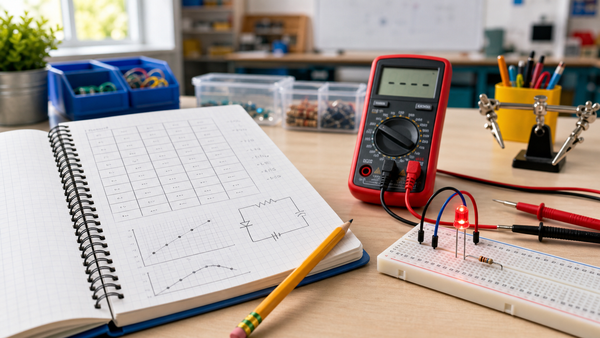
The Mr Circuit Lab 2 digital multimeter STEM kit is the most natural internal example because it turns measurement and troubleshooting into a taught skill instead of an emergency response after a robot fails.
A simple pre-robotics lesson order
- Build one closed circuit with a battery, resistor, and LED.
- Learn the role of the breadboard and polarity.
- Compare series and parallel paths in one short lesson.
- Add one input, such as a switch or simple sensor.
- Add one output that creates motion, such as a motor.
- Practice basic troubleshooting before introducing bigger robot assemblies.
This sequence does not replace robotics. It makes robotics more teachable.
What happens when these ideas are skipped
Students blame everything on programming
If the class has not learned to check power, polarity, or continuity of the path, every failure looks like “the code is wrong.” That wastes time and hides the real lesson.
Students assemble without understanding
They may finish a build, but they cannot explain why it works. That makes transfer to the next project much weaker.
Teachers end up doing all the debugging
When students lack a troubleshooting routine, the teacher becomes the only person who can rescue the activity. That does not scale well in a busy class.
How Mr Circuit’s sequence fits this path
Mr Circuit’s current site positioning lines up with a strong pre-robotics sequence: Lab 1 for basic circuits, Lab 2 for measurement and troubleshooting, and Lab 3 for logic-gate thinking. That is a sensible progression because robotics uses all three layers: circuit behavior, diagnosis, and control logic.
If you need the clearest beginner entry point, the Lab 1 Basic Electronics STEM Kit is the soft internal link that fits this article best. If your students are ready for control and digital reasoning, the Lab 3 Digital Logic Gates STEM Kit makes sense as the later bridge.
Frequently Asked Questions
Do students need to master all of electricity before robotics?
No. They need a practical beginner level: power source, closed loops, polarity, inputs, outputs, and troubleshooting habits.
Is a motor part of electronics or robotics?
It is both. In robotics, a motor is an electrical output that converts electrical energy into movement.
What is the best first sensor to teach before robotics?
A simple touch or light sensor works well because students can quickly connect the input to a visible response.
Why teach troubleshooting before a full robot build?
Because most beginner failures come from power, wiring, or connections. Students need a process for checking those issues early.
Can this pre-robotics sequence fit into a short unit?
Yes. Even a short sequence of focused circuit lessons can dramatically improve student success in later robotics work.