
You do not need three separate STEM lessons to manage mixed skill levels well. You need one clear learning goal, one shared launch, and a structure that gives beginners more support while giving confident students more complexity. The goal is not to split the class into labels. The goal is to keep everyone moving toward the same core understanding.
Last updated: June 9, 2026
That matters because many STEM classes include students who are brand new to tools and materials sitting next to students who already like to build, code, or troubleshoot. If the lesson is too open, beginners freeze. If it is too locked down, advanced students coast. A better design gives all students the same destination but not the exact same path.
Start with one shared goal, not separate tracks
The Australian Government's STEM education toolkit points out that differentiated learning matters because student readiness often varies widely in one group. CAST's UDL Guidelines 3.0 reinforce the same big idea from a design angle: plan multiple ways for students to access, engage with, and express learning. For a STEM teacher, that means the class should still be working on one main concept even when the supports differ.
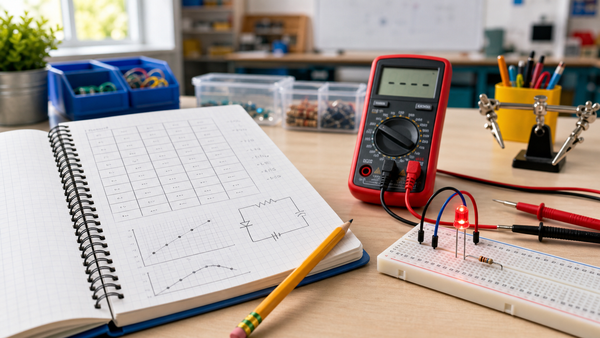
For example, the shared goal might be: build and explain a working simple circuit. One student may need a partially prepared setup and vocabulary supports. Another may be ready to add a switch, make a prediction, and troubleshoot independently. The learning target stays the same.
| Readiness level | What students often need | Teacher move |
|---|---|---|
| Beginning | Clear modeling, fewer decisions, visual supports | Give a starter layout, labels, and one check-in point early |
| On-level | Time to build, test, and explain | Use normal directions plus a prediction question |
| Ready for extension | More challenge without leaving the core task | Add a modification, comparison, or troubleshooting extension |
Use one common launch for everyone
Students should begin together whenever possible. Show the materials, state the goal, model one key move, and name one success criterion. This keeps the room coherent and prevents beginners from feeling like they are already behind before the work starts.
The article How to Teach Electronics When You Are Not an Electronics Expert supports this approach because it emphasizes routines and confidence rather than assuming deep technical knowledge from day one.
Differentiate by support and challenge, not by isolation
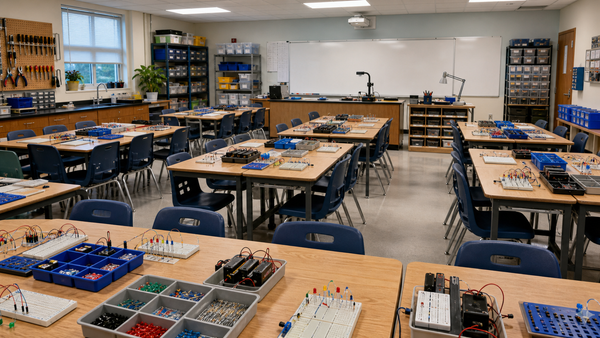
One of the most useful recent Edutopia points is that differentiation should not automatically become separation. In a STEM class, that means avoiding a visible "low group" and "smart group" structure whenever possible. Instead, keep students in the same task space and vary the supports:
- Give some students a partially completed diagram.
- Give others an extra design constraint or extension question.
- Offer a choice between written, verbal, or sketched explanations.
- Use checkpoints so students can move forward when ready.
This works because the difference is in scaffolding and challenge, not in whether students belong to the lesson.
Build lessons with tiered extensions
A strong mixed-skill STEM routine starts with one build that everyone can complete and understand. Then the teacher layers extension choices on top.
For example, if the base task is a simple LED circuit:
- All students build the working circuit.
- Some students explain why the path must be closed.
- Some students measure voltage or compare resistor values.
- Some students redesign the circuit to add a switch or solve a fault.
That kind of structure pairs well with 10 Hands-On STEM Activities That Teach Real Problem Solving because the best activities already allow for revision, testing, and variation.
Use checkpoints instead of hovering everywhere
Mixed-skill teaching becomes much more manageable when students know what to do before asking for help. Checkpoints are a practical way to do that:
- Checkpoint 1: Show the teacher your setup before power is connected.
- Checkpoint 2: Predict what will happen before you test.
- Checkpoint 3: If it fails, complete a quick troubleshooting step before asking for help.
These checkpoints reduce repeated confusion and free the teacher to support students who need the most direct coaching.
Group students flexibly during troubleshooting
Flexible grouping is more useful than permanent grouping. During the build phase, students might work in pairs. During troubleshooting, the teacher might briefly gather the students with similar error patterns. During extension, advanced students might compare design choices or document findings.
This matters because the skill difference in STEM is not always fixed. A student who is slow with setup may be strong at explanation. Another who builds fast may struggle with evidence or reflection.
Keep the engineering process visible
The Engineering Design Process for Middle School Students article is useful here because it gives the class a shared problem-solving language. Ask all students to define the problem, build, test, improve, and reflect, even if the amount of support changes.
That shared process protects rigor. Students are not doing random different activities. They are moving through the same design cycle with different supports.
What teachers should avoid
- Creating visibly lower-status work for beginners.
- Giving advanced students "more of the same" instead of better thinking work.
- Using open-ended challenges before students have enough structure.
- Answering every troubleshooting question before students test a reasoned idea.
- Letting faster finishers dominate tools or materials.
These mistakes usually reduce motivation for both ends of the class. Beginners feel exposed. Advanced students feel unchallenged. The better goal is shared participation with different levels of independence.
Where Mr Circuit fits naturally
For this topic, the best internal planning page is For Schools and Educators because it helps teachers think about classroom implementation, materials, and school ordering. If a starter example is useful, the Mr Circuit Lab 1 Basic Electronics STEM Kit fits the article because it supports a common starting build with room for extension.
For broader STEM framing, What Is STEM Education? is also a helpful internal link because it reinforces that real STEM learning includes problem solving, iteration, and evidence, not just assembly.
Frequently Asked Questions
How do you challenge advanced students without leaving beginners behind?
Use the same core task for everyone, then add extension questions, modifications, or troubleshooting challenges for students who are ready.
Should mixed-skill students always work in fixed groups?
No. Flexible grouping is usually better because students need different supports at different points in the lesson.
What is the biggest mistake in differentiating STEM lessons?
Turning differentiation into obvious separation that labels some students as less capable.
How can one teacher manage all of this realistically?
Use a common launch, clear checkpoints, tiered extensions, and troubleshooting routines so students do more independent thinking before asking for help.
Does differentiation lower rigor in STEM?
No. Good differentiation keeps the learning goal rigorous while adjusting support, access, and challenge.