
STEM education is a way of teaching science, technology, engineering, and math through connected problem solving. In a strong STEM lesson, students do more than memorize facts. They ask a question, build or test something, use evidence, apply math, and improve their design based on what they observe.
That practical definition matters because the word STEM gets used for almost everything: coding games, robotics clubs, science fairs, 3D printing, math worksheets, and even ordinary craft projects. Some of those can be excellent STEM learning. Some are just activities with a science label. The difference is whether students are using science, technology, engineering, and math together to understand and solve a problem.
What does STEM stand for?
STEM stands for science, technology, engineering, and mathematics. UNESCO describes STEM as an interdisciplinary approach that integrates these fields and supports critical thinking, problem solving, and innovation. The Virginia Department of Education similarly frames STEM as authentic learning where the fields connect instead of staying isolated in separate boxes.
For teachers, the useful classroom version is simple:
- Science explains what is happening and why.
- Technology includes the tools students use or create.
- Engineering gives students a problem, criteria, constraints, and a design process.
- Math helps students measure, compare, calculate, graph, and justify decisions.
A lesson does not need to use all four areas equally every time. A circuit activity may lean heavily on science and engineering. A robotics activity may lean on technology, engineering, and math. What makes it STEM is the connection between the subjects and the requirement that students think, test, and explain.
STEM education is not just a product, kit, or gadget
The easiest mistake is to define STEM by materials. A box of parts is not automatically STEM. A robot is not automatically STEM. A worksheet with the word "engineering" at the top is not automatically STEM.
STEM starts when students have a real task that requires reasoning. For example, lighting an LED can be a simple demonstration, or it can become a STEM lesson. The difference is in the questions students answer:
- What happens if the resistor value changes?
- How can we measure the current instead of guessing?
- Why does LED polarity matter?
- How can we redesign the circuit so it is easier to troubleshoot?
- What evidence proves the circuit is working correctly?
That is the shift. Students are no longer just following steps. They are using evidence to make decisions.
A practical STEM lesson pattern
Teachers do not need a complicated framework to make a lesson more STEM-focused. A dependable pattern is:
- Start with a problem. Give students a goal they can understand.
- Set criteria and constraints. What must the solution do? What limits exist?
- Build or model a solution. Students create something they can test.
- Measure the result. They collect numbers, observations, or both.
- Explain what happened. Students connect the result to science or math.
- Improve the design. They revise based on evidence.
This pattern lines up well with engineering design thinking. The National Science Teaching Association notes that middle school engineering design work often focuses on defining problems, designing solutions, and evaluating or improving designs based on evidence. In electronics, that can be as simple as asking students to build a circuit, measure it, find the problem when it fails, and revise the wiring until the evidence matches the expected result.
What STEM looks like in a real classroom
Here is a classroom example using a basic LED circuit.
Problem: Build a simple indicator light that turns on safely with a 9-volt battery.
Science: Students learn that an LED allows current to flow in one direction and has polarity.
Technology: Students use a breadboard, LED, resistor, battery snap, and jumper wires.
Engineering: Students choose where to place parts, wire the circuit, test it, and troubleshoot it when it does not work.
Math: Students compare resistor values, measure voltage or current, and explain why the resistor protects the LED.
That is a STEM lesson because the student has to connect the ideas. The LED lighting up is not the only goal. The goal is understanding why it lights, how the circuit can fail, and what evidence shows the design is correct.
STEM vs traditional science or math lessons
| Traditional lesson | STEM lesson |
|---|---|
| Teacher explains a concept first. | Students investigate a problem and use the concept to explain results. |
| Students solve one correct answer. | Students may compare several possible solutions. |
| Math is often separated from the activity. | Measurement and calculation help students make decisions. |
| Failure is usually treated as a mistake. | Troubleshooting is part of the learning process. |
| The lesson ends when students finish the worksheet. | The lesson ends when students explain, test, and improve. |
Neither approach is automatically good or bad. Students still need direct instruction, vocabulary, worked examples, and practice. The value of STEM is that it gives students a reason to use those skills in a connected way.
What makes a STEM activity strong?
A strong STEM activity usually has five traits:
- It has a clear problem. Students know what they are trying to solve or prove.
- It has constraints. Materials, time, cost, size, safety, or performance limits shape the design.
- It requires evidence. Students must observe, measure, record, or compare results.
- It allows revision. Students can improve the design after testing.
- It ends with explanation. Students explain what happened using science and math language.
If an activity has parts and excitement but no explanation, it may be fun, but it is not doing the full job of STEM education. If students build a circuit and never discuss voltage, current, resistance, polarity, or troubleshooting, the teacher has lost the best learning moment.
Common mistakes when teaching STEM
1. Making the project too open-ended too early
Beginners need structure. A completely open challenge can overwhelm students who do not yet know the tools, parts, or vocabulary. Start with guided builds, then add design choices once students understand the basics.
2. Treating failure as wasted time
In STEM, a non-working design is useful evidence. If a circuit fails, students can check power, polarity, connections, component placement, and measurement. That troubleshooting process is one of the most valuable skills in electronics, robotics, automotive technology, drones, and other technical fields.
3. Skipping measurement
Students often believe a circuit either "works" or "doesn't work." Measurement gives them a better standard. A multimeter reading, a resistance value, or an observed voltage drop turns guessing into reasoning.
4. Using expensive tools before students understand simple systems
Advanced tools can be useful, but they do not replace foundational understanding. Before students program a robot, it helps if they understand switches, LEDs, polarity, sensors, batteries, and troubleshooting. Simple circuits prepare students for more advanced STEM work.
A simple STEM activity teachers can run this week
Try this short circuit-based activity with students who are new to electronics.
Challenge: Make an LED indicator circuit and prove it works
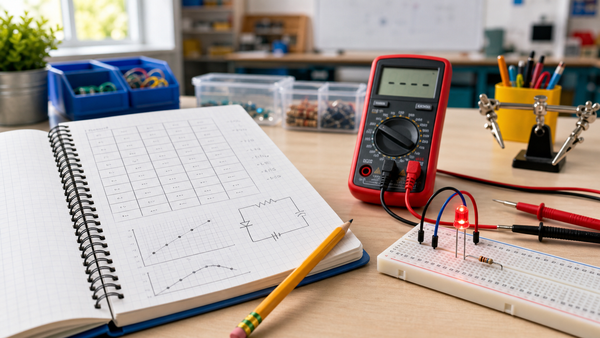
Materials: Breadboard, LED, resistor, battery or low-voltage supply, jumper wires, and a multimeter if available.
Student task: Build a circuit that lights the LED safely. Then change one thing, test the result, and explain what changed.
Evidence students can collect:
- LED on/off result.
- Battery voltage.
- Resistor value.
- Current reading if the class is ready for current measurement.
- A before/after wiring diagram.
Discussion questions:
- Why does the LED need to face the correct direction?
- What does the resistor do?
- What changed when you used a different resistor?
- What was your first troubleshooting step when the LED did not light?
This is a small activity, but it carries the full STEM pattern: build, test, measure, explain, improve.
Where Mr Circuit fits
Mr Circuit Technology was built around hands-on electronics learning for classrooms. The goal is not to make students memorize component names. The goal is to let students use real parts, build real circuits, troubleshoot mistakes, and connect the work to STEM and CTE skills.
Teachers who need classroom-ready electronics materials can start with the Mr Circuit schools and educators page. For a student-ready introduction to circuits, components, and no-solder breadboard work, see Mr Circuit Lab 1 Basic Electronics.
The bigger point is this: STEM education works best when students can touch the problem. A breadboard circuit gives them that chance. They can see the result, measure it, break it, fix it, and explain it.
Frequently Asked Questions
What is STEM education in simple words?
STEM education teaches science, technology, engineering, and math through connected problem solving. Students use ideas from more than one subject to build, test, measure, explain, and improve a solution.
What is an example of STEM education?
A simple example is a classroom circuit challenge. Students build an LED circuit, test whether it works, measure voltage or current, explain the role of the resistor, and troubleshoot the design if the LED does not light.
Does STEM education require robotics?
No. Robotics is one strong STEM pathway, but STEM can also happen through circuits, measurement, bridge design, energy projects, coding, environmental data, or classroom engineering challenges.
What age should students start STEM?
Students can begin STEM early with age-appropriate activities. Younger students can sort, build, observe, and compare. Older students can add measurement, design constraints, data, troubleshooting, and more formal engineering explanations.
How do you make a STEM lesson better?
Add a clear problem, require evidence, include measurement, let students revise, and end with an explanation. The strongest STEM lessons do not stop at "it worked." They ask students to explain why it worked.