
Hands-on circuit projects should be graded with a rubric that includes function, wiring quality, measurement evidence, troubleshooting process, explanation, and revision. A circuit that works once is not the whole learning goal. Students should also show how they planned, tested, found faults, and used evidence to improve the build.
This matters because electronics projects can be unfair if the final grade depends only on whether an LED lights at the exact moment the teacher walks by. A strong student may have a loose jumper wire during checkoff. A weaker student may copy a working build without understanding it. A better rubric grades both the product and the engineering process.
Why Working or Not Working Is Too Narrow
Project-based learning assessment should give teachers a fuller picture of what students know. Edutopia's PBL assessment guidance recommends varied assessments, and its project-based learning examples emphasize sharing rubrics early so students understand the standard. In circuit projects, that standard should include evidence, not just the final output.
Science Buddies' engineering notebook guidance supports the same idea: a design notebook should show the path from problem to solution. TeachEngineering circuit activities often ask students to build, measure, calculate, and compare results. Those are all assessable skills.
A Simple Circuit Project Rubric
Use five categories and score each one from 1 to 4. Keep the language visible before students begin the project.
| Category | What to look for | Why it matters |
|---|---|---|
| Function | The circuit performs the intended task or shows a tested near-solution. | Students need to build a real system. |
| Wiring and layout | Parts are placed clearly, polarity is handled, and the circuit can be inspected. | Neat layout makes troubleshooting possible. |
| Measurement evidence | Students record voltage, resistance, continuity, or observations with units. | Data shows students are testing, not guessing. |
| Troubleshooting process | Students identify faults, change one variable at a time, and explain revisions. | Debugging is a core electronics skill. |
| Explanation | Students can describe input, output, power path, and key components. | Understanding matters more than copying. |
Grade Evidence Students Can Actually Submit
Students do not need a long report for every circuit. Ask for small pieces of evidence that match the skill being taught.
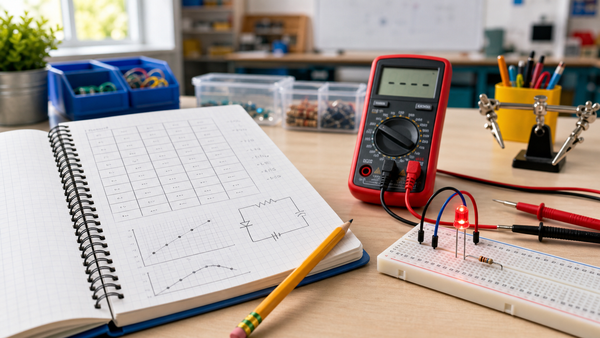
- A labeled sketch or photo of the circuit layout.
- A prediction written before power is connected.
- One or two multimeter readings with units.
- A short troubleshooting note: problem, test, change, result.
- A final explanation of what the circuit input and output do.
This pairs well with using measurement data in a STEM notebook. The notebook gives students a place to document the evidence you want to grade.
How to Grade a Circuit That Does Not Work Yet
A non-working circuit can still show real learning. If the student can identify the expected behavior, measure part of the circuit, find a likely fault, and propose a reasonable next test, that student has demonstrated technical thinking.
For example, a student builds an LED circuit that does not light. A product-only grade might be zero. A better rubric might give credit if the student checks battery voltage, confirms the resistor value, notices the LED polarity may be reversed, and records the next change. That process connects directly to circuit troubleshooting and predicting before measuring.
Use Group Grades Carefully
Many circuit projects happen in pairs or groups, especially in large classes. Grade the shared build as one category, but collect individual evidence for explanation and notebook work. That prevents one confident builder from carrying the project while other students receive the same score without understanding the circuit.
A practical split is 40 percent shared build and 60 percent individual evidence. The exact percentages can change, but the principle should stay: students can collaborate on the circuit, but each student should explain the learning.
Common Grading Mistakes
- Grading only the final circuit: This misses planning, measurement, troubleshooting, and explanation.
- Changing expectations after the build: Show the rubric before students begin.
- Rewarding messy speed: A fast build that cannot be inspected should not score higher than careful work.
- Ignoring revision: Students should get credit for improving a design after evidence shows a problem.
- Making the rubric too large: Five clear categories are easier to use than fifteen vague ones.
Where Mr Circuit Fits
Mr Circuit's hands-on labs make circuit assessment easier because students work with visible components, low-voltage builds, and repeatable project goals. Teachers can grade the build, the measurement routine, the troubleshooting notes, and the explanation without needing students to solder or work with advanced tools.
FAQ
Should a circuit project get full credit if it works?
Not automatically. A working circuit should still be graded for wiring quality, evidence, explanation, and the student's ability to troubleshoot.
How do I grade a circuit that fails at checkoff?
Look for evidence of correct planning, careful measurement, fault finding, and a reasonable next step. Do not grade only the final moment.
What should be in a circuit project rubric?
Include function, wiring and layout, measurement evidence, troubleshooting process, explanation, and revision.
Should group projects have individual grades?
Yes. The build can be shared, but each student should submit an individual explanation, notebook entry, or reflection.
How can students prove they understand their circuit?
Ask them to explain the power path, input, output, key component, expected behavior, and one measurement that supports their claim.