
Troubleshooting belongs in every STEM lesson because it turns failure into evidence instead of frustration. When students notice a problem, test possible causes, and revise their build, they are doing the thinking that makes STEM valuable. A class that only rewards first-try success may produce neat-looking projects, but it misses one of the most important habits in science, engineering, and technical work.
Last updated: June 15, 2026.
Why troubleshooting is not just a repair skill
Some classrooms treat troubleshooting as the messy part that happens after the real lesson. That is backwards. Troubleshooting is part of the real lesson because it forces students to connect cause and effect. If a circuit does not light, a robot does not respond, or a design falls apart, students have to ask what changed, what evidence they have, and what they should test next.
The Next Generation Science Standards for MS-ETS1-4 describe engineering as iterative testing and modification. That matters because it frames revision as normal, not as a sign that the student "did it wrong." The U.S. Department of Education's YOU Belong in STEM initiative also emphasizes problem solving, gathering evidence, and quality STEM learning environments. Troubleshooting is where those ideas become visible in class.
What students learn when they troubleshoot
| Troubleshooting move | What students learn | Classroom payoff |
|---|---|---|
| Isolate one variable | Cause and effect | Less random guessing |
| Test a prediction | Evidence-based reasoning | Better explanations |
| Compare expected vs actual result | Model revision | Deeper understanding |
| Record what changed | Technical communication | Stronger notebooks and assessments |
A student who can say, "We tested the battery first, then checked polarity, then found a loose jumper," is doing much more than fixing a project. That student is learning how technical systems are understood.
Troubleshooting makes engineering design real
Many STEM lessons say they teach design, but the structure does not always support it. If students only follow steps and stop when a teacher rescues them, they are doing assembly, not engineering. Real design includes testing and adjustment. NGSS makes that explicit by tying engineering to iterative improvement rather than one perfect attempt.
NASA's Sensor Solutions activity works from the same logic. Students have to explore how a sensing system could solve a problem, which means their first idea is rarely their final one. That is the mindset classroom troubleshooting should build: test, observe, refine.
Circuits are one of the clearest places to teach this habit
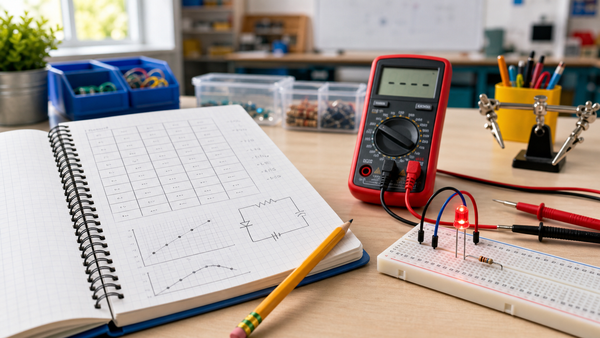
Circuits make troubleshooting visible because students can often see or measure the result of each change. In OpenStax's current chapter, current is defined as the rate of charge flow, and the simple circuit examples depend on a complete path. When an LED stays dark, students can investigate whether the path is broken, the polarity is reversed, the battery is weak, or a connection is loose.
That kind of problem is ideal for teaching a sequence:
- Describe the expected result.
- Identify what is actually happening.
- Test the simplest possible cause first.
- Change one thing at a time.
- Explain what the new result means.
Mr Circuit already has a practical follow-up in Why a Circuit Does Not Work: Student Troubleshooting Checklist. This article answers the bigger question: why that routine belongs in the lesson plan itself.
What changes when troubleshooting is built into the lesson
Students stop seeing mistakes as proof that they are "bad at STEM." Instead, they start seeing mistakes as information. That shift matters for persistence, especially with beginners. A lesson that expects troubleshooting is usually calmer and more productive than a lesson that treats every failed build like an emergency.
It also improves classroom talk. Students explain observations more precisely when the teacher asks, "What evidence do you have?" instead of "Who needs help?" That kind of language aligns well with the engineering design process and supports the confidence-building routines described in this student-confidence guide.
How to make troubleshooting a normal part of class
- Say before the build starts that first-try failure is common and useful.
- Give students a short checklist so they have a structure before they call for help.
- Ask for one observation and one tested idea before stepping in.
- Require notebook notes on what changed and what happened.
- Debrief common failures as class learning, not as student mistakes.
Those routines are especially useful for teachers who do not see themselves as electronics experts. If that is your situation, pair this article with How to Teach Electronics When You Are Not an Electronics Expert and How to Teach Students to Use a Digital Multimeter. The goal is not to know every answer in advance. The goal is to guide students through a better process.
Common mistakes teachers make with troubleshooting
- Fixing the build too quickly, before students have described the evidence.
- Allowing students to change five variables at once and call it testing.
- Grading only the final product, not the revision process.
- Treating troubleshooting as a delay instead of part of the learning target.
- Letting the fastest group define success for everyone else.
When those patterns change, engagement usually improves. Students have a reason to look closely, speak precisely, and keep working.
Where Mr Circuit fits naturally
Mr Circuit is a natural fit when a teacher wants low-voltage materials that make troubleshooting manageable and visible. The For Schools and Educators page can help programs choose the right starting point, and beginner circuit posts give students a stronger vocabulary before the lab begins.
The product itself is not the point of this article. The point is that students need environments where revision is expected, safe, and structured. Good classroom materials simply make that easier to do well.
FAQ
Why is troubleshooting important in STEM?
It teaches students to use evidence, isolate variables, revise ideas, and persist through uncertainty instead of stopping at the first problem.
Does troubleshooting slow the lesson down too much?
Only if the lesson has no structure. With a checklist and clear prompts, troubleshooting usually makes the learning more efficient because students stop guessing randomly.
Is troubleshooting only for engineering projects?
No. It matters in science labs, robotics, coding, electronics, and any task where students compare an expected result with an actual one.
What should a teacher ask before helping?
Ask what the student expected, what they observed, and what one cause they have already tested. That keeps the help evidence-based.
How do I grade troubleshooting fairly?
Grade the process as well as the product. Notes, explanations, revisions, and evidence use should count, not just whether the build works immediately.
What is the best first troubleshooting lesson?
A simple LED circuit works well because students can quickly test polarity, battery condition, loose connections, and path continuity without advanced tools.