
STEM education connects science, technology, engineering, and mathematics through a problem students can investigate. Instead of only receiving facts, students build or model a solution, gather evidence, explain what happened, and improve their work. A STEM lesson may emphasize some disciplines more than others, but the connections must help students make a decision.
That definition is more useful than saying STEM is any activity involving a robot, computer, science experiment, or construction material. Those tools can support excellent learning, but the materials do not make the lesson STEM. The thinking does.
What does STEM stand for?
STEM stands for science, technology, engineering, and mathematics. In a classroom task, each discipline can play a different role:
- Science helps students explain a phenomenon, such as why an LED has polarity or why current changes.
- Technology includes tools, systems, and processes students use or create, from a multimeter to a breadboard circuit.
- Engineering turns knowledge into a solution that must meet criteria within limits.
- Mathematics helps students measure, calculate, compare, graph, and justify a choice.
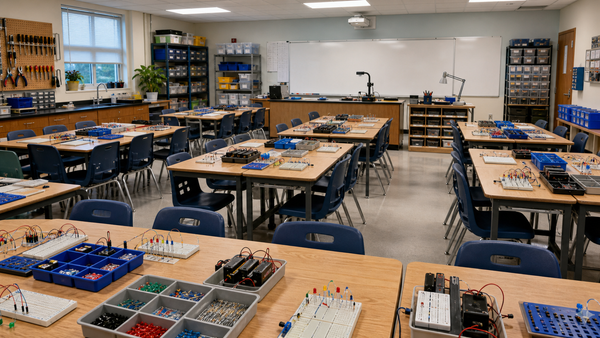
The U.S. National Science Foundation supports STEM learning across all ages and in both formal and informal settings. The NSF Directorate for STEM Education also connects high-quality STEM learning with STEM literacy, teaching research, learning technologies, and partnerships. In practical terms, STEM can happen in a science class, CTE lab, robotics club, makerspace, homeschool table, or after-school program.
Is every science or building activity a STEM lesson?
No. A lesson can teach one STEM discipline very well without being integrated STEM. A focused mathematics lesson or teacher-led science demonstration still has value. The National Academies' report on STEM integration in K-12 education specifically recognizes the value of individual disciplines while examining what explicit integration adds.
The important question is not whether all four letters appear on a lesson plan. Ask whether students must connect ideas from more than one discipline to solve, test, or explain something.
| STEM-themed activity | Integrated STEM learning |
|---|---|
| Students assemble a device by copying steps. | Students use a diagram, test the device, and explain a result. |
| The task ends when the model is finished. | The task ends after evidence, explanation, and revision. |
| There is one prescribed result and no decision. | Students compare options against criteria and constraints. |
| Numbers are recorded but never used. | Measurements help students choose or improve a solution. |
| A failed attempt is treated as lost time. | A failed test supplies evidence for troubleshooting. |
For a deeper planning distinction, see what makes a STEM activity educational instead of just fun.
A four-question test for a strong STEM lesson
Before calling an activity STEM, a teacher can apply this quick test:
- What problem are students solving? State the goal in language students can repeat.
- Which disciplines must they connect? Name what science explains, what technology enables, what engineering decides, and what math measures.
- What evidence will they collect? Choose observable results, measurements, drawings, or comparison data.
- What can they improve? Leave time for one evidence-based change.
If the teacher cannot answer those questions, the activity may need a clearer goal rather than more materials. The NGSS middle-school engineering design expectations reinforce this structure: students define criteria and constraints, compare possible solutions, analyze test data, and modify designs. The process is not simply “make something.”
What does STEM look like in an electronics classroom?
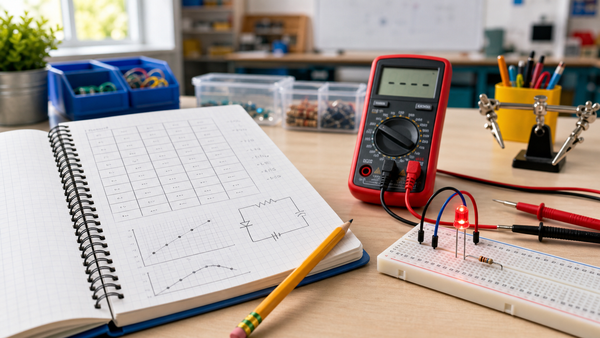
Consider a low-voltage LED indicator challenge. Give teams a breadboard, LED, current-limiting resistor, battery holder, jumper wires, and a multimeter when students are ready to use one.
Problem: Build a dependable indicator light that turns on safely and can be checked by another team.
Criteria: The LED lights; the circuit uses the required resistor; the wiring can be traced from the power source and back; the team can explain each component.
Constraints: Use only the supplied low-voltage power source and parts; do not bypass the resistor; finish within the class period.
Evidence: Record the battery voltage, resistor value, LED result, a circuit sketch, and the first troubleshooting check. Students who are prepared to measure current must place the meter in series and follow the teacher's meter procedure.
Revision: Teams swap with a partner group. The second group traces the circuit, identifies one clarity or reliability issue, and proposes one change.
This single challenge uses science to explain polarity and current, technology to build and measure, engineering to meet criteria within limits, and math to interpret values. Teachers can prepare the component knowledge with this resistor-and-LED explanation.
How do criteria, constraints, and iteration improve STEM learning?
Criteria describe what success must look like. Constraints describe the limits on materials, time, cost, size, or safety. Together, they turn an open activity into a design problem students can evaluate.
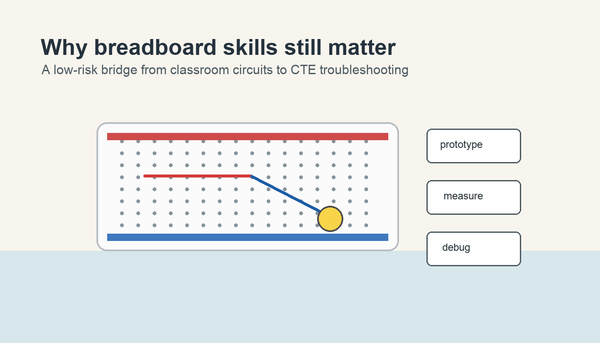
The TeachEngineering design process describes engineering as iterative: teams apply science and math, test prototypes, analyze data, and repeat steps as they learn. That is why troubleshooting belongs inside the lesson rather than after it. A circuit that does not light gives students a reason to inspect power, polarity, connections, component placement, and evidence. Mr Circuit's guide to troubleshooting in STEM lessons provides a classroom-ready routine.
A 45-minute STEM lesson structure
| Time | Teacher move | Student evidence |
|---|---|---|
| 0-5 minutes | Show the problem, criteria, constraints, and safety boundary. | Prediction and first sketch. |
| 5-12 minutes | Model only the unfamiliar tool or concept. | Parts check and revised plan. |
| 12-27 minutes | Question teams without fixing circuits for them. | Build, observations, and measurements. |
| 27-36 minutes | Prompt one systematic test and one change. | Troubleshooting note and revision. |
| 36-43 minutes | Facilitate a partner check or short comparison. | Evidence-based explanation. |
| 43-45 minutes | Collect an exit response and reset materials. | Claim, evidence, and next step. |
A complete build is helpful, but the learning target is the reasoning. A student who can explain a failed test and identify the next controlled check may show more STEM thinking than a student whose circuit happened to work immediately. For more pacing detail, use this 45-minute STEM lesson plan.
Common STEM planning mistakes
Starting too open-ended
Beginners need a shared foundation. Model one safe circuit or tool skill, then add a meaningful choice. Open-ended work becomes productive after students understand the system they are changing.
Using all four letters as a checklist
Do not force an artificial math worksheet or unnecessary device into the lesson. Use only the disciplines that help students understand the problem or justify a decision.
Collecting data without using it
A table of numbers is not enough. Ask students what the measurement changes, rules out, or supports. Evidence should influence an explanation or design choice.
Ending at “it works”
Ask students why it works, how they know, which constraint mattered, and what they would test next. This final explanation is where separate facts become connected knowledge.
Why STEM education matters beyond one project
The 2024 Federal Strategic Plan for Advancing STEM Education and Cultivating STEM Talent treats STEM learning as a long-term national effort involving learning opportunities, partnerships, and pathways. In a classroom, that large goal starts with small habits: define the problem, use evidence, test ideas, communicate results, and improve.
Those habits transfer from a breadboard to robotics, automation, engineering, and technical careers. Students moving toward robotics can continue with the circuits students should understand before robotics. Teachers planning a broader hands-on sequence can also use the Mr Circuit schools and educators resources.
Frequently Asked Questions
What is STEM education in simple words?
STEM education connects science, technology, engineering, and math through problems students investigate. They build or model, collect evidence, explain results, and improve a solution.
Does every STEM lesson need all four subjects equally?
No. A lesson can emphasize two or three disciplines. The important feature is that students connect the disciplines in a useful way rather than seeing four unrelated activities.
Is coding required for STEM education?
No. Coding is one technology pathway. Circuits, measurement, structures, energy investigations, data collection, and engineering challenges can all support STEM learning without coding.
Is a hands-on activity automatically STEM?
No. Strong STEM learning includes a clear problem, relevant disciplinary ideas, evidence, and a chance to explain or improve. Hands-on materials alone do not provide those elements.
What is a simple example of STEM education?
An LED indicator challenge is a simple example. Students build a low-voltage circuit, test polarity and connections, record evidence, explain the resistor's role, and revise the design.
How can teachers assess a STEM lesson?
Assess the reasoning as well as the product: problem definition, correct use of concepts, quality of evidence, troubleshooting process, explanation, and improvement.
Sources
- U.S. National Science Foundation: Directorate for STEM Education
- White House OSTP: 2024 Federal Strategic Plan for Advancing STEM Education and Cultivating STEM Talent
- Next Generation Science Standards: MS-ETS1-1 Engineering Design
- National Academies: STEM Integration in K-12 Education
- TeachEngineering: The Engineering Design Process