
A strong 45-minute STEM lesson ends with more than a rushed build. Students should understand the problem, make a reasonable plan, build something testable, and leave with evidence about what worked, what failed, and what they would change next.
That sounds ambitious for one class period, but it is possible when the lesson is narrow, materials are controlled, and the build target is realistic. The mistake teachers usually make is trying to teach too many concepts at once. A better approach is to pick one visible success condition and design the period backward from that point.
For beginner electronics, that success condition might be simple: “Every group will build a circuit that lights an LED and explain one reason it worked.” For a broader engineering lesson, it might be: “Every group will build a prototype that meets one testable requirement and record one improvement after testing.”
What a 45-minute STEM lesson can realistically accomplish
The NGSS emphasize that students should engage in practices such as defining problems, planning investigations, using evidence, and communicating information. That does not require a giant project every time. It does require a lesson structure that gives students a small but real cycle of thinking, building, and revision.
TeachEngineering also centers engineering tasks on clear constraints and real-world problem solving. For a single period, that means you should reduce variables, not increase them. If the goal is a working build, students need enough time to test one important idea well.
Start with one tight build goal
Before you plan the lesson, write one sentence that answers this question: What must be working by minute 35?
Good examples:
- Students can build a closed circuit with a battery, resistor, and LED.
- Students can make a paper tower hold one textbook for five seconds.
- Students can create a switch that turns a simple circuit on and off.
Weak examples:
- Students will explore electricity.
- Students will do engineering design.
- Students will build something creative.
The tighter the goal, the better the class period usually goes.
A practical 45-minute structure
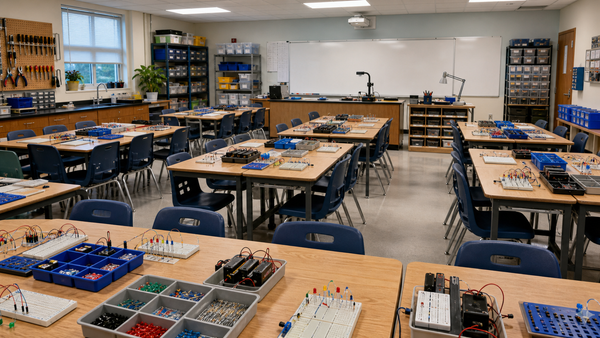
This template works well for middle school, CTE survey classes, homeschool groups, and beginner electronics labs.
| Minutes | Teacher move | Student task |
|---|---|---|
| 0-5 | Hook plus success criteria | Notice the challenge and predict what a successful build needs |
| 5-10 | Mini-model or safety demo | See one critical concept before building |
| 10-15 | Planning prompt | Sketch, label, or discuss the first build attempt |
| 15-30 | Build and troubleshoot | Construct, test, and revise |
| 30-38 | Evidence capture | Record results, measurements, or a photo with notes |
| 38-45 | Fast debrief | Explain one success, one problem, and one next change |
Example: a one-period beginner electronics lesson
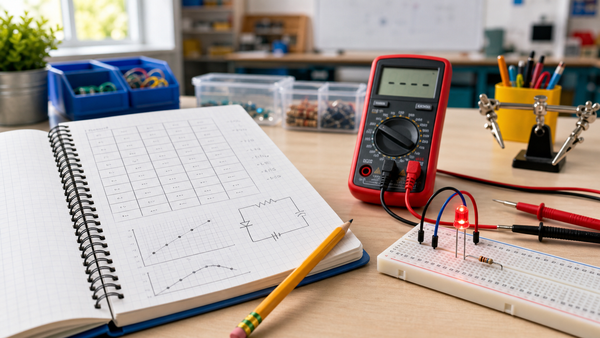
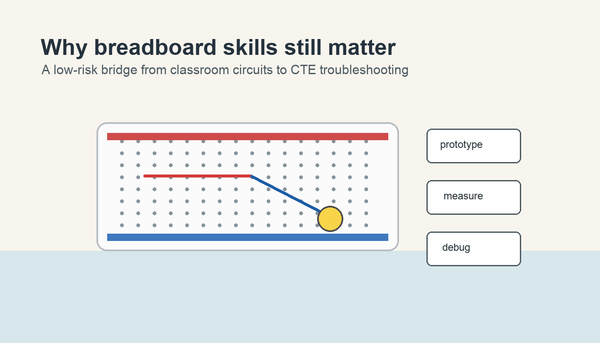
Suppose your objective is to help students build a working LED circuit on a breadboard.
Your lesson can stay focused on three ideas only:
- a circuit needs a complete path
- an LED has polarity
- a resistor protects the LED by limiting current
That is enough for one class.
A practical routine looks like this:
- Show a prebuilt example for one minute so students know the target.
- Model the battery, resistor, LED, and path on the board.
- Give each group the same parts in the same order.
- Require a quick sketch before they touch the materials.
- Circulate with two troubleshooting questions only: “Where is the path broken?” and “Is the LED facing the correct way?”
- End with a written explanation of why the resistor belongs in the circuit.
If you want students ready for this type of class, connect it to voltage, current, and resistance before the build day, or use those posts as follow-up reading.
Why working builds fail in short class periods
Too many new ideas
If students are learning the parts, the tool setup, the scientific concept, and the full design process at the same time, the class collapses into confusion.
Too much teacher talking
A ten-minute lecture can quietly destroy a one-period build lesson. Students need a short explanation, then time to test.
No visible checkpoint before the build
A thirty-second sketch or prediction slows students down just enough to reduce random trial-and-error.
No planned troubleshooting language
A 2025 study of engineering-design thinking found that students benefit from structured support for framing problems, assessing limitations, and reflecting on changes. In a 45-minute lesson, that structure matters even more because students do not have time to wander. Your prompts should already be ready before class starts.
How to keep the lesson rigorous without making it longer
Rigor in a short STEM lesson comes from the quality of the questions, not from piling on extra parts. Ask students to:
- predict before building
- test one change at a time
- explain why a result happened
- record one failure and one fix
- name the next revision they would make
That sequence gives you thinking, evidence, and communication inside one class period.
A teacher checklist for fast planning
- Choose one build target that can be demonstrated in under one minute.
- Limit materials so every group works with the same basic setup.
- Prepare a sample build and one non-working example for troubleshooting.
- Write the success criteria where students can see it all period.
- Plan two questions you will ask every stuck group.
- End with a short evidence task, not a vague cleanup-only ending.
If you teach schools or district buyers, it also helps to keep an educator-facing resource page nearby, such as Mr Circuit’s schools and educators page, so students and colleagues can see how the single lesson fits into a larger sequence.
Frequently Asked Questions
Is 45 minutes enough for real STEM?
Yes, if the challenge is narrow and the success criteria are visible. A short lesson can still include prediction, building, testing, and explanation.
Should every group finish with a working build?
That is a useful target for beginner lessons, but evidence of troubleshooting can also count as success when the task is harder.
How many materials should I introduce in one period?
Usually only the parts students truly need for the target build. Extra options often slow down beginners.
What is the best closing move?
Ask students to state what worked, what failed, and what they would change next. That keeps the lesson about reasoning, not just completion.
Can this structure work without electronics?
Yes. The same timing works for towers, ramps, boats, insulation tests, and other simple design challenges.
Sources
- Next Generation Science Standards DCI arrangements
- TeachEngineering engineering design process
- A Framework for K-12 Science Education
- Science Buddies engineering design process steps
Last updated: June 11, 2026