
An open circuit has a break in the path, and a closed circuit has a complete path. That is the fastest way to explain the difference. When the path is complete, electric current can move from the power source, through the load, and back again. When the path is broken, current stops.
Last updated: June 15, 2026.
What "open" and "closed" really mean
Students often hear the words open and closed and assume they work the opposite way they do in a door. In circuits, a closed circuit is the one that works because the path is complete. An open circuit is the one that does not work because the path is broken somewhere.
That idea matches the simple-circuit explanation in OpenStax's current chapter and in its chapter on simple circuits. In both cases, current depends on a complete path through the circuit.
Open circuit vs closed circuit at a glance
| Feature | Open circuit | Closed circuit |
|---|---|---|
| Path | Broken somewhere | Complete loop |
| Current flow | Stops | Can move through the circuit |
| Bulb or LED | Off | On, if the rest of the circuit is correct |
| Switch example | Switch open | Switch closed |
A simple classroom example
Imagine a battery, two wires, a switch, and a bulb. If the wires connect everything in a loop and the switch is closed, the bulb can light. If the switch is open, there is now a gap in the path. Even though the battery still has voltage, the bulb stays off because the path is incomplete.
This is one reason the PhET Circuit Construction Kit: DC simulation is useful in class. Students can watch what changes when a path is completed or broken instead of memorizing vocabulary without seeing the effect.
Why current stops in an open circuit
Current is the rate at which charge flows. If there is a gap in the path, the charges do not have a full route through the circuit. In student language, the electricity has nowhere to go. That is not the most formal phrasing, but it helps beginners understand why a break matters.
Later, you can connect that beginner language to the more precise version: a simple electric circuit requires a closed path for current to flow. That precision matters when students begin troubleshooting and need to identify exactly what is wrong.
Common examples students already know
- A flashlight turns on when the internal circuit is closed.
- A wall switch opens or closes a lighting circuit.
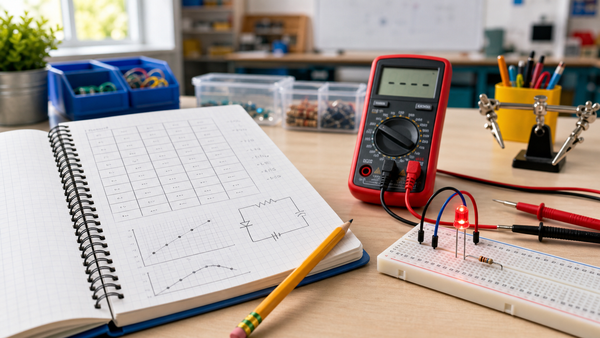
- A loose wire on a breadboard can create an open circuit.
- A battery pulled out of a device breaks the path immediately.
These examples work better than abstract definitions because students can picture them right away.
How this connects to other circuit concepts
If students are learning this topic for the first time, it helps to connect it to a few nearby ideas:
- Current tells you that charge has to move.
- Voltage explains the push that helps charges move.
- Resistance explains why current is limited, even in a closed circuit.
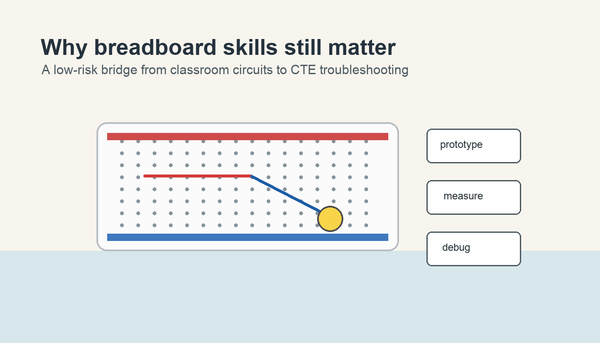
- Breadboards show how the path is built physically.
Those articles are useful internal follow-ups because students usually need the vocabulary cluster together, not one isolated definition.
A quick troubleshooting routine
If an LED does not light, students can use this sequence:
- Check whether the circuit path is complete.
- Look for loose jumper wires or the wrong breadboard row.
- Check whether the switch is open or closed.
- Then check polarity and battery condition.
That routine keeps students from guessing too early about more advanced causes. Very often, the problem is simply that the path is open somewhere.
Common misconceptions
- Thinking "open" means the circuit is ready to use.
- Assuming a battery alone makes current flow even with a gap.
- Believing a dark bulb always means the battery is dead.
- Forgetting that a switch changes the path, not just the brightness.
These are normal beginner errors. They are easier to fix when students can point to the path with a finger and describe whether it is complete.
Where Mr Circuit fits naturally
This topic fits well before or during a first build using the Mr Circuit Lab 1 Basic Electronics STEM Kit. It also pairs naturally with the night-light project, where students can see how one missing connection changes the result immediately.
For beginners, that visibility matters. A good first lesson should let students see the difference between a complete path and a broken one without a lot of extra theory.
FAQ
What is an open circuit?
An open circuit is a circuit with a break in the path, so current cannot keep flowing through the full loop.
What is a closed circuit?
A closed circuit has a complete path that allows current to move from the power source, through the load, and back again.
Is a switch open when the light is off?
In a simple switch circuit, yes. An open switch creates a gap in the path, so the light turns off.
Can a circuit be closed and still not work?
Yes. The path may be complete, but another issue such as wrong polarity, too much resistance, or a weak battery can still prevent the expected result.
How do I explain this to younger students?
Say that a closed circuit is a complete loop and an open circuit has a gap. Then show it with a battery, bulb, and switch.
Why do students mix up open and closed circuits?
Because the everyday meaning of open sounds like "ready" or "available." In circuits, the important idea is whether the path is complete.