
Electronics connects to aviation technology through avionics, aircraft electrical systems, sensors, switches, indicators, batteries, schematics, and troubleshooting. Students who can read a simple circuit, use a multimeter, identify opens and shorts, and explain input-output behavior have a stronger foundation for later aviation maintenance or avionics training.
Why aviation pathways depend on electronics
Aviation technology includes mechanical systems, structures, engines, safety procedures, and documentation, but electronics is central to modern aircraft work. The FAA notes that aircraft trade schools are placing more emphasis on aviation electronics and that technicians need stronger skills in electronic principles. BLS describes aircraft and avionics technicians as workers who install, test, adjust, and repair equipment and systems in aircraft. O*NET describes avionics technicians as workers who install, inspect, test, adjust, or repair equipment such as radar, radio, navigation, and control systems.
For a STEM or CTE classroom, the right starting point is not aircraft maintenance. It is a safe, low-voltage model that helps students understand circuit paths, signals, indicators, and evidence-based troubleshooting.
Classroom electronics skills that transfer to aviation
| Beginner electronics skill | Student practice | Aviation connection |
|---|---|---|
| Reading symbols and schematics | Matching a drawing to a real circuit | Interpreting aircraft drawings, wiring diagrams, and circuit symbols |
| Measuring voltage, current, and resistance | Using a meter with a clear purpose | Supporting electrical-system inspection and troubleshooting |
| Continuity testing | Finding complete and open paths | Checking switches, wires, fuses, and circuit paths |
| Switch and relay logic | Seeing how one action controls another output | Understanding control circuits and indicator systems |
| Short and open circuit diagnosis | Testing faults safely in a model circuit | Preparing for formal aviation maintenance troubleshooting standards |
A starter activity: build an indicator-panel model
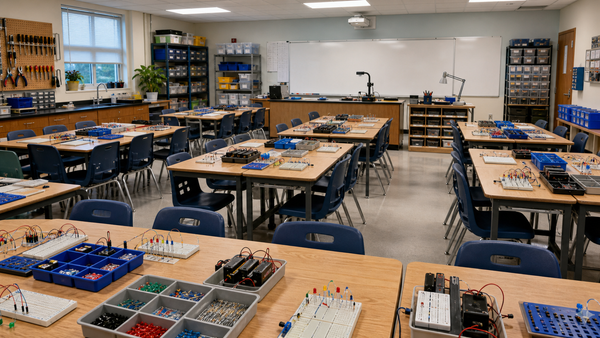
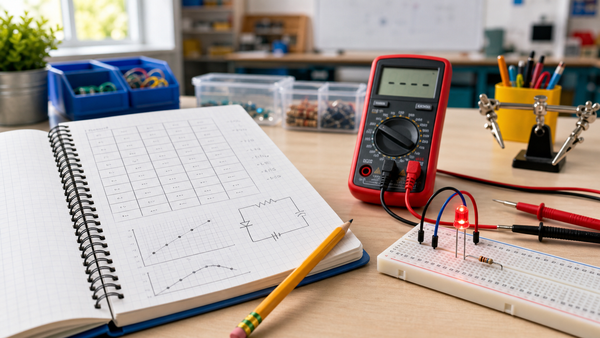
Have students build a low-voltage indicator panel with two or three LEDs, switches, resistors, and a battery pack. Present it as an aviation-inspired classroom model, not an aircraft system. The goal is to connect a schematic to a physical circuit and then diagnose a fault.
- Students study a simple schematic with battery, switch, resistor, and LED symbols.
- They build the first indicator circuit on a breadboard.
- They measure supply voltage and confirm LED polarity.
- They add a second switch-controlled LED.
- The teacher introduces one fault, such as an open jumper, reversed LED, missing ground return, or loose connection.
- Students document the test they used to locate the fault.
This keeps the work age-appropriate while building the habits aviation programs value: follow the diagram, use the correct measurement, document the result, and avoid unsupported guesses.
What the FAA standards signal to teachers
The FAA Aviation Mechanic Certification Standards include practical electrical skills such as performing circuit continuity tests, measuring voltage, current, and resistance, testing switches or relays, reading aircraft electrical circuit diagrams and symbols, troubleshooting circuits, identifying short and open circuit conditions, and measuring voltage drop across a resistor. Those are advanced certification standards, but they show why beginner electronics is relevant long before students enter a formal aviation program.
Common student mistakes
- Thinking aviation electronics means only screens and instruments, not basic circuits.
- Trying to memorize symbols without building the matching circuit.
- Using a multimeter as a random tool instead of asking a testable question.
- Calling every non-working circuit a short when many beginner faults are open circuits.
- Forgetting that aviation maintenance requires documentation, not just a working result.
How to connect this to a CTE pathway
Students do not need an aircraft in the room to start thinking like aviation technicians. They need precise habits: read the diagram, check the power source, confirm the return path, test the switch, inspect the load, record the evidence, and explain the fix. Those same habits also support robotics, automotive technology, HVAC controls, drones, and mechatronics.
Useful Mr Circuit next steps include reading a circuit schematic, what a multimeter measures, finding an open circuit, and finding a short circuit. Program planners can also review the schools and educators page.
Sources
- FAA: How to Become an Aviation Maintenance or Avionics Technician
- FAA Aviation Mechanic Certification Standards
- BLS: Aircraft and Avionics Equipment Mechanics and Technicians
- O*NET: Avionics Technicians
FAQ
Is aviation technology mostly electronics?
No. Aviation technology includes structures, powerplants, safety, maintenance procedures, documentation, and mechanical systems, but avionics and electrical systems make electronics a critical part of the pathway.
What electronics should aviation students learn first?
Start with low-voltage circuits, schematic symbols, continuity, voltage, current, resistance, switches, indicators, and troubleshooting.
Can students practice aviation electronics without aircraft equipment?
Yes. A classroom indicator-panel model can teach the same foundation: power, switch, load, return path, measurement, and documentation.
How does a multimeter connect to aviation training?
A multimeter helps students measure voltage, resistance, current, and continuity, which are foundational skills for diagnosing electrical paths and components.
Should students work on real aircraft systems?
No, not in a general STEM classroom. Real aircraft maintenance belongs in approved, supervised aviation programs that follow regulatory procedures.
Last updated: 2026-07-11.