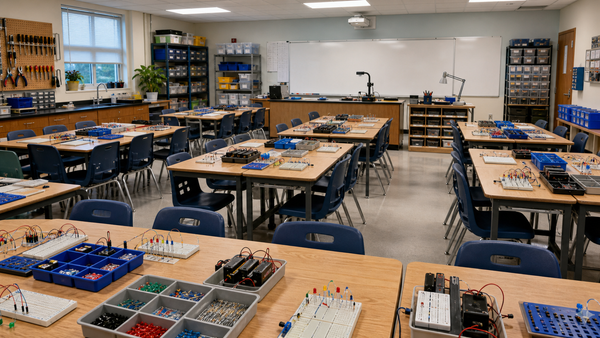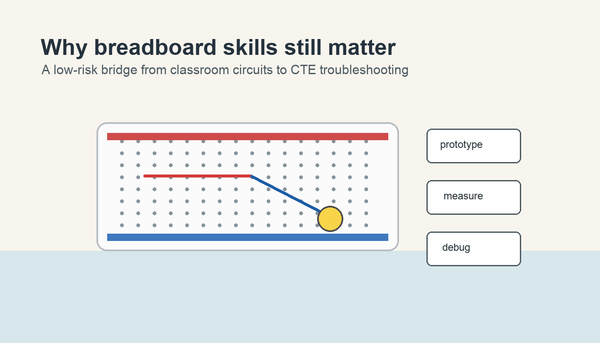

Electronics vocabulary for first-year CTE students should be taught as working lab language, not as a disconnected word list. Students need to connect each term to a real component, a circuit behavior, a measurement, or a troubleshooting decision so they can talk about what they built and why it works.
Why vocabulary matters in a first electronics class
First-year CTE students are often learning two things at the same time: the electronics concept and the professional language used to describe it. A student may build a correct LED circuit but still say "the battery pushes power through the light thing." That is a useful starting point, but the course goal is to move students toward clearer language: the battery provides voltage, current flows through the closed circuit, the resistor limits current, and the LED is a polarized output device.
Current CTE frameworks support this practical approach. Massachusetts describes electronics engineering technology as hands-on work with tools, test equipment, building, testing, and repair. Utah's entry-level electronics standards emphasize assembling components and operating electrical or electronic equipment. Those goals require vocabulary that students can use while they work, not only terms they can recite on a quiz.
The first vocabulary set to teach
Start with words that students will use in nearly every beginner lab. These are the terms that help them describe a circuit, record measurements, and ask for help without guessing.
| Term | Student-friendly meaning | Use it during lab when... |
|---|---|---|
| Circuit | A complete path for electric current | Students check whether the loop is open or closed |
| Voltage | Electrical push between two points | Students measure a battery or power rail |
| Current | The flow of electric charge | Students discuss why an LED needs a resistor |
| Resistance | Opposition to current flow | Students compare resistor values or LED brightness |
| Polarity | Correct plus/minus direction for a part | Students orient an LED, battery, diode, or capacitor |
| Continuity | An unbroken conductive path | Students use a meter to find an open connection |
| Schematic | A symbolic drawing of a circuit | Students translate a diagram into a breadboard build |
Group words by classroom action
A strong CTE vocabulary routine groups terms by what students are doing. During a build day, use component words: resistor, LED, breadboard, jumper wire, battery, switch, and sensor. During a measurement day, use meter words: voltage, resistance, continuity, probes, range, and reading. During a troubleshooting day, use fault words: open circuit, short circuit, loose connection, reversed polarity, and incorrect value.
This grouping helps students retrieve the right word at the right moment. It also keeps vocabulary connected to the skills CTE programs care about: using tools, applying math and science, conducting experiments, and building DC circuits.
A 10-minute vocabulary routine
- Show the physical part or measurement first.
- Give a one-sentence definition students can repeat.
- Ask students to point to the term in a real circuit.
- Have pairs use the word in a sentence about what they observe.
- Return to the term during troubleshooting and notebook writing.
For example, when introducing polarity, do not begin with a long lecture. Show a battery, an LED, and a diode. Ask students to identify which parts care about direction. Then have them build, reverse the LED, observe what changes, and write one sentence using the word polarity.
Common student mistakes
- Using voltage, current, and power as if they mean the same thing.
- Calling every small part a resistor because it has color bands or wire leads.
- Thinking a schematic is a picture of the breadboard layout.
- Describing a fault as "broken" instead of naming an open circuit, short circuit, wrong value, or reversed polarity.
- Memorizing definitions without connecting them to measurements.
How to assess vocabulary without making it busywork
Use short performance checks. Ask students to label a breadboard build, explain why an LED did not light, or write a two-sentence notebook entry using voltage, resistor, and polarity correctly. A practical vocabulary assessment should sound like a beginner technician explaining evidence, not like a dictionary test.
Helpful next links
After students learn the core terms, reinforce them with related lessons on beginner electronic components, solderless breadboards, multimeter measurements, and CTE electronics skills.
Sources
- Massachusetts DESE Electronics Engineering Technology framework
- New York technology education electricity/electronics foundation course
- Utah CTE Electronics, Introduction standards
- CTE Resource Center Electronics Systems I course description
FAQ
What electronics vocabulary should first-year CTE students learn first?
Start with circuit, current, voltage, resistance, power, polarity, component, input, output, measurement, continuity, schematic, and troubleshooting. Add part names as students physically use them.
Should students memorize electronics definitions before building?
No. Give a short working definition, let students build or measure, then return to the term after they have evidence.
How many terms should a beginner electronics unit introduce at once?
Five to eight terms per lab is usually enough. Too many words at once can hide the practical concept students are trying to learn.
How do you assess electronics vocabulary?
Ask students to explain a real circuit using the words correctly, label a simple diagram, and describe one troubleshooting step.
What is the difference between vocabulary and technical communication?
Vocabulary is knowing the word. Technical communication is using the word to explain evidence, a measurement, or a design choice clearly.
Last updated: 2026-07-10.