
The electronics skills that transfer best to real careers are the ones that teach students how to read a system, measure it, troubleshoot it, and document what happened. That includes component identification, schematic reading, multimeter use, fault-finding, safe build habits, and later bridges into digital logic, sensors, and timing.
Last updated: June 10, 2026
That answer matters for CTE because schools do not need a flashy project list as much as they need a defendable sequence of skills. Families, administrators, and students want to know whether classroom electronics prepares learners for real technical pathways. The honest answer is yes, when the course teaches transferable habits instead of one-off gadget assembly.
What CTE is actually trying to do
The U.S. Department of Education's Office of Career, Technical, and Adult Education says CTE should help students acquire challenging academic and technical skills and prepare for high-skill, high-wage, or high-demand occupations. Advance CTE makes a similar point from the program-design side: its Career Clusters Framework, modernized in 2024, is meant to support consistent, high-quality pathway design.
That means the goal of an electronics course is not just "students built something cool." The stronger goal is that students leave with skills that still matter when the project changes.
The skills that transfer furthest
| Classroom skill | What students really learn | Where it transfers |
|---|---|---|
| Component identification | How parts function inside a system | Electronics, robotics, maintenance, engineering foundations |
| Schematic reading | How to move from symbol to real build | Manufacturing, control systems, technical troubleshooting |
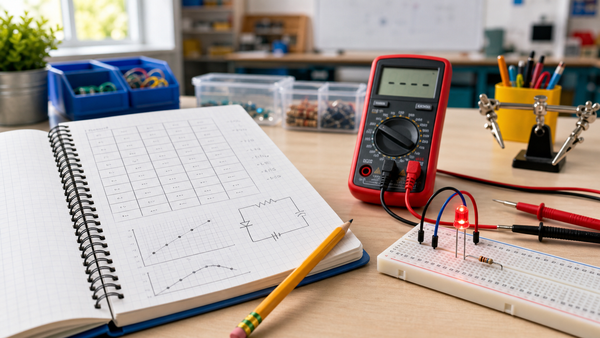
| Multimeter use | How to verify voltage, resistance, and continuity with evidence | Installation, repair, automation, lab work |
| Troubleshooting | How to isolate faults instead of guessing | Nearly every technical pathway |
| Documentation | How to record settings, results, and changes clearly | Engineering, quality control, field service, apprenticeships |
| Digital logic and timing | How inputs, outputs, and control behavior connect | Automation, robotics, digital systems, mechatronics |
Why measurement and troubleshooting matter so much
Students often think the most "career-ready" skill is building a complicated final project. In practice, measurement and troubleshooting are more durable. The Bureau of Labor Statistics page for electrical and electronics installers and repairers explicitly mentions diagnostic work with multimeters and oscilloscopes. That is a strong reminder that technical careers depend on evidence gathering, not just assembly.
That is also why articles like What Is Current in a Circuit? and What Is Resistance? matter inside a CTE sequence. These are not just science definitions. They are the language students need before they can diagnose why a system works, fails, or changes behavior.
Transfer does not mean one job title
Good CTE electronics instruction serves more than one pathway. Some students may continue toward engineering programs. BLS reports that electrical and electronics engineers had a 2024 median pay of $118,780 and a 2024-2034 outlook of 7%, which is faster than average. Other students may move toward technical installation, repair, automation, or manufacturing support roles. BLS reports that electrical and electronics installers and repairers had a 2024 median pay of $71,270.
The point is not to promise either outcome from one class. The point is that core electronics habits transfer across both higher-education and hands-on workforce directions.
A first-year CTE electronics sequence that makes sense
A strong beginner sequence usually looks like this:
- Identify common components and their jobs.
- Build simple low-voltage circuits on a breadboard.
- Read schematic symbols and trace complete paths.
- Measure voltage, resistance, and continuity with a meter.
- Troubleshoot open circuits, wrong polarity, and bad placement.
- Move into sensors, logic, or timing once the basics are stable.
That sequence works because it teaches the student to think like a technician and a problem solver before asking them to think like a system designer. The published article Circuits Students Should Understand Before Robotics supports the same logic: control systems go better when students already understand power, paths, polarity, and signals.
Where digital and timing skills fit
Not every course needs to start with digital electronics, but digital logic and timing are valuable later because they show how systems behave when inputs change. That is where timing chips, counters, and logic gates become more than extra topics. They become bridges into automation and control.
The internal article What Are Logic Gates? AND, OR, and NOT Explained With Real Circuits is a good example of that bridge. It takes students from "the circuit works" into "the system responds according to a rule."
Where Mr Circuit fits naturally
The Mr Circuit Lab 2 digital multimeter STEM kit is the best soft product example when you are explaining transferability because it centers measurement and troubleshooting. Those are two of the strongest cross-pathway skills in technical education.
The Mr Circuit Lab 5 Digital Electronics STEM Kit fits later in the sequence because it extends students into timers, counters, and digital systems. For planning, budgeting, or school ordering, the broader internal destination is the For Schools and Educators page.
Common mistakes when schools frame electronics pathways
- Focusing on impressive final builds instead of transferable habits.
- Skipping measurement until something breaks.
- Treating troubleshooting as failure instead of a taught skill.
- Assuming one course directly qualifies students for a specific job.
- Ignoring documentation, labeling, and clear technical communication.
The strongest programs do the opposite. They make the thinking visible and repeatable. That is what makes skills portable.
Frequently Asked Questions
What electronics skill transfers to the most careers?
Troubleshooting supported by real measurement is one of the most transferable because nearly every technical pathway needs people who can isolate faults and verify conditions.
Do students need advanced math before taking CTE electronics?
No. Students can begin with concrete builds, component functions, and measurement habits, then add more formal analysis as they progress.
Does a school electronics class lead only to engineering?
No. It can support engineering pathways, but it also supports installation, maintenance, robotics, manufacturing, automation, and technical training programs.
Why are multimeter skills so important?
Because they turn guesswork into evidence and prepare students for real diagnostic work in labs, shops, and field settings.
When should digital logic or timing be introduced?
Usually after students can already build simple circuits, read schematics, and use basic measurement tools with confidence.