
Middle school students do not need every electricity detail at once. They need to understand that a circuit needs a source and a closed path, that voltage provides the push, that current is charge flow, that resistance affects that flow, and that measurement and troubleshooting help explain what the circuit is doing. That core is enough to build strong later learning.
Last updated: June 8, 2026
That matters because electricity units often become either too abstract or too crowded. Teachers feel pressure to introduce every term quickly, while students are still trying to understand why an LED lights only when the loop is complete. A better sequence is to teach a smaller set of ideas deeply through safe, visible, low-voltage circuits.
What students should understand first
| Teach now | Why it belongs early | Can wait until later |
|---|---|---|
| Source and closed path | Without these ideas, nothing else in the circuit makes sense. | Detailed circuit algebra |
| Voltage, current, resistance | These give students language for what changes circuit behavior. | Complex component math |
| Series vs parallel structure | Students need to see one path versus branches. | Kirchhoff's laws and formal analysis |
| Measurement and troubleshooting | These turn observation into evidence. | Advanced instrumentation |
That sequence matches what strong hands-on lessons tend to do. TeachEngineering's current electricity lessons focus on building simple circuits and understanding voltage, current, and resistance through observable outcomes. NGSS evidence statements for elementary and middle grades also keep the emphasis on energy transfer, observation, and explanation rather than advanced calculation.
Start with a simple closed circuit
Khan Academy's basic circuit overview gives a useful beginner model: a simple circuit includes a voltage source, a resistor or load, and a loop of wires that allows current to flow. For middle school students, that model is enough to begin. If the loop is open, current stops. If the loop is closed, the circuit can do something visible, such as light an LED.
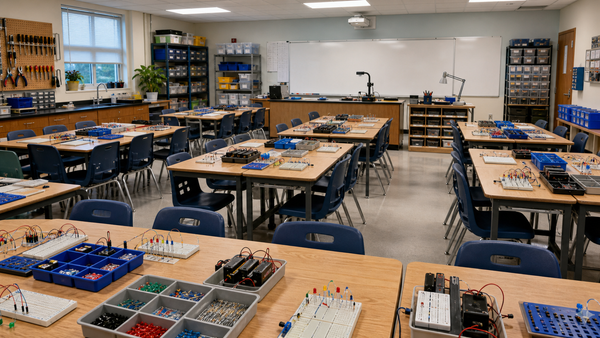
This is why a first electricity lesson should usually involve a real build, not only a diagram. Students need to see that a battery, jumper wires, resistor, and LED can either create a working loop or fail when the path is broken. That concrete experience does more instructional work than a long vocabulary list.
Teach these three ideas as a connected set
| Concept | Student-friendly meaning | Classroom question |
|---|---|---|
| Voltage | The push that can move charge | What is driving the circuit? |
| Current | The rate of charge flow | Is charge actually moving through the loop? |
| Resistance | The opposition to charge flow | What is limiting or shaping the flow? |
These ideas should not be taught as isolated definitions. They work best when students can move between them. That is why the Mr Circuit cluster already built around voltage, current, and resistance is useful as follow-up reading. Students should keep hearing that the battery provides the push, the path allows flow, and the resistor changes that behavior.
What middle school students do not need immediately
They do not need house wiring, mains electricity, or a fully mathematical treatment of circuit laws on day one. They also do not need every component type. If the first unit becomes too broad, students often leave with memorized terms but weak explanations.
What they do need is repeated success with visible cause and effect. A battery-powered LED circuit is enough to introduce source, path, polarity, resistance, and troubleshooting. A second lesson on one-path versus branch circuits adds structure. A third lesson with basic measurement adds evidence.
Use breadboards and diagrams together
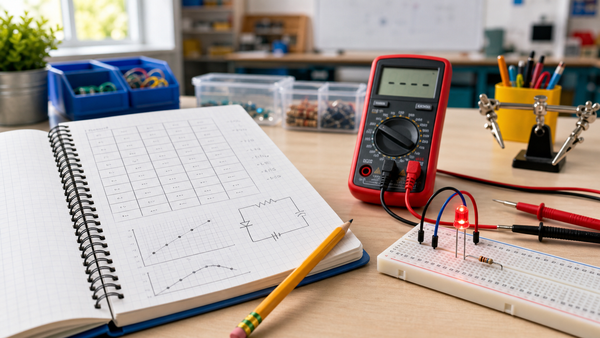
Students should learn that a physical build and a circuit diagram are two ways to describe the same system. TeachEngineering's circuit lessons make this especially clear by linking component symbols to real circuit construction. If students can move from a breadboard to a diagram and back again, their understanding becomes much more durable.
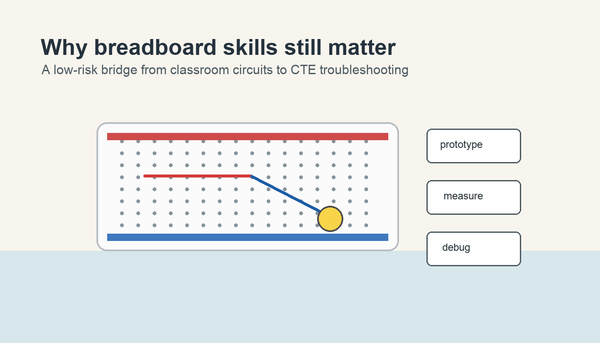
That is why What Is a Solderless Breadboard? fits naturally in this sequence. Many middle school errors are not conceptual at all. They are layout mistakes caused by not understanding how breadboard rows and rails connect.
Make troubleshooting part of the content, not an interruption
One of the biggest teaching mistakes is treating troubleshooting as wasted time. In reality, troubleshooting is where students learn to test explanations. When a circuit does not work, they can ask: Is the source present? Is the path closed? Is the LED reversed? Is the resistor in the correct place?
That is why a middle school electricity unit should include at least one short failure-analysis routine. Students remember circuit concepts better when they have used them to explain a problem. The existing series vs parallel lesson also supports this because structure affects how students predict behavior and diagnose failures.
What a strong first unit can look like
- Build a simple closed circuit with a battery, resistor, and LED.
- Introduce voltage as the push, current as the flow, and resistance as the opposition.
- Compare a working loop to an open circuit.
- Show one-path versus branch circuits.
- Measure source voltage or test a resistor value in a safe, structured routine.
- Have students troubleshoot one intentional fault and explain the cause.
This progression is manageable inside a middle school unit because each lesson adds one new reasoning tool without forcing students to learn everything at once.
Common misconceptions worth addressing early
- Current gets used up by the first component.
- A battery alone is enough, even if the path is open.
- If a wire touches something, it must be connected correctly.
- Voltage, current, and resistance are all the same idea with different names.
- Troubleshooting means the student failed instead of the student investigated.
These are not small misunderstandings. They shape every later circuit explanation. Addressing them early saves time later in robotics, electronics, and physical science units.
Where Mr Circuit fits naturally
The Mr Circuit Lab 1 Basic Electronics STEM Kit is the best soft product example for this topic because it stays inside the right instructional boundary: reusable, low-voltage, no-solder beginner circuits. That is the right environment for middle school students who are learning relationships, not just following directions.
For broader implementation planning, the For Schools and Educators page is the best internal destination because it positions these lessons inside a classroom system rather than as one isolated project.
Frequently Asked Questions
What is the most important electricity idea for middle school students?
That a circuit needs a source and a closed path before anything useful can happen.
Should middle school students learn voltage, current, and resistance?
Yes, but through simple examples and real builds rather than heavy math first.
Do students need to start with complex circuit diagrams?
No. Start with simple builds and then connect those builds to a few clear symbols and diagrams.
Why teach troubleshooting so early?
Because troubleshooting helps students use evidence to explain what a circuit is doing.
Should a middle school unit include house wiring or mains electricity?
Usually not at the start. Battery-powered classroom circuits are a safer and clearer first pathway.