
A short circuit happens when current finds an unintended path with very little resistance, so it bypasses the normal load and too much current can flow. In a student circuit, that often means a wire is placed in the wrong spot or the battery terminals are connected too directly. It is a different problem from an open circuit, where the path is broken and current stops.
Last updated: June 16, 2026.
What a short circuit means in simple language
Students usually learn first that a working circuit needs a complete path. That is true, but it is not the whole story. A circuit can still have a complete path and be wrong. In a short circuit, the current takes a path that is too easy. Instead of moving through the intended load, such as a bulb, resistor, or buzzer, it cuts around that part.
OpenStax's chapter on current and its section on simple circuits and resistance give the physics behind this. Current needs a path, and resistance helps limit how much current flows. If the path has too little resistance, the current can become much larger than the circuit was meant to handle.
Short circuit vs open circuit
| Feature | Short circuit | Open circuit |
|---|---|---|
| Path | Complete, but unintended and too low in resistance | Broken somewhere |
| Current flow | Too much current may flow | Current stops |
| What the load does | May be bypassed and fail to work correctly | Usually stays off because the path is incomplete |
| Common student cause | Misplaced jumper wire or direct battery connection | Loose wire, open switch, or missing connection |
This comparison matters because beginners often hear "the circuit does not work" and assume every problem is an open circuit. Sometimes the opposite is true. The path exists, but it is the wrong path.
A classroom example students can picture
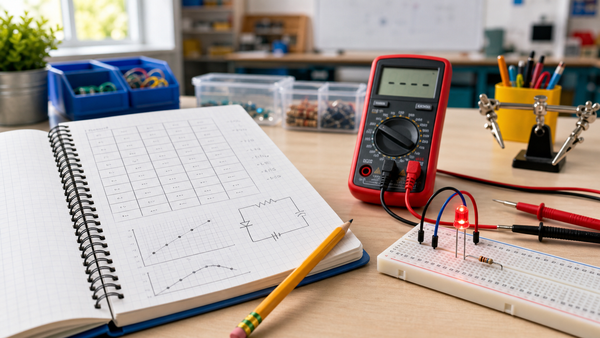
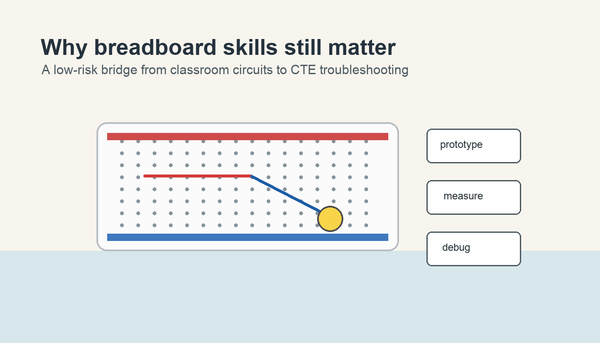
Imagine a battery, a resistor, and an LED on a breadboard. The goal is for current to move through the resistor first and then through the LED. Now imagine a jumper wire accidentally connects the battery terminals more directly, skipping the intended route. The LED may not light as expected because the current no longer has to go through it in the correct way.
That is a useful classroom moment because students can see that "complete path" is not enough by itself. The path must be complete and arranged correctly.
Why short circuits are a safety issue
In low-voltage classroom circuits, the main lesson is not fear. The lesson is respect for energy and good setup habits. If resistance is too low, more current can flow than the parts or battery should handle. That can warm wires, drain batteries quickly, or damage parts.
The FAA's PackSafe battery guidance is a useful reminder that batteries should be handled carefully and not allowed to short. For teachers and homeschool families, that supports a simple rule: do not let students connect battery terminals together directly, and do not experiment with deliberate shorts.
Common causes of a short circuit in beginner builds
- A jumper wire placed across the wrong breadboard rows.
- A bare wire touching two points that should stay separate.
- A battery connected too directly across a path with no useful load.
- A component placed so that it accidentally bypasses the resistor or switch.
- Damaged insulation or bent leads touching each other.
Most of these are not advanced failures. They are ordinary setup mistakes, which is why teachers should introduce the concept early.
How to explain it to students without overcomplicating it
A good explanation is: An open circuit has a gap. A short circuit has a shortcut. That is not the full engineering definition, but it is strong beginner language. After students understand that, you can add the more precise idea that the shortcut has very little resistance and can let too much current flow.
This article pairs well with Mr Circuit's open circuit vs closed circuit guide because students usually need the vocabulary together. They should be able to say whether the path is broken, correct, or unintentionally bypassed.
A quick troubleshooting routine for suspected shorts
- Disconnect power before touching the build.
- Trace the intended path from the battery to the load and back again.
- Look for any wire or component lead that creates a shortcut around the load.
- Check whether the resistor or switch is being bypassed.
- Reconnect power only after the path looks correct.
That sequence works well alongside the student troubleshooting checklist because it teaches students to inspect the path before guessing about the battery or blaming the component.
How this connects to current and resistance
If students already know what current is and what resistance does, this topic becomes much easier. Current is charge flow. Resistance limits that flow. A short circuit matters because it gives current a path with too little opposition.
That is why short circuits belong in the same teaching cluster as current, resistance, open circuits, and basic breadboard layout. The ideas reinforce each other.
Where Mr Circuit fits naturally
This is a useful pre-lab article for teachers using the Mr Circuit Lab 1 Basic Electronics STEM Kit. It can be read before a first LED build, or used afterward when students need better words for why a circuit behaved unexpectedly.
For schools and programs building a safer beginner sequence, the For Schools and Educators page is the next natural internal link.
Common misconceptions
- Thinking a short circuit just means "the circuit is fast."
- Assuming every non-working build is an open circuit.
- Believing a bright spark is needed before something counts as a short.
- Forgetting that a direct battery connection can also be a short.
Correcting these early makes later troubleshooting much easier.
FAQ
What is a short circuit?
A short circuit is an unintended path with very low resistance that lets current bypass the normal route.
How is a short circuit different from an open circuit?
An open circuit has a break, so current stops. A short circuit creates the wrong path, so current may flow too easily.
Can a short circuit happen in a classroom breadboard build?
Yes. A misplaced jumper or direct battery connection can create a short in a low-voltage student circuit.
Why is a short circuit dangerous?
Because too much current can flow, which can heat wires, damage parts, or stress the battery.
Should students test a short on purpose?
No. It is better to explain the idea with diagrams, safe examples, or teacher-controlled demonstrations than to create deliberate shorts.
What should students check first if they suspect a short?
They should disconnect power and trace the intended path to see whether any wire is bypassing the load.