
A photocell, also called a photoresistor or light-dependent resistor, is a part whose resistance changes when light hits it. In beginner circuits, teachers use that changing resistance to make voltage shift, LEDs respond, or night-light style projects react when a room gets brighter or darker.
This topic works well in STEM class because students can test it directly. Cover the sensor, uncover the sensor, watch the output change, and explain why the circuit behaved differently. That makes the lesson more concrete than simply memorizing that a photocell is "a sensor."
Adafruit's current photocell guides remain useful here because they explain two critical ideas in plain language: first, a photocell changes resistance with light; second, individual photocells vary and are not precision light meters. Mr Circuit also currently offers an MC1-03 How a Photocell Works lesson kit and a related night-light build, so the site already has a strong internal path for this concept.
What a photocell does
A photocell is still a resistor, but it is a resistor whose value changes with light. More light lowers its resistance. Less light raises its resistance. That simple pattern is the heart of the lesson.
For students, the easiest explanation is that the part helps a circuit "notice" light changes. The photocell itself does not make a decision. Instead, its resistance changes, and the rest of the circuit responds to that change.
Bright light versus low light
| Condition | What happens |
|---|---|
| Brighter light | The photocell's resistance drops, so the circuit's voltage or current relationship changes. |
| Darker light | The photocell's resistance rises, which changes the circuit in the opposite direction. |
That is why the part is useful in projects such as automatic night-lights, simple alarms, and beginner sensing lessons. Students do not need to memorize exact resistance values first. They need to understand the pattern.
How to teach it in a circuit
The cleanest beginner setup is a voltage divider. Adafruit's lesson still recommends that approach because it turns the resistance change into a changing voltage that a meter or microcontroller can read. In a teacher-led class, that means students can compare observations instead of guessing.
This article also connects naturally to what a sensor is, what resistance means, and the circuit ideas students should know before robotics. A photocell is often the first part that helps students see how a circuit can respond to the outside world.
Simple classroom light test
- Wire the photocell into a safe low-voltage divider circuit.
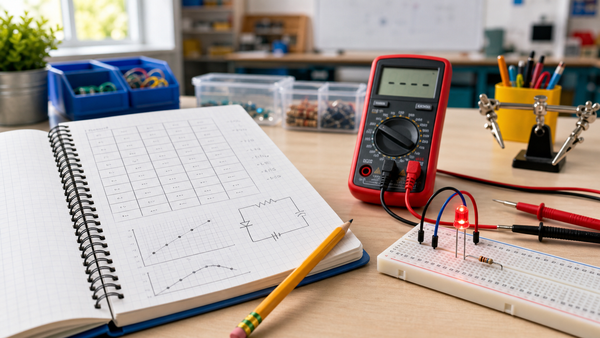
- Measure the output node with a meter.
- Cover the photocell and record the reading.
- Shine more light on it or uncover it and record the new reading.
- Ask students to explain how the light change affected resistance and the output.
A strong classroom routine is prediction first, measurement second, explanation third. That sequence turns the part into a science lesson instead of just a wiring exercise.
Common student mistakes
- Assuming the photocell directly measures "brightness" with perfect precision.
- Thinking the sensor itself powers the output instead of changing circuit conditions.
- Skipping the resistor-divider explanation, which leaves students unsure how the circuit notices the change.
- Expecting every photocell to behave identically even though the parts vary.
That last point matters. Adafruit explicitly notes that photocells can vary a lot from part to part, which is why this is a good qualitative classroom sensor even though it is not the best choice for precision lux measurement.
Where this fits in the Mr Circuit learning path
The best internal article companion is How to Build a Simple Night-Light Circuit, because it shows the photocell doing real work in a student-safe build. The broader planning destination is For Schools and Educators, especially for teachers thinking about classroom implementation. If a product link is useful, the Mr Circuit Lab 1 sequence and the dedicated MC1-03 photocell lesson kit are the most relevant starting points.
FAQ
Is a photocell the same thing as a sensor?
It is one type of sensor. More specifically, it is a light-sensitive resistor.
Does a photocell measure exact brightness?
Not very well. It is good for noticing changes in light, but it is not a precision lux instrument.
Why does a photocell work well in beginner lessons?
Because students can change the input with their hands by covering or uncovering the sensor and then watch the circuit respond.
How does this connect to robotics?
It helps students understand that a robot or control circuit needs an input that changes when the environment changes.
What is the best first project after the definition lesson?
A simple night-light or light-triggered output is usually the strongest next step because the response is easy to observe.
Sources and classroom citations
Last updated: June 20, 2026.