
A diode is an electronic component that lets current move mainly in one direction and blocks it in the other direction. In beginner circuits, that matters because parts like LEDs only work when they are oriented correctly, and some diodes are used to protect circuits from reverse connection.
Last updated: June 17, 2026.
What a diode is in simple language
OpenStax describes a diode as a circuit element that allows electric current to flow in only one direction, like a one-way valve. That is the core beginner definition. A diode is built from a p-n junction, which means two different types of semiconductor material are joined together. When the diode is oriented one way, it can conduct. When it is oriented the other way, it resists current flow.
For most students, the semiconductor physics can stay in the background. What matters first is the behavior: direction matters.
Why teachers should care about diodes early
Many beginner electronics lessons already use diodes without saying the word very often. An LED is a light-emitting diode. OpenStax notes that LEDs are a special kind of diode made from semiconducting materials that emit visible light. So when students learn that an LED only lights in the correct orientation, they are already learning the most important beginner fact about diodes.
That makes this article a natural bridge between simple circuit lessons and later topics such as sensors, 555 timer applications, or reverse polarity protection.
What "one-way current" really means
The phrase "one-way current" is useful, but it can be oversimplified. A diode is not a perfect door that is either fully open or fully locked. Real diodes have electrical characteristics that depend on voltage, current, and the exact device type. Still, for low-voltage classroom builds, the one-way idea is the right place to begin.
OpenStax explains that when the p-n junction forms, a depletion layer appears at the junction. That layer is part of why the diode behaves differently in the forward and reverse directions. You do not need to teach the full band diagram to beginners, but it is worth knowing that the one-way behavior comes from real device physics, not magic.
Diode vs resistor
| Component | Main job | Does direction matter? |
|---|---|---|
| Resistor | Limits current and creates voltage drop | No, not in normal beginner use |
| Diode | Controls direction of current flow | Yes, orientation matters |
This comparison helps students who are used to switches, wires, and resistors. A resistor changes how much current can flow. A diode changes which direction current can flow easily.
A simple classroom example: the LED
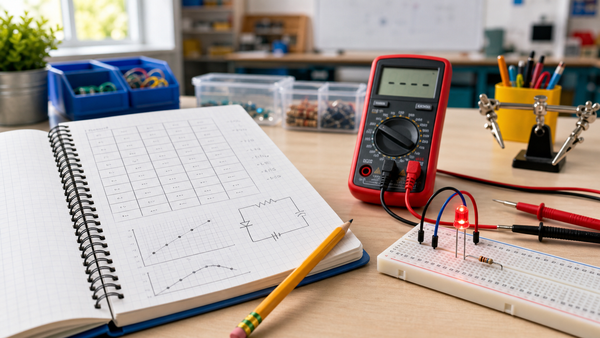
The easiest diode example is an LED and resistor on a breadboard. If the LED is oriented correctly, the circuit lights. If the LED is flipped, it usually stays dark. That does not mean the battery failed or the resistor is wrong. It means the diode behavior of the LED is blocking the current in that direction.
That is why Mr Circuit's articles on why LEDs need resistors and how a resistor works in a simple LED circuit are strong internal companions to this topic. The resistor limits the current. The diode behavior of the LED determines whether current can move through it in the intended direction at all.
Where diodes show up beyond LEDs
Students do not need a full catalog of diode families yet, but it helps to know that diodes are used for more than just little indicator lights. Texas Instruments' diode guidance points to applications such as reverse battery protection and reverse current blocking. In simple language, a diode can help stop current from moving the wrong way through part of a system.
That practical use is a good teaching moment. A diode is not just a tiny part with stripes and symbols. It solves a real problem in a circuit.
How to explain polarity without confusion
Some teachers tell students, "A diode is like a one-way gate." That works as long as you add one important note: every circuit still needs the right overall voltage and the right supporting components. A diode by itself does not guarantee success.
A helpful routine is:
- Disconnect power.
- Check the component orientation mark.
- Trace the intended current path.
- Reconnect power only after the direction looks correct.
That routine prevents students from flipping parts randomly while the circuit is powered.
How this connects to other beginner topics
Diodes make more sense when students already know voltage and current. Voltage provides the push, current is the flow, and the diode helps decide whether that flow can happen in the chosen direction.
This also helps later when students meet timing and control circuits such as 555 timer applications, where direction-sensitive parts appear in more meaningful ways.
Common uses students can understand
- LED indicators that light only in the correct orientation.
- Simple protection against connecting a battery backward.
- Directing current so one part of a circuit does not feed backward into another part.
Those are enough uses for a strong beginner lesson. You do not need to start with rectifier equations or power-supply design.
Common misconceptions
- Thinking a diode is just another kind of resistor.
- Assuming current can flow either way as long as the battery is strong enough.
- Believing an LED is "just a light" instead of a direction-sensitive component.
- Flipping a component while the battery is still connected.
Correcting those ideas early gives students better habits for every later breadboard project.
Where Mr Circuit fits naturally
This is a useful pre-lab article for teachers using low-voltage beginner kits such as the Mr Circuit Lab 1 Basic Electronics STEM Kit. It gives students the vocabulary they need before working with LEDs, polarity, and other direction-sensitive parts.
FAQ
What is a diode?
A diode is an electronic component that allows current to move mainly in one direction and blocks it in the other direction.
Why is an LED called a diode?
Because an LED is a light-emitting diode. It has diode behavior and also produces light when current flows through it in the correct direction.
Does a diode always act like a perfect one-way gate?
No. Real diodes have more detailed electrical behavior, but the one-way idea is the right beginner model.
What happens if a diode is backwards in a simple circuit?
In many beginner circuits, the current is blocked and the part will not work as intended.
Is a resistor the same as a diode?
No. A resistor mainly limits current, while a diode mainly controls direction of current flow.
Should students flip diodes while the circuit is powered?
No. Disconnect the battery first, then check orientation and reconnect after the path is correct.