
Basic circuits can start students toward many STEM career paths because nearly every technical field uses power, signals, sensors, measurement, and troubleshooting. A student who can build a safe LED circuit, read a simple schematic, measure voltage, and explain why a circuit failed is practicing the same habits used in electronics, robotics, automotive technology, aviation, HVAC controls, manufacturing, and engineering labs.
Why basic circuits are a strong career starting point
Basic circuits are not only a science unit. They are a practical gateway into technical work. The U.S. Bureau of Labor Statistics describes electrical and electronic engineering technologists and technicians as workers who help design, develop, test, and repair electrical and electronic equipment. O*NET lists tasks such as assembling, testing, maintaining, and troubleshooting electronic systems. Those job descriptions sound advanced, but the first classroom versions are familiar: make a complete loop, protect an LED with a resistor, follow a diagram, and test one change at a time.
The point is not to tell students that one breadboard lesson makes them career-ready. The point is to show that the skill pattern is real. Technical careers reward careful observation, safe measurement, documentation, and patient debugging. Those habits can begin with a battery, resistor, LED, switch, and multimeter.
Career paths that use circuit thinking
| Career area | How circuits show up | Beginner classroom bridge |
|---|---|---|
| Electronics technician | Builds, tests, calibrates, and repairs electronic equipment | LED circuits, continuity checks, resistor values, schematic reading |
| Robotics | Connects sensors, motors, controllers, and outputs | Input-process-output models and switch-controlled outputs |
| Automotive technology | Uses sensors, batteries, wiring diagrams, and diagnostics | Voltage measurement, polarity, and troubleshooting checklists |
| Aviation and avionics | Uses instruments, wiring, signal paths, and test procedures | Reading diagrams and documenting tests |
| HVAC controls | Uses thermostats, relays, sensors, motors, and low-voltage controls | Sensor-to-output circuits and relay-style switching logic |
| Manufacturing and automation | Uses control panels, sensors, indicators, and maintenance routines | Switches, LEDs, buzzers, and fault-finding practice |
The five transferable skills students should name
Students often see a circuit project as a one-time build. Teachers can make the career connection stronger by naming the transferable skills during the activity.
- Reading a diagram: Students learn that technical drawings are instructions, not decorations.
- Building carefully: A working circuit depends on placement, polarity, and complete paths.
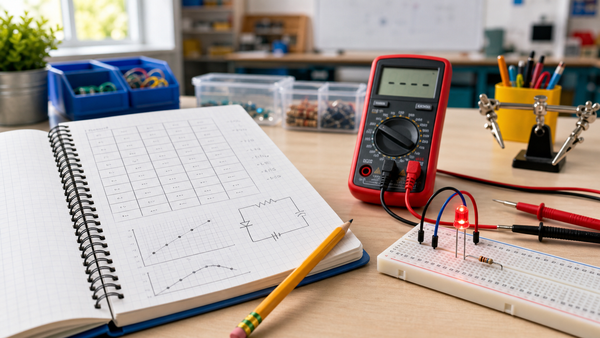
- Measuring before guessing: Voltage, resistance, and continuity checks turn troubleshooting into evidence.
- Explaining cause and effect: Students connect a wiring change to a visible result.
- Documenting results: Notes, sketches, and measurements make technical work repeatable.
A career-path classroom activity
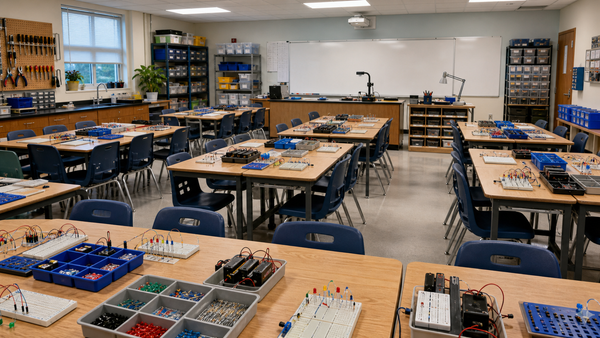
Set up a simple LED circuit with a switch, resistor, and battery pack. After students make it work, ask them to turn the same circuit into three career examples. For robotics, the switch becomes a sensor input and the LED becomes a robot output. For automotive technology, the circuit becomes an indicator lamp controlled by a switch. For HVAC controls, the switch becomes a thermostat call and the LED represents a fan command.
Students do not need advanced hardware to make the connection. They need a clear model: input, electrical path, output, measurement, and troubleshooting. Have each group create a short table with three columns: what changed, what stayed the same, and what career uses this idea. This turns one circuit into a career map.
What top search results often miss
Career pages often list job titles, pay, or education requirements without showing how a beginner class connects to the work. Project pages often show a fun build without explaining the career skill underneath. A useful STEM career lesson should connect both sides: the project should work, and students should be able to say which technical habit they practiced.
How to avoid overpromising
Teachers should be honest. Basic circuits are a starting point, not a complete job training program. BLS notes that electrical and electronic engineering technologists and technicians commonly need an associate degree, and specific pathways may require certifications, apprenticeships, or employer training. Still, early circuit work helps students decide whether they like technical problem solving before they choose a CTE pathway, robotics program, engineering course, or community college program.
Internal links for the next lesson
Useful follow-up lessons include what voltage means, measuring battery voltage, student troubleshooting, input-process-output automation, and the schools and educators page.
Sources
- BLS: Electrical and Electronic Engineering Technologists and Technicians
- O*NET: Electrical and Electronic Engineering Technologists and Technicians
- Science Buddies: Electricity and Electronics Science Projects
- TeachEngineering: Electricity Curriculum Unit
FAQ
What STEM careers start with basic circuits?
Electronics technician, robotics, automotive technology, aviation maintenance, HVAC controls, manufacturing automation, and engineering technology all use circuit thinking.
Do students need advanced math before learning circuits?
No. Beginners can start with complete loops, polarity, switches, LEDs, and observations before using formulas.
How do circuits connect to robotics careers?
Robots use power, sensors, controllers, motors, and outputs. Simple circuits help students understand those building blocks.
Is a breadboard useful for career exploration?
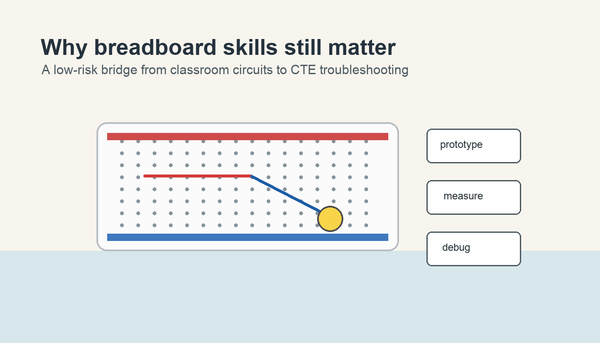
Yes. Breadboards let students prototype, test, and troubleshoot without soldering, which makes technical thinking visible.
What should students write in their STEM notebook?
They should sketch the circuit, record measurements, describe faults, explain fixes, and connect the activity to a technical career habit.
Last updated: 2026-07-12.