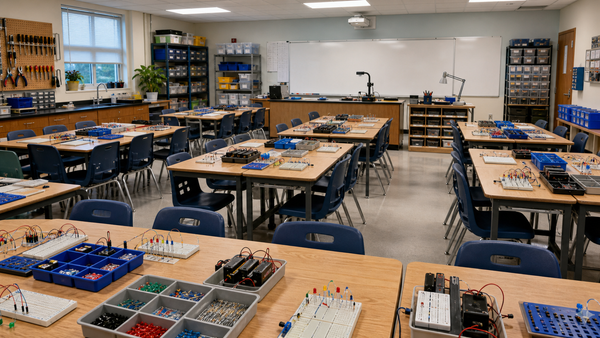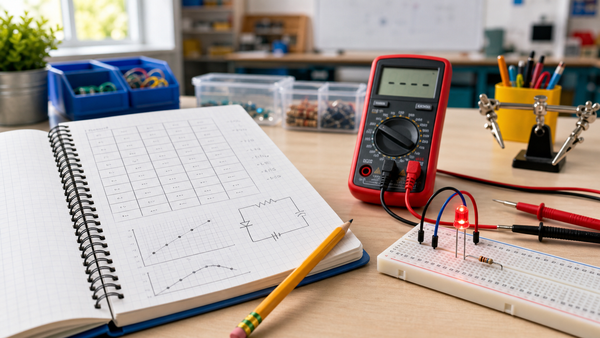

Safe circuit projects for ages 12 and up use low-voltage battery power, breadboards, clear supervision, and simple components such as LEDs, switches, buzzers, and light sensors. The best projects teach one or two circuit ideas at a time instead of mixing risky power choices with too many unfamiliar parts.
Last updated: July 3, 2026.
What "safe" actually means in beginner electronics
Safe does not mean random. It means the project is limited, supervised, and predictable. For older beginners, that usually means low-voltage battery power, solderless breadboards, clear startup and shutdown routines, and projects that can be tested one stage at a time.
It also means saying no to the wrong kinds of projects. Ages 12 and up is a good fit for supervised electronics learning, but it is not a reason to introduce wall power, improvised battery packs, or advanced builds that bury the core concept under too much complexity.
Why battery handling still matters
Many beginner electronics articles talk about safety in a vague way. The better sources are more specific. In a 2024 NSTA article, Lithium-Based Power Supplies: Safety Issues and Protocols Revisited warns that school settings increasingly use lithium-based power supplies and notes that explosions and fires have occurred during storage, use, and disposal when routines are weak.
OSHA's publications index also lists a Lithium-ion Battery Safety Fact Sheet dated 2025. That does not mean low-voltage classroom projects are unsafe by default. It means adults should choose known battery packs, inspect them, and store them correctly instead of treating power as an afterthought.
Why breadboards are the right starting point
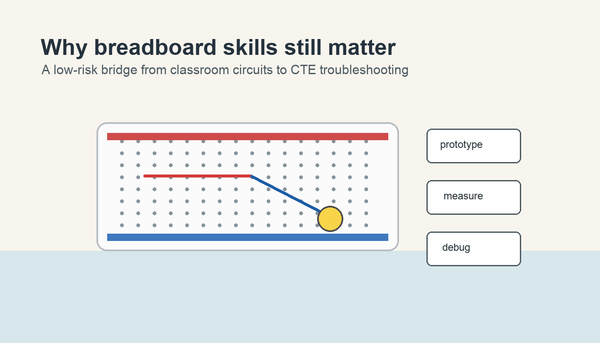
The safest beginner circuit projects are usually built on breadboards because they are easy to revise and easy to inspect. The updated Adafruit Breadboards for Beginners guide, last edited February 26, 2025, describes solderless breadboards as durable, reusable, and inexpensive, which is exactly why they work well for supervised first builds.
If something is wrong, you can pull one wire, re-check the row, and try again. That is a much better learning environment than starting with permanent assembly before a student even knows what an open circuit looks like.
Project types that are usually safe for ages 12 and up
| Project type | What it teaches | Why it is a safe choice |
|---|---|---|
| LED and switch circuit | Open and closed paths, polarity, simple control | Low parts count and easy visual feedback |
| Continuity or buzzer project | Completing a path, testing, troubleshooting | Simple low-voltage output and easy staged testing |
| Light-sensor project | Inputs, outputs, and threshold behavior | Clear cause and effect without high power |
| Doorbell or alarm-style project | Switching, timing, output comparison | Still battery-powered and concept-first when supervised |
Good first projects to choose
If you are selecting a first batch, start with a small group of projects that build confidence in sequence. A simple LED build, continuity tester, doorbell circuit, and night-light circuit give students visible progress without forcing them into risky power or advanced debugging.
The recent TeachEngineering night-light maker challenge is also a useful reminder that sensor projects can still stay beginner-friendly when the power source is controlled and the output is just LEDs responding to light.
A practical safety routine before every build
- Use a known low-voltage battery pack, not household wiring or loose battery improvisation.
- Check the battery pack, leads, and breadboard for visible damage before starting.
- Build one section at a time and test it before adding more parts.
- Keep liquids, metal clutter, and spare loose batteries away from the work area.
- Disconnect the circuit when students are not actively testing it.
- Store batteries and small parts in a predictable place after the lesson.
Why staged testing matters
One of the best safety habits is also one of the best teaching habits: test in stages. The Science Buddies pencil resistor project includes practical reminders to check for open circuits, insert batteries correctly, and disconnect the circuit when it is not being used. That mindset applies to almost every beginner build.
Instead of wiring the full project all at once, test the output first, then the switch, then the sensor or timer stage. Students make fewer random changes, and adults can spot mistakes faster.
Projects that are usually the wrong fit
Ages 12 and up does not automatically mean students are ready for every electronics category. The wrong starting projects often include mains-powered work, large-current battery experiments, builds that require soldering before students understand the circuit, or projects with too many unknown parts at once.
If the lesson objective is beginner circuit reasoning, keep the power modest and the variable count low. A student should be able to explain what each part is supposed to do.
Common mistakes adults make with beginner electronics safety
- Calling a project "safe" without defining the power source and supervision level.
- Using too many new parts in the first lesson, which turns every mistake into a mystery.
- Leaving batteries connected between tests.
- Introducing lithium-powered devices without a storage and inspection routine.
- Skipping basic setup skills such as breadboard layout and polarity.
What to use in class or at home
If you want a structured beginner path, the Mr Circuit Lab 1 Basic Electronics STEM Kit is the most natural fit for older beginners who need guided low-voltage practice. If you are planning for a larger group, the For Schools and Educators page is the better starting point. For a broader classroom routine, the electronics lab safety checklist should sit next to the project plan, not behind it.
FAQ
What are the safest circuit projects for ages 12 and up?
The safest ones are low-voltage, battery-powered breadboard projects such as LED circuits, continuity testers, simple buzzer builds, and light-sensor projects with supervision.
Is a breadboard safer than soldering for beginners?
Usually yes. Breadboards let students inspect and revise connections without heat, permanent joints, or extra tool risk.
Can ages 12 and up use lithium battery devices?
They can use teacher- or adult-managed devices, but the battery handling routine needs to be explicit. Storage, inspection, and charging should not be casual.
Should beginners start with Arduino?
Only if the project stays low-voltage and the circuit idea remains simple. Many students benefit from learning basic LED, switch, and sensor behavior before adding code.
What makes a project unsafe for this age group?
Mains power, unknown power sources, too many new parts at once, weak supervision, and projects that cannot be tested in small stages all make beginner electronics less safe.