
How to Prepare a Substitute-Friendly STEM Lab
A substitute-friendly STEM lab is a hands-on lesson that a guest teacher can supervise without needing deep technical knowledge. Keep the build low-voltage, pre-sort every material, use clear station cards, assign student roles, include a stop rule, and choose an activity students have already seen at least once.
The goal is not to leave your most ambitious lab. The goal is to protect learning time without creating a safety problem, a cleanup problem, or a pile of half-broken materials for tomorrow. A good substitute plan lets students practice, document, sort, troubleshoot, or compare. It should not require the substitute to introduce a brand-new tool or diagnose advanced circuit faults.
What Makes a STEM Lab Substitute-Friendly?
A strong substitute lab has four traits: predictable materials, simple student choices, visible progress, and a clean reset routine. This is especially important in electronics because one misplaced wire can stop the whole circuit. If the substitute cannot tell whether a circuit is wrong, the lesson needs student-facing checks that make progress obvious.
Safety planning should be explicit. The NSTA safety resources are a useful reminder that hands-on science instruction needs clear expectations, appropriate supervision, and known procedures. For a substitute day, that usually means low-voltage battery work only, no soldering, no wall power, and no new chemicals, blades, heating tools, or unknown devices.
Keep This, Avoid That
| Keep | Avoid |
|---|---|
| Low-voltage battery circuits students have practiced | New tools students have never used |
| Pre-counted bins for each station | Loose shared parts with no inventory routine |
| One-page student instructions | Long technical directions only the teacher understands |
| Notebook reflection, diagram, or sorting task | Open-ended builds with unclear stopping points |
| Reset tray photo or checklist | Cleanup based on memory |
Build a One-Page Substitute Packet
Do not hand a substitute a full unit plan. Hand them a one-page operating sheet. Include the class goal, the exact activity name, what students should produce, where materials are located, what not to touch, and the stop rule. Put the most important safety line near the top: "Use only the prepared battery packs and parts in the station bins."
The packet should also include a timing plan. For example: five minutes for attendance and roles, ten minutes for review, twenty minutes for build or test, ten minutes for notebook answers, and five minutes for reset. The substitute does not need to improvise pacing if the day already has a rhythm.
Use Stations Instead of Whole-Room Chaos
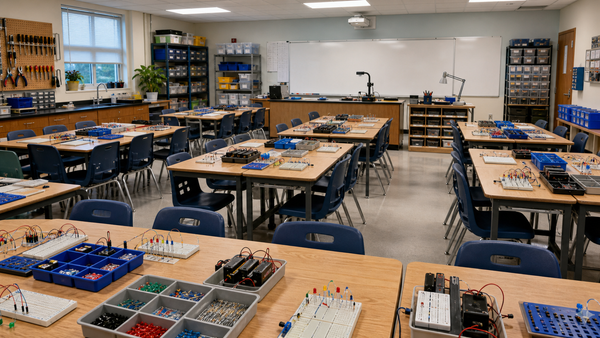
Stations help because each table gets one limited job. One station can build a simple LED circuit. Another can sketch a breadboard layout. Another can sort parts back into bins. Another can answer troubleshooting cards. If your class has already completed a related lesson, a substitute day can become practice and evidence collection rather than a new build.
For electronics classes, use the organization habits from organizing components for a classroom electronics lab. Pre-count LEDs, resistors, battery holders, jumper wires, and switches. Give each bin a reset card with a picture or simple count. A substitute should not have to know the difference between similar-looking components to clean up correctly.
Choose the Right Lab Task
The best substitute STEM task is one step below the class's current challenge level. If students are learning switches, leave an LED-and-switch verification task. If students are learning troubleshooting, leave a controlled fault-finding checklist. If students are not ready to build independently, leave a notebook analysis task using photos or diagrams from a previous lab.
The NGSS engineering design standards support criteria, constraints, testing, and data. A substitute lab can still use those practices. For example, students can compare two circuit layouts, identify which one meets the criteria, and explain the evidence in their notebook.
A Simple Substitute-Friendly Circuit Lab
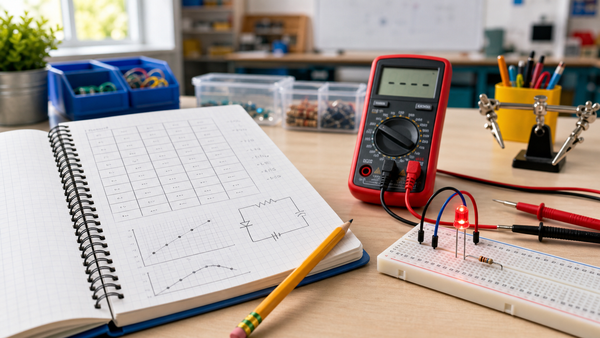
- Students pick up a pre-counted tray: breadboard, battery holder, LED, resistor, switch, and five jumper wires.
- One student is the builder, one is the checker, one is the recorder, and one is the reset lead.
- The team builds a known LED circuit from a diagram they have seen before.
- They test the switch three times and record whether the output matched the prediction.
- If it fails, they use a three-step checklist: battery direction, LED direction, complete path.
- They reset the tray and complete one notebook reflection.
This kind of lesson connects naturally to electronics lab safety, student lab notebooks, and keeping students engaged during circuit labs.
Reset and Accountability Routine
End the lesson with reset, not with the bell. Students should return every tray to its starting count, remove batteries if that is your normal storage rule, and leave notebooks open to the evidence page. The substitute can stamp, initial, or collect one exit response: "What was the input, what was the output, and what evidence showed the circuit worked?"
For large classes, use the shared-kit logic from running a 30-student electronics lab on a small budget: fewer materials, clearer roles, and tighter reset routines are usually better than more freedom on a substitute day.
FAQ
Should a substitute teacher run a brand-new STEM lab?
Usually no. A substitute-friendly STEM lab should practice or extend a routine students already know unless the activity is fully nontechnical and low risk.
What electronics activities work best with a substitute?
Simple LED circuits, switch tests, part sorting, diagram labeling, notebook analysis, and controlled troubleshooting tasks work well because they have visible outcomes.
How much material should I leave out?
Leave only the materials required for that lesson, pre-counted by station. Extra parts invite confusion and make reset harder.
How do I prevent cleanup problems?
Use trays, part counts, reset cards, and a final five-minute cleanup routine. Make one student in each group responsible for reset.
Can a substitute-friendly lab still be rigorous?
Yes. Rigor can come from prediction, evidence, comparison, notebook explanation, and design criteria, not just from a more complicated build.
For longer-term planning, connect substitute routines to your normal grading and evidence system with hands-on circuit project grading.