
Electronics connects to automotive technology because modern vehicles depend on circuits, sensors, switches, batteries, control modules, and diagnostic measurements. Students who understand voltage, current, resistance, polarity, continuity, and troubleshooting are better prepared to understand why a vehicle system works, why it fails, and how a technician uses evidence instead of guessing.
Why automotive students need electronics early
Automotive technology is no longer only mechanical. A beginning student may first notice engines, brakes, tires, and tools, but many vehicle problems are diagnosed through electrical signals. The U.S. Bureau of Labor Statistics notes that automotive technicians often use onboard diagnostic systems and electronic testing equipment such as scan tools and multimeters. O*NET also lists tasks such as testing electrical circuits, rewiring electrical or electronic systems, and troubleshooting system operation problems.
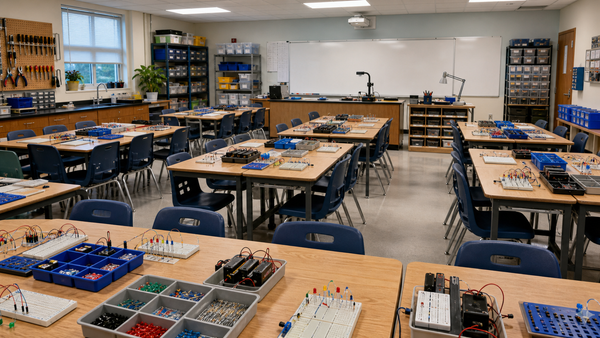
That does not mean middle school or first-year CTE students should start by probing a real vehicle. The better bridge is a low-voltage classroom model where students can see the same thinking in a safe, simple form: power source, input, signal path, control decision, output, and measurement.
Classroom electronics skills that transfer to automotive technology
| Classroom electronics skill | What students practice | Automotive connection |
|---|---|---|
| Measuring battery voltage | Checking a DC source before blaming the circuit | Understanding why voltage supply matters before diagnosing a system |
| Reading continuity | Finding whether a path is complete or open | Tracing wiring, switches, fuses, connectors, and grounds |
| Using LEDs as outputs | Seeing when a circuit responds to an input | Modeling indicator lights, brake lights, dashboard warnings, and status outputs |
| Testing sensors | Watching resistance or voltage change with light, position, or temperature | Understanding how vehicle sensors send information to control systems |
| Troubleshooting one change at a time | Using evidence instead of replacing random parts | Building the diagnostic habits technicians need |
A starter activity: build a sensor-to-indicator model
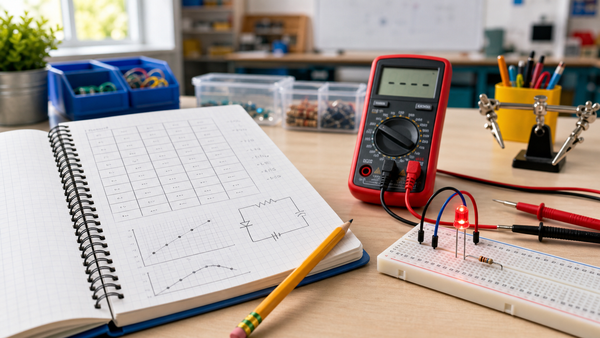
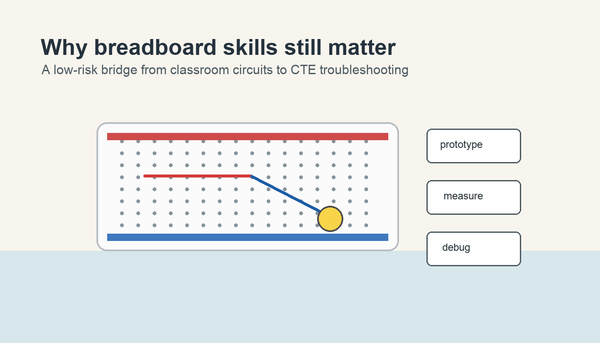
Set up a low-voltage breadboard circuit with a battery pack, current-limiting resistor, LED, switch, and one simple sensor such as a photocell or potentiometer. Tell students the model represents a vehicle input and output, not an actual vehicle circuit. The goal is to show how a change at the input can affect a visible output.
- Students sketch the circuit before building.
- They measure the battery voltage and record it.
- They build the LED output and confirm polarity.
- They add the switch or sensor as the input.
- They change the input and record what the LED does.
- They create one intentional fault, such as an open jumper or reversed LED, and diagnose it with inspection and continuity checks.
This activity gives teachers a direct path from simple circuits to automotive diagnostics without asking students to work on a live car. Students practice the language of technicians: source, load, ground, signal, open circuit, short circuit, continuity, and measurement.
What students should understand before scan tools
A scan tool can report a code, but the technician still needs electrical reasoning. Students should know that a code is a clue, not a complete answer. A sensor reading can be wrong because the sensor failed, the connector is loose, the wire is open, the ground is poor, or the supply voltage is missing. Classroom troubleshooting makes that logic visible.
Before introducing automotive-specific equipment, make sure students can answer four questions about any simple circuit: Where does the energy come from? What is the input? What is the output? What evidence shows where the fault is?
Common student mistakes
- Assuming every electrical problem is a bad part instead of checking power and connections.
- Using a meter without first deciding what measurement would prove.
- Forgetting that polarity matters for LEDs, diodes, and many electronic parts.
- Confusing an open circuit with a short circuit.
- Skipping a sketch or schematic because the circuit looks simple.
How to connect this to a CTE pathway
Frame electronics as a foundation for automotive confidence. Students do not need to memorize every vehicle system at the start. They need to build habits: read the diagram, check the source, follow the path, test the input, observe the output, and document the evidence. Those habits also support robotics, aviation, HVAC, manufacturing, and mechatronics.
Mr Circuit resources that fit this sequence include what a multimeter measures, how to measure battery voltage, student troubleshooting, and simple sensor examples. Schools building a full sequence can also review the Mr Circuit schools and educators page.
Sources
- BLS: Automotive Service Technicians and Mechanics
- O*NET: Automotive Service Technicians and Mechanics
- ASE Education Foundation
- CTE Resource Center: Electronics Systems I
FAQ
Do automotive students need electronics?
Yes. Modern vehicle diagnostics involve batteries, wiring, sensors, control modules, grounds, fuses, and measurements, so electronics fundamentals help students understand the evidence behind repairs.
What electronics topic should automotive students learn first?
Start with low-voltage DC circuits, voltage, continuity, polarity, switches, LEDs, and meter use before moving into vehicle-specific systems.
Can middle school students learn automotive electronics?
They can learn the foundation through safe classroom models. Real vehicle diagnostics should be reserved for supervised CTE programs with proper procedures.
How does a sensor relate to automotive technology?
A sensor changes a physical condition into an electrical signal. Vehicles use sensors to report information such as position, temperature, speed, pressure, or oxygen level.
What is the best classroom activity for this topic?
A low-voltage sensor-to-LED model works well because students can see input, output, power, wiring, and troubleshooting without using a real vehicle.
Last updated: 2026-07-11.