
Circuits connect to physics class by turning abstract ideas like energy transfer, potential difference, current, and resistance into something students can predict, build, measure, and explain. A simple low-voltage circuit gives physics students visible evidence instead of definitions they only memorize.
Last updated: June 10, 2026
That matters because electricity can feel invisible to beginners. Students may hear words such as voltage or current, but until they see a bulb light, a meter change, or a circuit fail because of one missing connection, the topic can stay too abstract. Circuits help physics feel like an investigation instead of a vocabulary quiz.
Why circuits belong in physics class
Physics class is about explaining how the world behaves with evidence. Circuit work fits that goal well because students can ask a question, test a setup, collect measurements, and revise their explanation. The Physics Classroom still organizes its electric-circuits sequence around potential difference, current, resistance, and misconceptions, which is exactly the kind of concept structure a science teacher needs before choosing activities.
Circuits also make it easier to connect model and measurement. Students can predict that an LED will light only when there is a complete path, or that changing resistance will affect current, and then check those ideas with an actual build. That predict-test-explain loop is physics.
| Physics idea | What students can observe | Why it matters |
|---|---|---|
| Potential difference | A battery creates a push across two points | Students stop treating voltage as just a number on a worksheet |
| Current | A complete path is required for charge flow | Students can connect circuit behavior to cause and effect |
| Resistance | Components limit current and change outcomes | Students see why resistors and loads matter |
| Energy transfer | Electrical energy becomes light, heat, or motion | Students can link electricity to the broader energy unit |
Circuits help students see energy transfer
TeachEngineering's current activity sequence explicitly ties electric current to energy moving from place to place, which is a useful reminder for teachers: a circuit lesson is not separate from core science. It is one of the cleanest places to show that energy can be transferred and then observed through light, heat, or motion.
That is why even a very simple build has physics value. A battery, a switch, an LED, and a resistor can support discussions about stored energy, closed loops, component roles, and why observations matter more than guessing. If students need vocabulary support first, What Is Voltage? A Student-Friendly Explanation, What Is Current in a Circuit?, and What Is Resistance? are strong companion reads.
Use prediction before formulas
Many classes stall because formulas arrive before students have any mental picture of what the quantities mean. A better order is to ask students to predict what will happen, then let them build, then connect the result back to the formal term.
- Show a simple circuit and ask whether it will work.
- Ask what changes if the path is open, the resistor changes, or the batteries change.
- Build the circuit and observe the result.
- Measure when appropriate.
- Use the measurements to explain the outcome in physics language.
SparkFun's beginner explanation of voltage, current, and resistance is helpful here because it treats those quantities as the basic building blocks students need before more advanced problem solving. In other words, the measurement comes after meaning starts to form, not before.
Where measurement fits
Measurement is where circuit work becomes especially valuable in physics. Students move from "the light came on" to evidence such as voltage across a battery, current in a loop, or resistance of a component. That is a major shift in thinking.
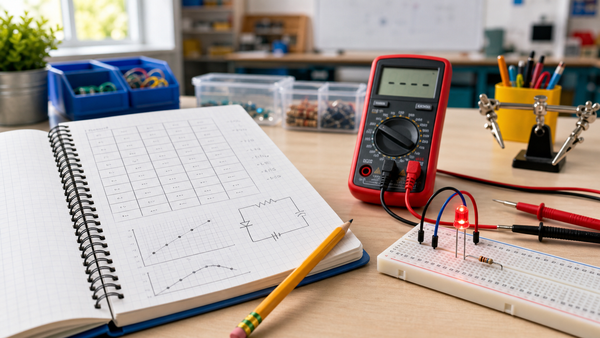
The most natural internal example is the Mr Circuit Lab 2 digital multimeter STEM kit because it turns electrical ideas into measured evidence. Instead of treating the meter as a teacher-only rescue tool, the class can use it to check claims, compare setups, and troubleshoot why one build behaves differently from another.
Simulation and physical build work best together
Teachers do not need to choose between a simulation and a real circuit. The best sequence often uses both. PhET still provides a current circuit-construction simulation for series circuits, parallel circuits, and Ohm's law topics, which is useful for early prediction work or for revisiting a lab after class.
Simulation is strongest when students need to test many ideas quickly. Physical builds are strongest when students need to deal with real components, loose wires, reversed LEDs, and measurement habits. Together, they support both conceptual understanding and real lab behavior.
A one-period physics routine that works
If you want a short classroom structure, keep it simple:
- Start with one direct question: what must be true for the component to work?
- Have students sketch or identify the path.
- Build one version of the circuit.
- Introduce one controlled change such as a new resistor or a series/parallel variation.
- Measure one quantity that supports the explanation.
- End with a written claim backed by observations.
If you want a ready-made comparison lesson, Series vs Parallel Circuits: One Class Period Lesson Plan already follows that teacher-friendly structure.
Common misconceptions to correct early
- Electricity gets used up before it reaches the end of the loop.
- One wire from the battery is enough to power a component.
- Brighter always means more voltage in the component itself.
- A formula matters more than the actual circuit evidence.
- If the build fails, the lesson failed.
The last point matters. Failed circuits are often the most useful part of the lesson because they force students to inspect paths, identify variables, and explain why a prediction broke down. That is science work, not wasted time.
Where Mr Circuit fits naturally
The Mr Circuit Lab 1 Basic Electronics STEM Kit is the best soft product link for this topic because it keeps the learning environment inside the right physics boundary: low-voltage, no-solder, visible beginner circuits. For broader implementation questions such as quotes, school ordering, and classroom fit, the stronger planning destination is the For Schools and Educators page.
Frequently Asked Questions
Are circuits really part of physics or just STEM enrichment?
They are part of physics because they let students investigate energy transfer, electric potential, current, resistance, and measurement with direct evidence.
Should students memorize formulas before building circuits?
No. Students usually learn better when they first observe and measure circuit behavior, then connect those observations to formal equations.
Is simulation enough for a physics electricity unit?
Simulation helps with fast testing and visualization, but real builds teach wiring habits, troubleshooting, and measurement in a way a screen alone cannot.
What should students measure first?
Start with one clear quantity such as battery voltage or current in a simple series loop so the measurement supports the explanation instead of overwhelming it.
What is the best first circuit for physics class?
A simple low-voltage battery, resistor, LED, and switch circuit is usually enough to teach complete paths, component roles, and basic evidence gathering.