
Last updated: June 4, 2026
The best hands-on STEM activities teach students to define a problem, test ideas, measure what happened, and revise their design. Good activities use simple materials, clear constraints, and enough time for troubleshooting, because real problem solving usually starts when a first attempt does not work perfectly.
What makes a STEM activity teach real problem solving?
Not every hands-on classroom activity develops strong STEM thinking. Some are fun demonstrations. Others are crafts with a science label. A real problem-solving activity asks students to make decisions under constraints, test whether those decisions worked, and improve the result with evidence.
That is the pattern visible across NASA design challenges, TeachEngineering lessons, and Science Buddies engineering activities. Students are not just building. They are solving a defined problem, working within limits, and revising based on what they observe.
How to choose the right activity
Before picking a challenge, ask four questions:
- Does the activity have a clear problem to solve?
- Will students have to make tradeoffs or decisions?
- Is there time for at least one test-and-revise cycle?
- Can students explain why their final design worked better?
If the answer is no to any of those, the lesson may still be engaging, but it is less likely to build real problem-solving habits.
10 hands-on STEM activities that build problem-solving skills
| Activity | What it teaches | Simple materials | Time |
|---|---|---|---|
| 1. Paper bridge challenge | Load testing, iteration, evidence-based revision | paper, tape, books or weights | 30-45 min |
| 2. Straw or paper rocket redesign | Variables, testing, improvement cycles | paper, straws, tape | 30-45 min |
| 3. Water filtration prototype | Criteria, constraints, environmental design | bottles, sand, gravel, filters | 45-60 min |
| 4. Locker or desk organizer challenge | User-centered design, planning, reflection | cardboard, paper, tape, scrap materials | 45-60 min |
| 5. Spaghetti tower | Structures, criteria, fast iteration | pasta, tape, marshmallow or small load | 20-30 min |
| 6. Balloon or rubber-band vehicle | Motion, friction, design variables | balloons, straws, wheels, tape | 45-60 min |
| 7. Hydraulic arm build | Team communication, mechanical systems, redesign | syringes, tubing, cardboard or wood | multiple periods |
| 8. Solar oven or heat capture design | Energy transfer, optimization, measurement | box, foil, plastic wrap, thermometer | 45-60 min |
| 9. LED indicator or simple circuit challenge | troubleshooting, safe prototyping, measurable success | battery pack, LED, resistor, breadboard | 30-45 min |
| 10. Rover or payload landing challenge | criteria under constraints, design tradeoffs | paper cups, wheels, tape, lightweight materials | 45-60 min |
1. Paper bridge challenge
This is one of the simplest ways to teach that a design is only as good as its performance. Students must span a gap and hold weight with limited paper and tape. The first build rarely works as expected, which makes revision natural instead of forced.
2. Straw or paper rocket redesign
NASA's engineering activity collections include several launch and rocket tasks because they make variables visible. Students can change fin shape, body length, or launch angle, then compare distance and stability. The value is not the launch by itself. The value is learning that one change at a time produces usable evidence.
3. Water filtration prototype
Water filtration challenges are strong because success criteria are easy to explain and tradeoffs are obvious. Students must work within material limits and decide what arrangement is most effective. TeachEngineering uses this kind of design challenge to show how engineering connects to real human needs.
4. Locker or desk organizer challenge
The TeachEngineering locker organizer activity is a good example of a low-cost, high-thinking task. Students solve a familiar problem, which reduces cognitive overhead and lets them focus on the design cycle itself. This is especially useful for teachers introducing the engineering process for the first time.
5. Spaghetti tower
Fast structure challenges teach students that ideas need testing, not just confidence. NASA JPL's engineering resources include load-bearing examples like spaghetti structures because they force teams to think about stability, compression, and design tradeoffs quickly.
6. Balloon or rubber-band vehicle
Vehicle design challenges are excellent for measurement and iteration. Students can test distance, straightness, and speed while experimenting with wheel spacing, body mass, and friction. These activities work well in mixed-skill classrooms because there are many possible improvements to discuss.
7. Hydraulic arm build
The TeachEngineering hydraulic arm challenge adds teamwork and communication pressure in a good way. Students often discover that problem solving is not only technical. It also depends on sketches, shared language, and careful coordination between sub-teams.
8. Solar oven or heat capture design
Energy activities become stronger when students must optimize a design rather than just observe a phenomenon. A solar oven or heat-capture challenge pushes them to compare materials, angles, and insulation choices using actual temperature data.
9. LED indicator or simple circuit challenge
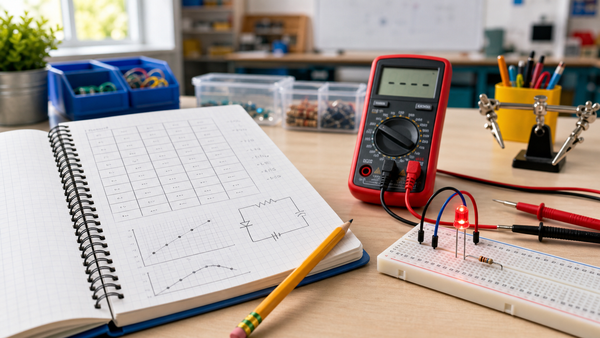
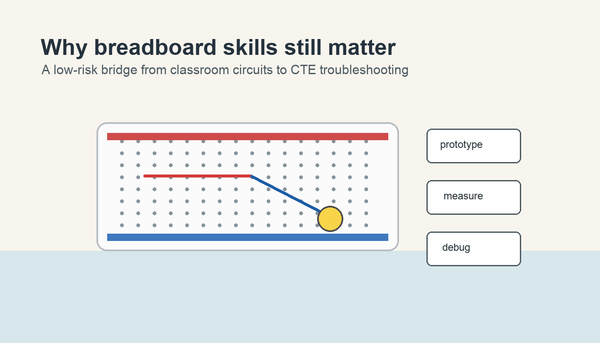
This is the best bridge between broad STEM and beginner electronics. Instead of following fixed wiring directions, students can be asked to design a reliable indicator light or night-light under clear constraints. That makes troubleshooting part of the lesson. If students need background support, internal posts such as Ohm's Law in One Class Period and Reading the Resistor Color Code Without Memorizing are natural follow-ups. If you need a classroom-ready materials example, the Lab 1 Basic Electronics STEM Kit is the most relevant internal product link because it stays aligned with low-voltage, no-soldering work.
10. Rover or payload landing challenge
Payload landing and rover-style builds are strong because they create obvious tradeoffs. A design that travels farther may be less stable. A design that protects a payload may become too heavy. Those tensions are where real problem-solving discussion happens.
How to make these activities stronger in class
- Give students a clear success measure before they start building.
- Limit materials enough that tradeoffs become necessary.
- Require a sketch or plan before the first build.
- Pause for one formal test checkpoint.
- Make revision mandatory, even if version one already "works."
- End with reflection on what changed and why.
What students should learn from the struggle
STEM Teaching Tools notes that in science and engineering, failure is the generative moment when ideas run into physical reality. That is exactly why hands-on STEM should not be over-scaffolded. Students need enough support to stay safe and productive, but enough room to notice that weak designs produce weak results.
Edutopia also points out that hands-on, collaborative problem solving can make students feel more connected to the classroom community. In practice, that means good STEM activities do more than teach content. They help students see themselves as contributors whose ideas matter.
Internal links worth using around this topic
For readers who need a broader definition of what STEM instruction should look like, link to What Is STEM Education?. For school implementation context, the For Schools and Educators page is the best internal destination.
Common mistakes to avoid
- Choosing activities because they look impressive instead of because they create reasoning opportunities.
- Giving students only one build attempt.
- Providing so many instructions that students make no decisions.
- Using too many materials at once for beginners.
- Skipping measurement and reflection.
Frequently Asked Questions
What age group are these STEM activities best for?
Most of these work well for grades 5-8 with adjusted materials, time, and supervision. The key is matching the complexity of the problem to the students' independence level.
Do I need expensive kits to teach problem solving in STEM?
No. Many strong NASA, TeachEngineering, and Science Buddies activities use low-cost classroom materials. Kits can help with consistency, but they are not the reason students learn to solve problems.
How do I grade a hands-on STEM activity fairly?
Grade the process as much as the product: planning, testing, revision, teamwork, and evidence-based explanation. A design that fails but shows strong reasoning can still demonstrate meaningful learning.
What if students get frustrated when their first design fails?
That is normal. Build revision into the lesson from the start, and talk about first attempts as prototypes rather than final answers.
Can these activities work if I am not an engineering teacher?
Yes. Good STEM problem-solving lessons depend more on clear structure than on specialized credentials. If you can define the problem, the constraints, and the testing routine, you can run the activity well.
Sources and citations
- NASA JPL: STEM Activities for Families and Classrooms
- TeachEngineering: NGSS Engineering Design Activities
- Science Buddies: Middle School Projects, Lessons, and Activities
- Science Buddies: Engineering Challenge
- STEM Teaching Tools: Making, Equity, and Excitement in STEM
- Edutopia: How STEM Projects Support Belonging in Middle School