
Voltage is the electrical push, current is the flow of charge, and resistance is the opposition to that flow. In a simple circuit, voltage helps move charge, resistance limits how much charge moves, and current is the result you can observe, predict, and sometimes measure.
Students often mix these three words together because they show up in the same lesson. The cleanest fix is to compare them side by side in one working circuit instead of teaching them as isolated vocabulary. Once students can separate the ideas, Ohm's law starts to make sense instead of feeling like a random formula.
Current vs voltage vs resistance at a glance
Khan Academy describes current as the rate of charge flow and voltage as energy transferred per unit charge. The Physics Classroom connects those ideas to resistance with the current-voltage-resistance relationship. Put together, they give teachers a practical starter model.
| Term | What it means | Unit | Simple classroom example |
|---|---|---|---|
| Voltage | The push that can move charge through a circuit | Volt (V) | A battery provides the push |
| Current | The rate that charge moves through the circuit | Ampere (A) | The amount of charge flowing through the LED path |
| Resistance | The opposition to charge flow | Ohm (Ω) | A resistor limits how much current can move |
NIST identifies the ohm as the SI unit of electrical resistance, which helps anchor the vocabulary to a real standard and not just a classroom chart.
How the three ideas work together
The Physics Classroom's lesson notes summarize the relationship as V = I x R. That means current increases when voltage increases, and current decreases when resistance increases, as long as the other factor stays the same.
Teachers do not need to start with algebra. Start with a simple battery, resistor, and LED circuit instead. Then ask:
- What part is providing the push?
- What part is limiting the flow?
- What result do we see at the LED?
That sequence helps students attach each word to a job.
Use one circuit to explain all three
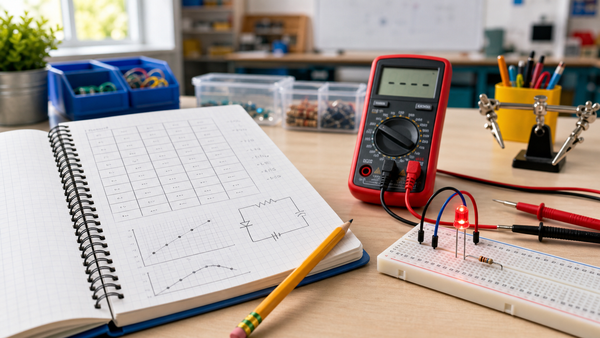
A low-voltage breadboard circuit is the easiest classroom example. A battery provides voltage. The resistor adds resistance. The current that results is what makes the LED light.
If you increase the battery voltage while keeping the resistor the same, the current can increase. If you increase the resistor value while keeping the battery the same, the current drops. SparkFun's beginner Ohm's law experiment uses exactly this kind of LED setup because students can see the effect directly.
| If you change... | What usually happens | What students observe |
|---|---|---|
| Voltage goes up | Current can go up | The LED may get brighter if the circuit is still safe |
| Resistance goes up | Current goes down | The LED may get dimmer |
| Resistance goes down | Current can go up | The LED may get brighter or become unsafe |
What students usually confuse
1. Thinking voltage and current are the same thing
They are related, but they are not identical. Voltage is not the flow. Voltage helps create the conditions for flow.
2. Thinking resistance is always bad
Resistance is not a mistake by itself. In many beginner circuits, resistance is what keeps the circuit controlled and safe.
3. Treating the equation like the lesson
Ohm's law is useful, but the concept has to come first. The internal article Ohm's Law in One Class Period fits best after students already know what the three quantities mean.
Simple analogies that help without oversimplifying
Teachers often use a water analogy: voltage is the push, current is the flow, and resistance is the narrowing that makes flow harder. That can help, but only if you remind students it is a model, not the actual mechanism inside a wire.
A classroom movement analogy can also work. Imagine students trying to move through a hallway. The rule that starts movement is like voltage. The number moving past the doorway each second is like current. A narrow doorway or obstacle acts like resistance.
Use analogies briefly, then return to the real circuit so the class does not confuse the picture with the electronics.
A one-period classroom routine
- Show a working LED circuit with a resistor.
- Ask students to label the source of voltage, the source of resistance, and the visible result of current.
- Swap in a larger resistor and ask what changed.
- Connect the observation back to the three terms.
- Have students summarize the relationship in one sentence.
This keeps the lesson concrete. It also creates a natural bridge to the deeper posts on voltage, current, and resistance.
Where measurement fits
Students learn these terms faster when they can compare prediction to evidence. The Mr Circuit Lab 2 digital multimeter STEM kit is the most natural internal example because it turns definitions into actual voltage, current, and resistance checks.
For classes that are not ready for meter work yet, the Mr Circuit Lab 1 Basic Electronics STEM Kit is the better first step because it keeps the lesson focused on safe, visible circuit behavior.
Why this comparison matters before harder topics
If students cannot separate current, voltage, and resistance, they will struggle with troubleshooting, resistor choice, brightness changes, and later robotics work. A clean comparison article gives them a mental map they can reuse across many lessons.
For broader classroom planning, the For Schools and Educators page is the best internal destination. It gives teachers a path from one basic circuit lesson to a larger STEM or CTE sequence.
Frequently Asked Questions
What is the difference between voltage and current?
Voltage is the push that can move charge, while current is the rate that charge actually moves through the circuit.
What does resistance do in a circuit?
Resistance opposes charge flow and helps control how much current moves for a given voltage.
Can a circuit have voltage but no current?
Yes. A battery can still provide voltage even if the circuit is open and no current is flowing.
Does more voltage always mean more current?
Not by itself. The amount of resistance in the circuit still matters.
What unit measures resistance?
Resistance is measured in ohms, written as the symbol Ω.