
STEM vs STEAM is not a fight between rigor and creativity. In a good STEM lesson, students use science, technology, engineering, and math to solve a problem. In a good STEAM lesson, they still solve a problem, but they also use art and design choices such as visual communication, modeling, storytelling, aesthetics, or user experience to improve the work.
For most teachers, the practical question is simple: what changes in the classroom? The answer is not that STEAM means adding a coloring page to a science unit. The real difference is that STEAM asks students to communicate, design, and revise with greater attention to human use, visual clarity, and creative expression while still meeting the same learning goal.
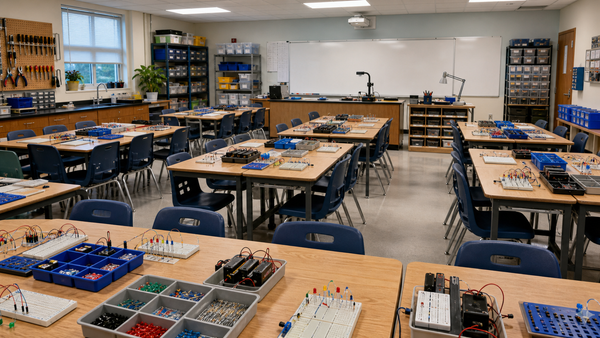
If you teach electronics, robotics, engineering, or hands-on science, this matters because many classroom builds already live in the overlap. Students do not just make a circuit work. They also decide how to organize it, explain it, test it, and improve it for another person to use or understand.
What STEM and STEAM both should include
The Next Generation Science Standards frame strong science instruction as three-dimensional learning. Students build understanding through core ideas, crosscutting concepts, and science and engineering practices. That means the strongest STEM lessons already move beyond memorizing facts. Students define problems, test ideas, analyze results, and communicate what they learned.
TeachEngineering takes a similar position. Its curriculum emphasizes real-world challenges, prototypes, iteration, and standards-aligned engineering work. That is important because it keeps the conversation grounded. Good STEM is already active, applied, and student-centered. STEAM does not replace that. It extends it.
What changes when a lesson becomes STEAM
The biggest shift is that students are asked to think not only about whether something works, but also about how it is experienced, explained, or expressed.
| Classroom move | Typical STEM version | STEAM version |
|---|---|---|
| Problem framing | Build a working solution | Build a working solution that also communicates or serves a user clearly |
| Student output | Prototype, lab notes, measurements | Prototype, lab notes, measurements, and a visual or presentation choice that explains the design |
| Revision | Improve function | Improve function and usability, appearance, or audience understanding |
| Assessment | Accuracy, evidence, troubleshooting | Accuracy, evidence, troubleshooting, and communication of design choices |
That means a STEM bridge challenge might ask, “Can it hold the load?” A STEAM version might ask, “Can it hold the load, fit a design brief, and clearly explain why your structure looks and works the way it does?”
What STEAM is not
Teachers often avoid STEAM because they assume it means lowering technical expectations. That is usually the wrong conclusion.
STEAM is not:
- Adding decoration after the real work is finished.
- Replacing evidence with opinion.
- Turning every lesson into an art project.
- Dropping math, measurement, or troubleshooting.
The strongest STEAM lessons still require content knowledge. Students still need to test, revise, and justify decisions. The difference is that they also consider communication, creativity, and audience.
A simple electronics example: STEM and STEAM side by side
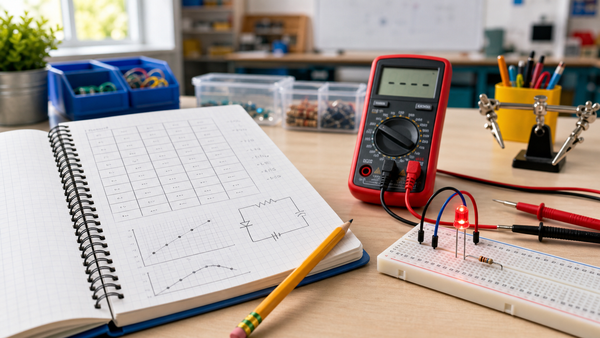
Imagine students are building a simple LED night-light circuit.
In a STEM version, students might:
- build the circuit on a breadboard
- identify the resistor’s role
- test what happens in brighter or darker conditions
- record what changes and why
In a STEAM version, students still do all of that, but they might also:
- design the housing so the light is useful in a real room
- sketch or model where the sensor should sit
- choose how to communicate the circuit flow visually
- explain how the build balances function, appearance, and user need
Neither version is automatically better. The right choice depends on your objective. If your main goal is current, resistance, and sensor behavior, STEM may be enough. If your goal includes design communication or product thinking, STEAM may be the stronger frame.
How to decide which approach fits your lesson
Use STEM when the main goal is helping students understand a scientific or engineering idea clearly and efficiently. Use STEAM when the lesson benefits from communication, user-centered design, or creative interpretation that is still tied to evidence.
A quick teacher checklist:
- Choose STEM if students mainly need to explain, test, measure, and troubleshoot.
- Choose STEAM if students also need to present, visualize, model, design for an audience, or improve user experience.
- Use the same rubric core for both: evidence, iteration, and reasoning.
- Add a separate design-communication criterion only when it serves the lesson objective.
Why this distinction helps teachers
A 2025 physics education paper on engineering-design problem solving found that students benefit from structured support in framing problems, iterating, and reflecting on design limits. That is a useful reminder for classroom teachers: whether you call the lesson STEM or STEAM, students need a clear structure for revision. They do not automatically know how to move from “I made something” to “I improved something for a reason.”
That is where the arts or design lens can help. It gives students another reason to revise and another way to explain their thinking. In practice, this often helps mixed-skill classrooms because some students first enter through building, while others first enter through visual design, storytelling, or presentation.
If you want more classroom-ready examples, start with what STEM education looks like in practice, then compare it with hands-on problem-solving activities and the engineering design process for middle school.
Common mistakes when schools talk about STEM vs STEAM
1. Treating STEAM as branding only
If the instruction does not change, the new label does not matter. Students still need a real problem, evidence, and revision.
2. Assuming STEM has no creativity
Strong STEM teaching already includes creative problem solving. STEAM just makes some design and communication choices more visible.
3. Assessing the poster instead of the thinking
Presentation quality should never replace science or engineering reasoning. If a visual product is part of the task, it should support the learning objective, not distract from it.
Frequently Asked Questions
Is STEAM better than STEM?
Not automatically. STEAM is better when the arts or design element directly improves the learning goal. If it does not, STEM may be the clearer choice.
What does the A in STEAM usually mean?
It usually refers to arts, design, visual communication, creativity, or human-centered presentation rather than fine arts alone.
Can an electronics lesson be STEAM?
Yes. If students design how a circuit is presented, housed, explained, or used by another person, the lesson can naturally move into STEAM.
Do I need special materials for STEAM?
No. Many STEAM moves come from how students explain and refine their work, not from buying extra equipment.
How should I assess a STEAM lesson?
Keep the main score on evidence, function, and reasoning. Add design communication only if it is part of the objective.
Sources
- Next Generation Science Standards DCI arrangements
- TeachEngineering engineering design process
- A Framework for K-12 Science Education
- Possibilities and challenges of STEAM pedagogies
Last updated: June 11, 2026