
The best electronics gifts for curious kids are safe, visible, reusable, and open-ended. A good gift lets a child build something that responds: an LED lights, a buzzer sounds, a motor spins, a meter changes, or a switch controls an output. The point is not to buy the most complicated kit. The point is to give the child a first win and a path to keep experimenting.
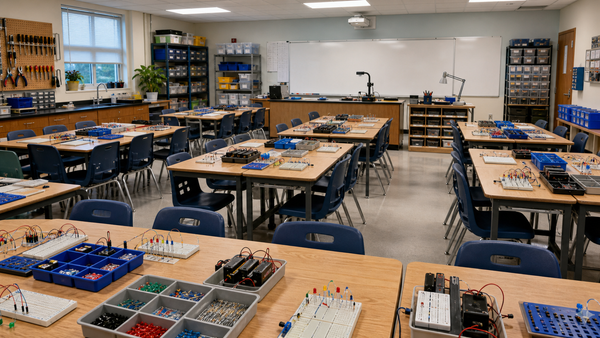
For homeschool families, the strongest electronics gift often looks less flashy than a toy aisle gadget. Breadboards, LEDs, resistors, jumper wires, battery packs, switches, buzzers, motors, safety glasses, and project cards can teach more than a sealed device that only does one trick.
Choose by Learning Behavior, Not by Hype
Before buying, ask what kind of builder the child is. Some kids like following steps exactly. Some like taking things apart. Some like decorating projects. Some want to know why a circuit failed. A gift works best when it matches that behavior.
| Child's interest | Good gift direction | Why it works |
|---|---|---|
| Likes visible results | LED, buzzer, motor, and switch kit | Outputs are easy to see and test |
| Likes puzzles | Breadboard project set with troubleshooting cards | Small wiring changes create clear cause and effect |
| Likes art and design | Paper circuits or light-up cards | Electronics supports a creative project |
| Likes science fair work | Measurement-friendly circuit parts | Projects can produce data, graphs, and comparisons |
| Not ready for hardware | Circuit simulation plus simple notebook prompts | Students can explore safely before using parts |
Use a Safety-First Buying Checklist
CPSC toy guidance tells families to follow age guidance and safety information on packaging, choose toys that match a child's abilities, keep small parts away from children younger than 3, and pay attention to choking-hazard labeling. That matters for electronics gifts because small parts are normal: LEDs, resistors, screws, magnets, and battery covers all need adult judgment.
Use this checklist before buying:
- Does the gift clearly state an age range?
- Does it use low-voltage battery power instead of wall power?
- Are the instructions readable for the child or parent?
- Are small parts stored in a closable organizer?
- Are batteries secured in a proper holder?
- Can the child build more than one project with the same parts?
- Does the kit teach what changed when the circuit works or fails?
Be especially careful with button or coin batteries. CPSC maintains button and coin battery safety resources because ingestion can cause serious injury. For beginner homeschool electronics, AA or AAA battery packs with secure holders are usually easier to supervise and teach.
Gift Categories That Teach Real Electronics
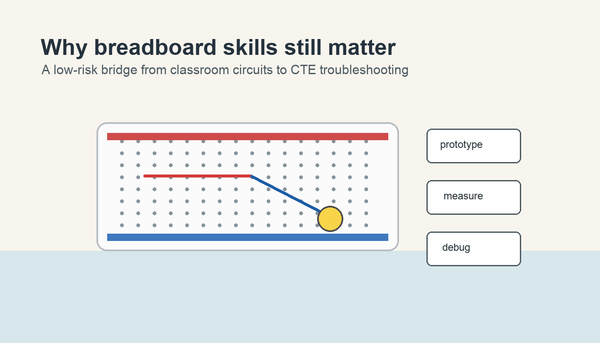
Reusable breadboard starter set: This is the most flexible option for a child who likes building. Look for a breadboard, jumper wires, LEDs, resistors, push buttons, switches, buzzers, and a battery holder. Add a small organizer so cleanup becomes part of the routine.
Paper circuit materials: Copper tape, coin-cell alternatives where appropriate, LEDs, and cardstock can create light-up cards or models. For younger siblings in the home, avoid loose coin cells and choose supervised options.
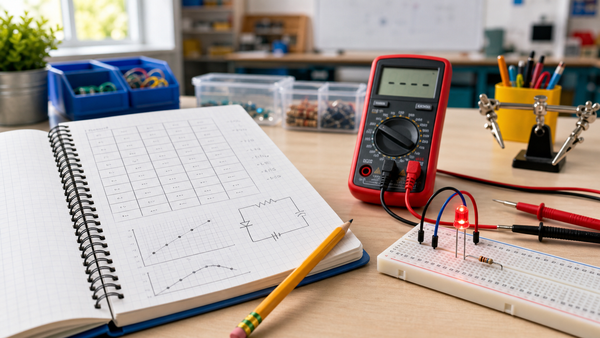
Measurement add-on: A beginner digital multimeter can turn "it works" into "what changed?" Students can measure battery voltage, check continuity, and compare resistor values when they are ready.
Project cards or notebook prompts: A gift becomes more educational when it includes prompts such as predict, build, test, draw, measure, and explain. The prompts matter as much as the parts.
Simulation-first gift: PhET's Circuit Construction Kit: DC lets families explore batteries, switches, bulbs, series circuits, parallel circuits, and Ohm's law without buying anything first. Pair it with a notebook and one small hardware build later.
What to Avoid
Avoid gifts that make electronics look like magic. If the circuit is sealed, the child may enjoy it, but they may not learn much about current, polarity, switches, or troubleshooting. Also avoid kits that require mains power, include tools beyond the child's supervision level, use loose button batteries, or depend on a phone app before the child understands the circuit.
Science Buddies' electricity and electronics project collection is a useful reality check because projects vary by grade level, cost, time, and material availability. A good gift should fit the child's current patience and the parent's available supervision time.
Internal Links for Gift Buyers
For a project sequence, start with Best Electronics Projects for Homeschool Beginners and Safe Circuit Projects for Homeschool Students. Parents who want a low-pressure start can use How to Start Teaching Electronics at Home Without Special Equipment. For parts knowledge, link to What Is a Solderless Breadboard? and How to Build a Continuity Tester.
FAQ
What is the best first electronics gift?
A reusable low-voltage breadboard set with LEDs, resistors, switches, jumper wires, and a battery pack is usually the best first gift because it supports many projects.
Should an electronics gift include soldering?
Not for most beginners. Start with solderless breadboards or paper circuits. Add soldering later with proper instruction, ventilation, eye protection, and close supervision.
Are electronics kits good for homeschool?
Yes, when the kit includes reusable parts and encourages prediction, testing, measurement, and explanation instead of one-time assembly.
What should I check before buying for a younger child?
Check age guidance, small parts, battery type, storage, tool requirements, and whether an adult must supervise every step.
Can a simulation be a gift?
A free simulation can be part of the gift if paired with a notebook, project challenge, or later physical parts. It is especially useful when families want to preview circuits safely.