
How to Teach Electronics Without a Textbook
You can teach beginner electronics without a textbook by using short hands-on builds, simple drawings, predictions, measurements, and notebook reflections. A textbook can help later, but the first goal is for students to see a complete circuit work, change one variable, and explain what happened in plain language.
This approach is especially useful for homeschool families because it removes the pressure to teach electronics like a college course. You do not need to start with equations. Start with a battery pack, an LED, a resistor, a switch, a breadboard, and a question: What has to be connected for the light to turn on?
Use a Four-Part Lesson Loop
Every no-textbook electronics lesson can follow the same loop:
- Observe: Show a working circuit or a real object with an electrical output.
- Predict: Ask what will happen if one wire, switch, resistor, or battery changes.
- Build: Let the learner assemble or modify the circuit safely.
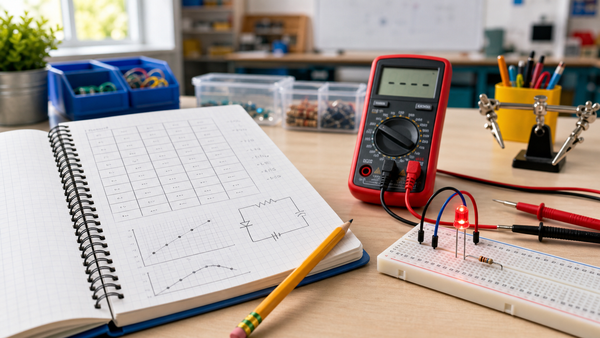
- Explain: Have the learner sketch the circuit and write one sentence about what changed.
This loop gives students structure without turning the lesson into a reading assignment. It also reveals misunderstandings quickly. If a learner can build an LED circuit but cannot explain the path from battery to resistor to LED and back, the next lesson should slow down and focus on the complete loop.
Start With Six Small Lessons
| Lesson | Build | Concept | Notebook Prompt |
|---|---|---|---|
| 1 | Battery, resistor, LED | Complete circuit | Draw the current path |
| 2 | Add a switch | Open and closed circuit | What changed when the switch opened? |
| 3 | Reverse the LED | Polarity | Why did direction matter? |
| 4 | Try two resistor values | Current limiting | What happened to brightness? |
| 5 | Build two LEDs in series | One path | What happens if one LED is removed? |
| 6 | Build two LED branches | Multiple paths | How is this different from series? |
Science Buddies' electricity and electronics projects show how many beginner investigations can grow from simple parts. TeachEngineering's electricity unit supports the same progression: current electricity, conductors, batteries, switches, series circuits, and parallel circuits.
Use Simulations When Parts Are Limited
A simulation is not a replacement for touching components, but it is useful when a learner needs to test ideas quickly. The University of Colorado's PhET Circuit Construction Kit: DC lets students explore series circuits, parallel circuits, and Ohm's law in a visual environment. A good routine is to predict on paper, test in the simulation, then build one version physically.
This sequence also helps students who are nervous about getting the circuit wrong. They can test a wire placement digitally before trying the breadboard. The key is to keep the simulation tied to a real build, not isolated as screen time.
Teach Vocabulary Only When Students Need It
Textbook-first lessons often introduce too many terms at once. In a build-first lesson, vocabulary arrives when it solves a problem. When the LED only works one way, teach polarity. When the switch disconnects the path, teach open and closed circuit. When brightness changes with resistor value, teach resistance. When two branches behave differently, teach series and parallel.
Mr Circuit readers can reinforce those ideas with how to start teaching electronics at home without special equipment, what a solderless breadboard is, why LEDs need resistors, and beginner homeschool electronics projects.
Assess Understanding Without a Test
Ask students to do three things at the end of each lesson: redraw the circuit from memory, explain one mistake they fixed, and predict one change. This checks understanding better than asking them to recite definitions. The NGSS middle school engineering design standards emphasize testing, evidence, models, and iteration; a simple notebook can capture all four.
A strong notebook entry does not need to be long. It can include a sketch, a prediction, one measurement, and a conclusion. Over time, students learn that electronics is not magic. It is a system they can observe, test, and improve.
Common Mistakes to Avoid
Do not start with soldering. Do not start with wall power. Do not start with a long parts list. Do not turn every lesson into a vocabulary quiz. The first few sessions should build confidence with safe low-voltage circuits and visible outputs such as LEDs, buzzers, and small motors.
FAQ
Do I need an electronics textbook to teach beginners?
No. A textbook can become a reference later, but beginners often learn faster from short builds, sketches, predictions, and explanations.
What should the first no-textbook electronics lesson be?
Build one LED circuit with a battery pack, resistor, and breadboard. Then open the circuit, close it again, and draw the complete path.
How much math is needed at the beginning?
Very little. Start with observation and comparison. Bring in Ohm's law after students understand voltage, current, resistance, and measurement tools.
Are circuit simulations useful for homeschool electronics?
Yes, especially for prediction and troubleshooting. Use simulations alongside physical builds so students connect the model to real parts.
How do I know if my child understands the circuit?
Ask them to redraw it, explain the job of each part, and predict what happens if one connection changes. Clear prediction is a good sign of understanding.