
A weekly STEM routine at home works best when it is short, predictable, and easy to restart. Families do not need a perfect curriculum to make progress. They need a repeatable pattern: one small build, one question worth testing, one short reflection, and enough materials on hand that curiosity can turn into action without a long setup fight.
Last updated: June 13, 2026.
Why routine matters more than intensity
Many families try STEM at home as a big one-time project and then stop for weeks. That is understandable, but it usually creates pressure instead of momentum. A better goal is to make STEM feel normal. The NASA at Home for Kids and Families hub and NASA JPL STEM Activities for Families both point toward a wide range of activities that can fit informal home learning instead of a strict school-style block.
The U.S. Department of Education's YOU Belong in STEM initiative makes a related point: students need access to quality STEM environments and problem-solving opportunities, not just occasional exposure. That idea is especially useful for parents and homeschool families who want a system they can sustain.
A realistic weekly pattern
| Day | Time target | What to do |
|---|---|---|
| Day 1 | 15-20 minutes | Ask one question, gather materials, and predict what might happen. |
| Day 2 | 20-30 minutes | Build or test something simple. |
| Day 3 | 10-15 minutes | Troubleshoot, change one variable, or improve the design. |
| Day 4 | 10 minutes | Reflect: What worked? What was confusing? What should we try next? |
That schedule is enough. It gives children a rhythm without turning STEM into a second full school day. Families can run the routine on any four days they choose, or compress it into two longer sessions if needed.
What the routine should include every week
- One question students can actually investigate
- One hands-on action such as building, measuring, sorting, or comparing
- One moment where a child has to explain evidence
- One adjustment or retry instead of stopping at the first result
This structure matches what recent family-engagement research keeps surfacing: hands-on home STEM works best when adults support observation, prediction, experimentation, and discussion instead of trying to lecture the whole topic. A 2023 family STEM engagement paper in ERIC also noted that home experiences can strengthen confidence, participation, and interest when families are given practical activities instead of abstract expectations.
Good weekly themes for home STEM
Families do not need a different supply set every week. Use themes that return to the same core ideas:
- Circuits: batteries, LEDs, polarity, switches, and troubleshooting
- Structures: towers, bridges, load testing, and redesign
- Measurement: compare lengths, time, voltage, or temperature
- Nature and observation: weather, shadows, plant growth, or simple sensors
- Engineering design: build, test, improve, and explain
That variety keeps STEM broad enough for younger siblings while still giving older students real thinking work.
How to keep the routine from falling apart
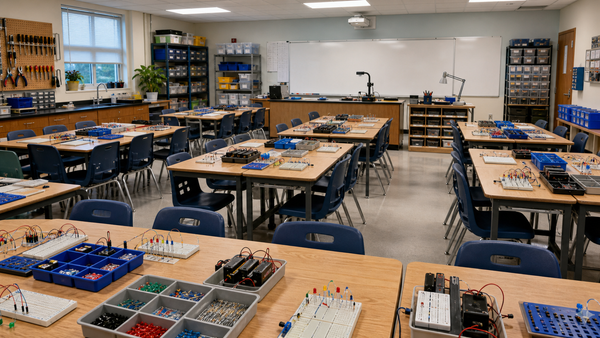
- Store materials in one visible place so setup never becomes the hardest part.
- Keep one “easy win” activity ready for low-energy days.
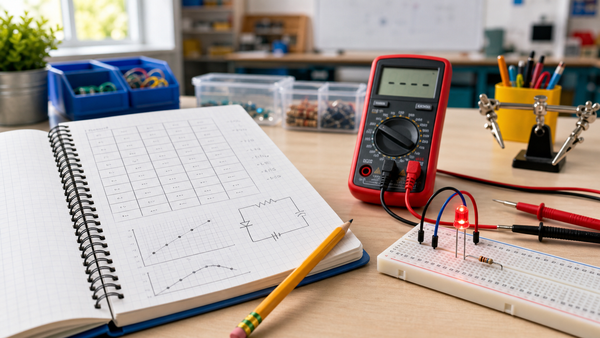
- Use a notebook, not for grades, but for predictions, results, and next ideas.
- Let children repeat favorite builds instead of forcing novelty every week.
- End every session with a next step, even if it is just one sentence.
The biggest mistake families make is assuming every session needs to be impressive. It does not. A short repeatable routine builds more confidence than a giant Saturday project that never happens again.
Age adjustments that help
For younger learners, focus on noticing, naming, and trying again. For middle grades, add simple measurements and short explanations. For older students, introduce troubleshooting logic, component choices, or design constraints. The routine stays the same even when the complexity changes.
If a family has mixed ages, use the same theme but assign different jobs. One child can build. Another can record results. Another can explain what changed. That keeps the activity shared without making every child do the same task at the same level.
Where Mr Circuit fits naturally
This is where a structured kit can help. Mr Circuit's Kit of the Month Club gives families a recurring project rhythm. Lab 1 helps older beginners build repeatable circuit habits, and the Coloring Book Lab gives younger learners a gentler way into part recognition and vocabulary.
Internal articles can keep the routine going between kit sessions. Families can pair this weekly plan with hands-on activity ideas, beginner teaching guidance, and confidence-building strategies.
Common mistakes
- Making sessions too long to repeat.
- Changing materials every week until setup becomes expensive and exhausting.
- Turning reflection into a quiz instead of a conversation.
- Assuming STEM at home only counts if it looks advanced.
FAQ
How many days per week should home STEM happen?
Two to four short touchpoints is enough if the routine is consistent.
What if a parent is not a STEM expert?
That is fine. The adult's main job is to help the child notice, ask, test, and reflect, not to know every answer in advance.
Do families need expensive equipment?
No. A stable routine matters more than premium tools. Start with simple materials and add kits only when they genuinely reduce friction and improve the experience.
What should families record?
Predictions, what happened, what changed, and what to try next. That is enough to create a strong STEM notebook habit.
Can one routine work for mixed ages?
Yes. Keep the theme shared and vary the roles or depth of explanation for each child.
What is the best Mr Circuit product for a weekly home routine?
For recurring family momentum, the Kit of the Month Club is the most natural fit. For a more structured beginner electronics path, Lab 1 is the stronger anchor.