
Electronics connects to HVAC training because climate-control systems use sensors, thermostats, relays, motors, wiring diagrams, low-voltage controls, and troubleshooting routines. Students who understand input-process-output thinking, voltage, continuity, switches, and safe measurement are better prepared for HVAC controls and building automation concepts.
Why HVAC students need electronics fundamentals
HVAC is often introduced through heating, cooling, airflow, and refrigeration, but the control side is electronic. BLS describes HVAC technicians as workers who install and work on complicated climate-control systems and may assemble, repair, and program components. O*NET includes laying out and connecting electrical wiring between controls and equipment according to wiring diagrams. DOE workforce discussions also point to basic controls concepts as an important training need for technician trainees.
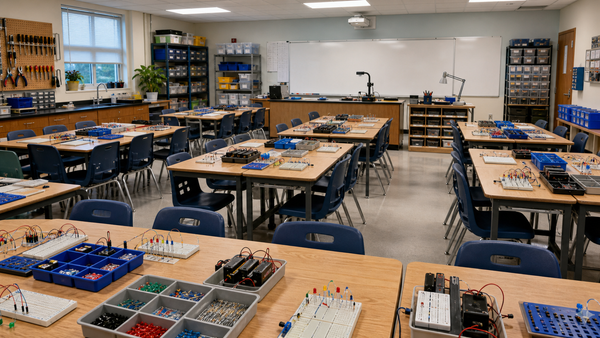
For a STEM or first-year CTE class, the safest bridge is a low-voltage controls model. Students should not work on mains-powered HVAC equipment in a general classroom. They can still learn the logic: a sensor or switch detects a condition, a control decision happens, and an output such as a fan, relay, buzzer, or LED turns on.
Classroom electronics skills that transfer to HVAC
| Classroom electronics skill | What students practice | HVAC connection |
|---|---|---|
| Input-process-output thinking | Connecting a sensor or switch to an output | Understanding thermostat and control-board behavior |
| Voltage and continuity checks | Using a meter to confirm a path or source | Following wiring diagrams and checking control circuits |
| Relay or transistor switching | Letting a small signal control a larger output | Modeling how controls command fans, compressors, or valves |
| Temperature or light sensors | Watching a physical condition change an electrical signal | Preparing for thermostat, temperature, humidity, and occupancy sensors |
| Troubleshooting one variable | Changing one part of the system at a time | Diagnosing controls without guessing |
A starter activity: thermostat logic with a fan output
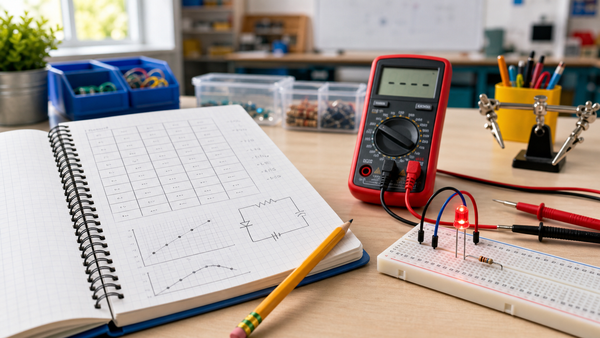
Build a low-voltage model with a battery pack, switch or temperature sensor, resistor, LED, and small DC fan or fan indicator LED. Present it as a simplified thermostat-control system: input, control, output. The activity should focus on logic and measurement rather than real HVAC service.
- Students identify the input, control path, and output.
- They measure the supply voltage before connecting the output.
- They build the LED or small fan output circuit.
- They add a switch or sensor to represent a thermostat call.
- They record what changes when the input changes.
- They diagnose one teacher-created fault, such as an open jumper, wrong row, disconnected sensor, or missing ground return.
This activity gives students a mental model they can reuse later: controls are not magic boxes. They respond to signals, switch outputs, and can be tested step by step.
How this connects to building automation
Modern buildings increasingly use sensors, actuators, and controllers to manage comfort, energy, and equipment operation. DOE research materials describe sensors, actuators, and controllers as core parts of building energy management and cyber-physical systems. That is a large topic, but the classroom entry point is simple: a sensor detects, a controller decides, and an output acts.
NATE's Knowledge Areas of Technician Expertise are exam roadmaps for HVAC technicians. Even before students reach certification preparation, beginner electronics gives them vocabulary and confidence for controls, wiring diagrams, troubleshooting, and measurement.
Common student mistakes
- Thinking HVAC is only pipes, ducts, and refrigerant instead of also controls and signals.
- Confusing the thermostat input with the output device.
- Skipping voltage and continuity checks before replacing parts.
- Assuming every motor or fan problem starts at the motor.
- Working beyond the safe classroom voltage level. General STEM activities should stay low-voltage.
How to connect this to a CTE pathway
A useful sequence is simple circuits first, then switches and sensors, then relays or transistor switching, then input-process-output diagrams, then troubleshooting. Students learn that technical work is a chain of evidence: identify the signal, follow the path, test the output, and document what changed.
Mr Circuit posts that fit this pathway include input-process-output for automation, sensor examples, how switches become inputs, and battery voltage measurement. Schools planning a hands-on sequence can also visit the schools and educators page.
Sources
- BLS: Heating, Air Conditioning, and Refrigeration Mechanics and Installers
- O*NET: HVAC Mechanics and Installers
- NATE Knowledge Areas of Technician Expertise
- DOE EMCS Workforce Roundtable
- DOE Building Technologies Office emerging technologies research
FAQ
Do HVAC students need electronics?
Yes. HVAC training includes controls, thermostats, sensors, wiring diagrams, motors, relays, and troubleshooting, so electronics fundamentals are useful early.
What is a safe HVAC electronics activity for students?
Use a low-voltage thermostat model with a switch or sensor input and an LED or small DC fan output. Do not use mains-powered HVAC equipment.
How do sensors connect to HVAC?
Sensors help a control system detect temperature, humidity, pressure, occupancy, or equipment state so the system can respond.
What should students learn before HVAC controls?
They should understand voltage, continuity, polarity, switches, sensors, relays or transistor switching, wiring diagrams, and input-process-output logic.
How does electronics help with HVAC troubleshooting?
Electronics helps students test whether the source, input, control path, or output is causing the problem, which reduces guessing.
Last updated: 2026-07-11.