
Why use Mr Circuit Labs and Kits to teach electronics to your students?
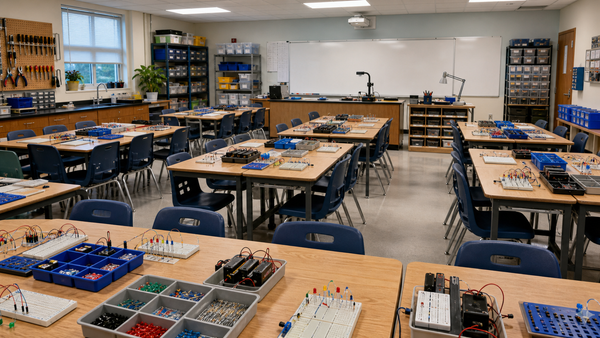
Many schools have installed expensive labs that have furniture, expensive test equipment, and plug-in modules to try to teach the concepts we cover in Mr Circuit Labs and Kits.
We call those expensive labs "Photo-Op" labs because they look good in a picture but, in the end, they do not excite or inspire the student who needs and wants real, hands-on, transferable knowledge.
In contrast, Mr Circuit Labs and Kits work with real electronic parts and the student can do the same experiments at home and not just at school with expensive trainers. Our lab experiment parts are inexpensive enough so the student can afford to buy their own set. I would recommend that you don’t make the mistake of buying those expensive "Photo-Op" labs. Your students will be bored and your class will diminish.
This post is about why we built Mr Circuit labs the way we did, and what we think every electronics teacher should be looking for.
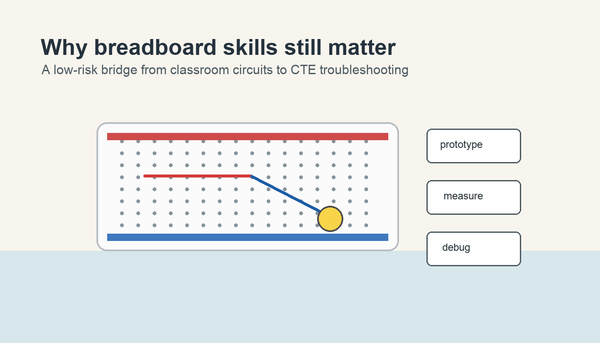
Mr Circuit Labs and Kits do four things, in this order:
-
1. Explain each component used in a circuit, before any project is built.
-
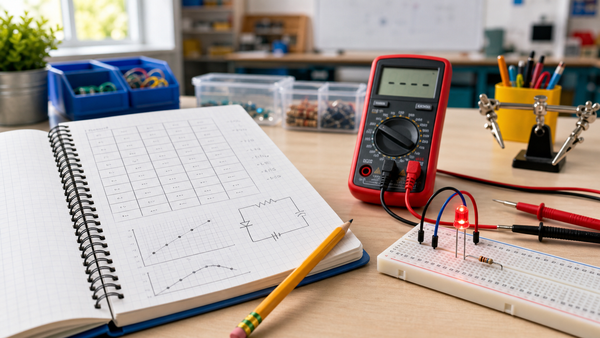
2. Allow the student to physically wire each experiment on an actual solderless circuit board, just like engineers and technicians do in the real world, with the right polarity, the right values, the right places.
-
3. Encourage the student to measure something — voltage, current, resistance — and write the number down.
-
4. Teach the student how to troubleshoot and debug the circuit when it does not work the first time.
What "Hands-To-Mind" learning actually looks like
The phrase we use around Mr Circuit Technology is "Hands-to-Mind" learning. It is older than us — it traces back to John Dewey and to a long tradition of vocational and trade education — but the idea is simple. “Knowledge gets stored in the body before it gets stored in the head.”
A student who has plugged a 1.2k resistor into row 14 of a breadboard, watched a 9V battery's red lead reach over to the anode of an LED, and seen the LED finally light up — that student knows what a resistor is. They know it the way they know how to ride a bicycle. The next time they see a schematic, the schematic stops being scribbles. It becomes a map of something they have actually held.
Get started today. Order some Mr Circuit Labs and Kits for your students. You and your students will be glad you did.
For any comments or questions you may have, please drop us a line at Gary@MrCircuitTechnology.com or call us at 805-295-1642.