Back to Mr Circuit Labs that include electronic components and online lessons, experiments and quizzes (includes white box and printed lab manual)
Mr Circuit Labs that include electronic components and online lessons, experiments and quizzes (includes white box and printed lab manual)

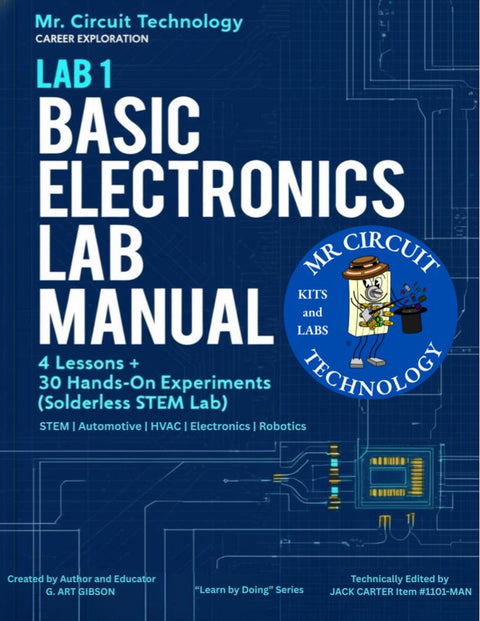
MR CIRCUIT DELUXE LAB 1 – "Basic Electronics" - For STEM & CTE Students & MAKERS | Made in USA - (#1101-LAB)

Mr Circuit TechnologySKU: 1101-LAB
In stock — ships today
$34.90/ each
Mr Circuit Lab 1 Basic Electronics Technology Lab (#1101-LAB) 1000’s Sold • Most Popular Lab The perfect starting point for students learning electronics, robotics, and technology pathways. 34 Structured Lessons No Soldering Required Reusable Classroom Kit 9-Volt Powered Why Teachers Love Lab 1 Hands-on Learning: Students build over 30 real circuits and experience electronics by doing. Complete Curriculum: Includes printed manual, online lessons, quizzes, and structured assessment tools. No Special Equipment Needed: All experiments powered by a 9V battery. Industry-Standard Tools: Uses a professional solderless circuit board (breadboard). Cost Effective: Because labs are reusable, training costs only a few dollars per student. What Students Learn Core Components Resistors, capacitors, diodes, transistors, SCRs, ICs Circuit Building Oscillators, alarms, timers, generators Troubleshooting Compare schematics to physical builds Real-World Skills Robotics, HVAC, automotive, drones, engineering Skill Set Upon Completion Read resistor color codes and identify component values Build circuits from schematic diagrams Construct oscillators and timer circuits using a 555 IC Understand electron flow and current in simple circuits Use potentiometers, photocells, and speakers in circuits Troubleshoot circuits effectively Recognize and explain the 11 most common electronic components Includes Assessment & Online Support Cloud-based lessons, video presentations, quizzes, and written assessments included. Order Today — Your Students Will Thank You. We accept Credit/Debit Cards or Public School Purchase Orders. Home Page Table of Contents for Mr Circuit Basic Electronics Experiment Lab  (#1101-P)  Lesson #1   How a RESISTOR Works Lesson #2   How a POTENTIOMETER Works Lesson #3   How a PHOTOCELL Works Lesson #4   How a CAPACITOR Works Lesson #5   How a SPEAKER Works Lesson #6   How a DIODE Works Lesson #7   How an SCR Works Lesson #8   How an NPN bipolar Transistor Works Lesson #9   How a PNP bipolar Transistor Works Lesson #10 How a Two-Transistor Oscillator Works Lesson #11 How a 555 Timer Integrated Circuit Works Lesson #12 Build a BURGLAR ALARM Circuit Lesson #13 Build an AUTOMATIC NIGHT LIGHT Circuit Lesson #14 Build a DC TO DC POWER SUPPLY Circuit Lesson #15 Build an ELECTRONIC METRONOME Circuit Lesson #16 Build an ELECTRONIC MOTORCYCLE Circuit Lesson #17 Build a RAILROAD LIGHTS Circuit Lesson #18 Build a VARIABLE SPEED LIGHTS Circuit Lesson #19 Build a CONTINUITY TESTER Circuit Lesson #20 Build an AUDIO GENERATOR Circuit Lesson #21 an ELECTRONIC POLICE SIREN Circuit Lesson #22 Build a WAKE-UP ALARM Circuit Lesson #23 Build a VARIABLE TIMER CIRCUIT Circuit Lesson #24 Build a MOISTURE DETECTOR Circuit Lesson #25 Build a CODE OSCILLATOR Circuit Lesson #26 Build an ELECTRONIC POLICE SIREN Circuit Lesson #27 Build an ENGLISH POLICE SIREN Circuit Lesson #28 Build an ELECTRONIC CANARY Circuit Lesson #29 Build a SPACE MACHINE GUN Circuit Lesson #30 Build an ULTRASONIC PEST REPELLER Circuit   Upon completion of this lab, the you will be able to: Draw an atom and label each element. Describe electron flow in a simple circuit. Draw a simple circuit schematic and identify the elements required for current to flow. Draw and identify basic electronics symbols. Read the Resistor Color Code and determine the values of resistors. Discuss the concepts and principles of a solderless circuit board. Construct circuits on a solderless circuit board. Correctly read the values of ceramic disc and electrolytic capacitors. Select the correct components and build an electronic circuit. Build a basic circuit using a potentiometer.  Understand and use a photocell in an electronic circuit. Construct a circuit using a schematic diagram. Understand how and when to use a capacitor in an electronic circuit. Use a transducer like a speaker to make sounds from electron flow in a circuit. Know why you hear a clicking sound in a speaker when you connect and disconnect a circuit. Understand how the Gate in an SCR works and how to use it in an electronic circuit. Build a two-transistor oscillator with a PNP and an NPN transistor. State the function of a resistor and recognize its schematic symbol. State the function of a capacitor and recognize its schematic symbol. State the function of a power diode and recognize its schematic symbol. State the function of bipolar transistors and recognize its schematic symbols. State the function of a switch and recognize its schematic symbol. Understand the uses of a 555 Timer Integrated Circuit and how to use it to make an oscillator. Build an SCR Checker on a solderless circuit board. Build an NPN and PNP bipolar Transistor Checker. Build a Diode checker on a solderless circuit board. Troubleshoot electronic circuits by comparing the schematic to the physical circuit. State the 11 most common electronics components in use in electronics and their functions. Build a Variable Timer, Moisture Detector, Audio Generator, and more. We accept Credit / Debit Cards or Purchase Orders. Thank you from Gary Gibson, author and educator Mr Circuit Technology  805-295-1642 We ship orders the same business day we receive them.

Ordering for a classroom? Request a quote ->
Exact Replacements
Ships same day
POs accepted
Reusable

About this part

Mr Circuit Lab 1

Basic Electronics Technology Lab (#1101-LAB)

1000’s Sold • Most Popular Lab

The perfect starting point for students learning electronics, robotics, and technology pathways.

34 Structured Lessons
No Soldering Required
Reusable Classroom Kit
9-Volt Powered

Why Teachers Love Lab 1

  • Hands-on Learning: Students build over 30 real circuits and experience electronics by doing.
  • Complete Curriculum: Includes printed manual, online lessons, quizzes, and structured assessment tools.
  • No Special Equipment Needed: All experiments powered by a 9V battery.
  • Industry-Standard Tools: Uses a professional solderless circuit board (breadboard).
  • Cost Effective: Because labs are reusable, training costs only a few dollars per student.

What Students Learn

Core Components
Resistors, capacitors, diodes, transistors, SCRs, ICs
Circuit Building
Oscillators, alarms, timers, generators
Troubleshooting
Compare schematics to physical builds
Real-World Skills
Robotics, HVAC, automotive, drones, engineering

Skill Set Upon Completion

  • Read resistor color codes and identify component values
  • Build circuits from schematic diagrams
  • Construct oscillators and timer circuits using a 555 IC
  • Understand electron flow and current in simple circuits
  • Use potentiometers, photocells, and speakers in circuits
  • Troubleshoot circuits effectively
  • Recognize and explain the 11 most common electronic components
Includes Assessment & Online Support
Cloud-based lessons, video presentations, quizzes, and written assessments included.
Order Today — Your Students Will Thank You.
We accept Credit/Debit Cards or Public School Purchase Orders.

Table of Contents for Mr Circuit Basic Electronics Experiment Lab  (#1101-P) 

Lesson #1   How a RESISTOR Works

Lesson #2   How a POTENTIOMETER Works

Lesson #3   How a PHOTOCELL Works

Lesson #4   How a CAPACITOR Works

Lesson #5   How a SPEAKER Works

Lesson #6   How a DIODE Works

Lesson #7   How an SCR Works

Lesson #8   How an NPN bipolar Transistor Works

Lesson #9   How a PNP bipolar Transistor Works

Lesson #10 How a Two-Transistor Oscillator Works

Lesson #11 How a 555 Timer Integrated Circuit Works

Lesson #12 Build a BURGLAR ALARM Circuit

Lesson #13 Build an AUTOMATIC NIGHT LIGHT Circuit

Lesson #14 Build a DC TO DC POWER SUPPLY Circuit

Lesson #15 Build an ELECTRONIC METRONOME Circuit

Lesson #16 Build an ELECTRONIC MOTORCYCLE Circuit

Lesson #17 Build a RAILROAD LIGHTS Circuit

Lesson #18 Build a VARIABLE SPEED LIGHTS Circuit

Lesson #19 Build a CONTINUITY TESTER Circuit

Lesson #20 Build an AUDIO GENERATOR Circuit

Lesson #21 an ELECTRONIC POLICE SIREN Circuit

Lesson #22 Build a WAKE-UP ALARM Circuit

Lesson #23 Build a VARIABLE TIMER CIRCUIT Circuit

Lesson #24 Build a MOISTURE DETECTOR Circuit

Lesson #25 Build a CODE OSCILLATOR Circuit

Lesson #26 Build an ELECTRONIC POLICE SIREN Circuit

Lesson #27 Build an ENGLISH POLICE SIREN Circuit

Lesson #28 Build an ELECTRONIC CANARY Circuit

Lesson #29 Build a SPACE MACHINE GUN Circuit

Lesson #30 Build an ULTRASONIC PEST REPELLER Circuit


Upon completion of this lab, the you will be able to:

  • Draw an atom and label each element.
  • Describe electron flow in a simple circuit.
  • Draw a simple circuit schematic and identify the elements required for current to flow.
  • Draw and identify basic electronics symbols.
  • Read the Resistor Color Code and determine the values of resistors.
  • Discuss the concepts and principles of a solderless circuit board.
  • Construct circuits on a solderless circuit board.
  • Correctly read the values of ceramic disc and electrolytic capacitors.
  • Select the correct components and build an electronic circuit.
  • Build a basic circuit using a potentiometer. 
  • Understand and use a photocell in an electronic circuit.
  • Construct a circuit using a schematic diagram.
  • Understand how and when to use a capacitor in an electronic circuit.
  • Use a transducer like a speaker to make sounds from electron flow in a circuit.
  • Know why you hear a clicking sound in a speaker when you connect and disconnect a circuit.
  • Understand how the Gate in an SCR works and how to use it in an electronic circuit.
  • Build a two-transistor oscillator with a PNP and an NPN transistor.
  • State the function of a resistor and recognize its schematic symbol.
  • State the function of a capacitor and recognize its schematic symbol.
  • State the function of a power diode and recognize its schematic symbol.
  • State the function of bipolar transistors and recognize its schematic symbols.
  • State the function of a switch and recognize its schematic symbol.
  • Understand the uses of a 555 Timer Integrated Circuit and how to use it to make an oscillator.
  • Build an SCR Checker on a solderless circuit board.
  • Build an NPN and PNP bipolar Transistor Checker.
  • Build a Diode checker on a solderless circuit board.
  • Troubleshoot electronic circuits by comparing the schematic to the physical circuit.
  • State the 11 most common electronics components in use in electronics and their functions.
  • Build a Variable Timer, Moisture Detector, Audio Generator, and more.
We accept Credit / Debit Cards or Purchase Orders.
Thank you from Gary Gibson, author and educator
Mr Circuit Technology  805-295-1642

We ship orders the same business day we receive them.

Specifications
TypeElectronic Lab
SKU1101-LAB
OriginMade in USA
ShippingSame-day from SLO, CA
SchoolsPOs accepted
SupportTeaching since 1996